
TLDR;
India’s rapid economic growth presents a strong long-term investment case, but it does not guarantee high stock-market returns for every investor. The debate weighs India’s domestic market, demographics and potential currency tailwinds against concerns about productivity, employment, manufacturing, competition, valuations and the lack of major home-grown technology firms. One speaker favours India as part of a diversified, ten-year portfolio; the other argues that US technology companies currently offer stronger productivity growth and investment prospects.
- Economic growth and investment returns are related, but the relationship is not automatic.
- India’s future depends on creating productive jobs, improving manufacturing and competition, and building businesses that capture more value.
- AI could reshape productivity and markets, but its transformative potential does not guarantee that today’s AI companies will deliver good returns.
- The speakers disagree about India’s growth data, job quality, market performance and the best way to compare Indian and US investments.
- Their final positions differ: one sees India as a compelling long-term investment, while the other remains cautious about investing in India over the next decade.
Is India the Greatest Investment Opportunity of the Next Decade? [0:00]
India’s stock market has recently delivered weak returns, prompting a debate about whether the country’s rapid economic growth makes it a strong investment opportunity. Optimists point to India’s fast-growing economy, large consumer market, young population, digital economy and manufacturing ambitions. Critics argue that headline GDP growth can obscure weak job creation, under-reported inflation and India’s limited role in artificial intelligence (AI), which they see as a major source of future wealth.
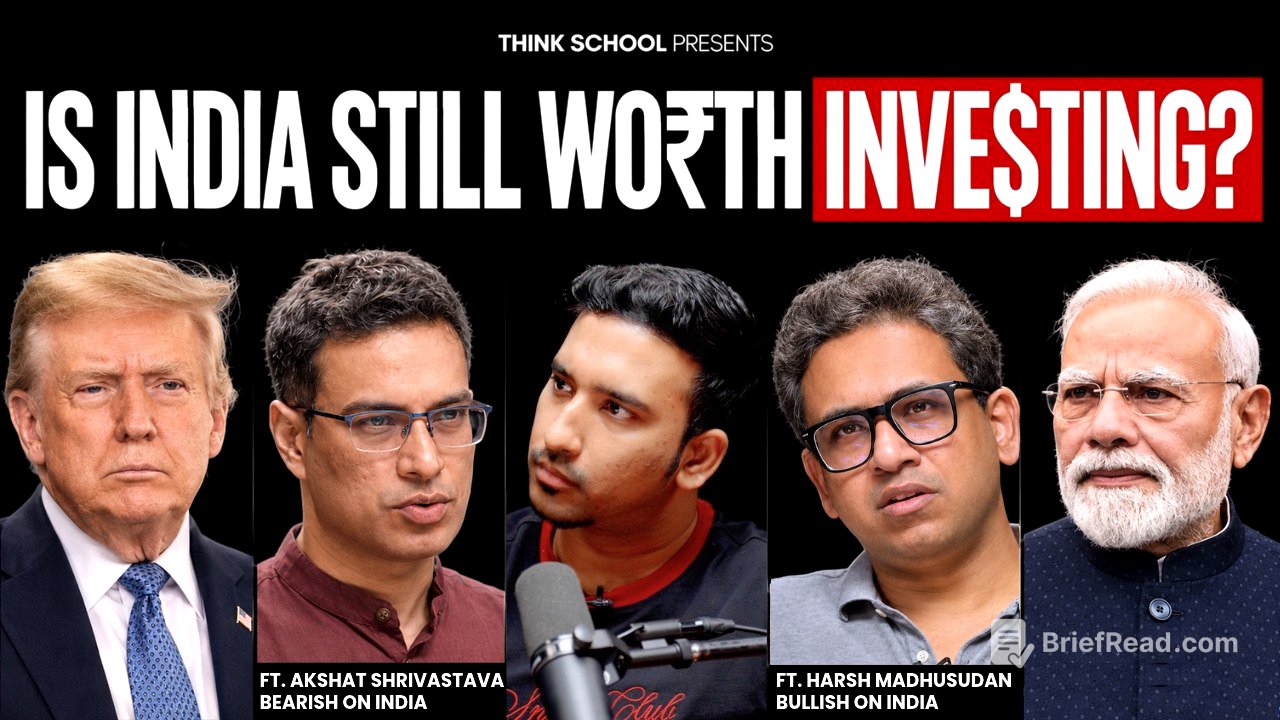
Wealth fund manager Harsh Madus argues that India could outperform over the next decade, particularly if the US dollar’s current strength reverses. Investor and entrepreneur Akshat Srivastava disagrees, saying he would not commit his money to India for ten years. The central question is whether India’s economic growth will translate into attractive returns for investors—and whether those returns will be competitive with opportunities elsewhere.
Who Is Really Getting Rich From the Indian Stock Market? [3:09]
Harsh argues that India’s economy is likely to grow faster than current expectations and that, unlike some other economies, this growth generally translates into investment returns. He believes a passive investor who wants to invest in a broad Indian market fund and leave it untouched for ten years could do well. He also expects the rupee and foreign investment flows to benefit if the US dollar enters a weaker phase. As an example of how market cycles can differ, he notes that the S&P 500 performed poorly during the 2000s, while Indian equities rose strongly in dollar terms.
Akshat questions who benefits from India’s market performance. He says the government earns record tax revenue and asset management companies collect fees, while retail investors may see disappointing returns. He describes this as financial repression: in his view, Indian savers receive relatively low after-tax returns on deposits while facing high borrowing costs and insufficient compensation for equity risk.
The speakers also disagree over how to interpret historical comparisons. Harsh says India outperformed the US market over some long-term periods, while Akshat argues that comparisons depend heavily on the dates and indices chosen. The discussion sets up their broader disagreement: whether India’s growth, domestic investment and currency cycle are enough to support future returns, or whether investors should focus on where productivity and corporate profits are growing fastest.
Why Is America Creating Wealth Faster Than India? [8:08]
Akshat argues that AI has created a new global economic turning point. In his view, the US market is benefiting because leading AI companies are American, while a large share of investment in Indian AI infrastructure also comes from US firms. He expects those firms to retain much of the resulting profit, meaning the gains may flow more to the US economy than to India.
Harsh counters that productivity growth is not limited to frontier technology. A person gaining access to a bank account, or moving from low-productivity farm work into a factory job, can also represent a major productivity improvement. He says India has experienced rapid total factor productivity growth and could benefit from economic catch-up, even if it does not own the most advanced technology companies.
The debate then turns to whether AI’s economic importance makes AI stocks good investments. Harsh says technological transformation and commercial viability are separate issues. He questions whether the high valuations and huge spending plans of companies such as OpenAI and Anthropic can generate adequate returns. Akshat, meanwhile, points to the profitability and strong earnings growth of established US technology companies, arguing that their cash flows support buybacks and market valuations.
Can India Deliver Extraordinary Returns Without Extraordinary Innovation? [12:12]
Akshat argues that productivity depends on both effective workers and productive machines. He says many of the digital tools people use every day—such as Google, Meta, Amazon and Netflix—are American-owned, while India has not yet created an equivalent group of globally dominant technology companies. He also questions whether India is making enough use of its demographic advantage, pointing to unemployment and the movement of workers into agriculture, which he sees as a comparatively low-productivity sector.
He notes that manufacturing’s share of India’s economy has remained around 15–16%, despite the Make in India ambition to raise it to 25%. Harsh responds that a stable share does not mean manufacturing output has stopped growing: if the overall economy doubles while manufacturing retains the same share, manufacturing output can also double. They agree that manufacturing has not gained a larger portion of GDP, but disagree over how much that indicates failure.
The discussion also covers valuation and AI. Akshat compares the high price-to-earnings ratio (P/E)—the share price relative to a company’s earnings—of Indian retailer Lenskart with the lower valuation of Nvidia, arguing that US companies often combine lower multiples with stronger earnings growth. Harsh cautions that AI’s transformative impact does not settle whether current AI companies’ valuations are justified, especially if their high spending cannot be matched by sustainable revenue.
India vs America: Where Would Your Money Have Grown More? [16:48]
The speakers dispute which US benchmark should be compared with Indian equities. Harsh says that comparing the broad Indian market with the US technology-heavy Nasdaq 100 is misleading; comparing Indian financial companies with the broader US market, for example, can produce a different result. He argues that Indian catch-up growth can create productivity even without frontier technology, and maintains that India could be the best “buy and forget” investment over a ten-year period.
Akshat says that comparisons should account for company size, liquidity and risk. The S&P 500 comprises much larger, more liquid companies than a broad index of Indian firms, and small Indian companies can be difficult to trade. However, he argues that QQQ, an exchange-traded fund tracking the Nasdaq-100, is more relevant to Indian investors who want exposure to companies such as Google, Microsoft and Meta.
The debate also considers how to measure productivity and economic performance. Akshat points to joblessness, stagnant wage growth in some sectors and the growing share of work in agriculture. Harsh says poverty has fallen in absolute terms, though wealth inequality has increased. Both recognise that the US has benefited greatly from technology, but they differ on whether that advantage makes US equities a better long-term investment than India.
Are Indian Investors Paying Premium Prices for Ordinary Businesses? [22:25]
Akshat argues that many Indian businesses do not show the earnings growth of leading US technology companies, despite some Indian shares trading at high valuations. He uses Lenskart’s high P/E as an example and contrasts it with Nvidia’s lower multiple. In his view, US technology firms can support their valuations through faster growth, greater profitability and the ability to buy back shares. He also says that firms such as Amazon and Meta can invest in India while still directing profits towards their own shareholders.
Harsh focuses on the business model behind AI. He describes OpenAI and Anthropic as the front-end companies that sell AI services, while hyperscalers provide computing capacity and firms such as semiconductor and equipment makers supply the infrastructure. If the AI services cannot become commercially viable, demand for computing and chips could slow as well. He says that the technology may transform the world even if some companies behind it fail to earn enough to justify their valuations.
The debate extends to India’s service exports and global capability centres (GCCs), which are offices that multinational companies establish in India to perform business and technology work. Harsh says GCC employment is expanding and that AI tools may help Indian workers compete with higher-paid workers elsewhere. Akshat remains concerned that India is not capturing enough high-value technology profits. They also disagree about how much ordinary households have benefited from growth, with Harsh pointing to falling poverty and Akshat highlighting weak wage growth and reliance on government transfers.
If India Is Growing So Fast, Why Aren't Indians Getting Richer? [33:13]
Akshat challenges India’s reported unemployment rate of about 3.1%, arguing that the figure can miss discouraged workers who have stopped looking for a job and people who are technically employed in low-paid or unsuitable work. An engineering graduate driving for a delivery or ride-hailing service may count as employed, even if that work does not use their training. He also says that family businesses and farms can absorb people without necessarily creating productive employment.
He points to agriculture as a major source of recent job growth and argues that this reflects too few better-paid opportunities elsewhere. Women’s participation in the workforce may rise when women work on family farms, he says, but this does not necessarily mean new, high-productivity jobs have been created. Harsh accepts that agriculture can function as a fallback when urban and industrial work is unavailable, while noting that farm workers are still doing real work and that mechanisation and consolidation could improve productivity.
The speakers also discuss India’s low per-capita income compared with the US and the scale of informal or gig work in other countries. Harsh cites China’s large gig workforce to argue that advanced economies also contain many workers outside conventional formal employment. They agree that the key issue is not simply whether people are counted as employed, but whether economic growth produces productive jobs and rising incomes.
What Happened to India's Manufacturing Dream? [37:47]
Akshat argues that India has not achieved its goal of making manufacturing a much larger share of GDP. Despite the Make in India programme, manufacturing remains around 15–16% of the economy, while workers continue to enter agriculture and informal work. He sees this as evidence that India has not created enough factory jobs to absorb its growing workforce.
Harsh agrees that manufacturing has not gained a larger share, but distinguishes between its share and its total output. If GDP grows substantially while manufacturing remains at roughly the same percentage, manufacturing production can still increase substantially in absolute terms. He therefore argues that saying manufacturing has not grown would be inaccurate, even if the political target to raise its share has not been met.
The broader disagreement is about what the figures imply. Akshat sees the lack of a rising manufacturing share as a sign that India’s industrial transformation is falling short. Harsh argues that growth in services and other sectors can keep manufacturing’s share stable even as factories produce more. Both recognise that expanding manufacturing would matter for job creation and productivity.
Why Is the Nifty Struggling Despite India's Economic Boom? [39:12]
Akshat argues that the Nifty’s growth has slowed across successive periods: it rose fivefold from 1999 to 2007, doubled from 2009 to 2019, and doubled again over roughly the next six or seven years. He links this to a slowdown in India’s dollar-adjusted per-capita growth and says reported GDP may overstate real progress if inflation is undercounted. Harsh disputes that interpretation, citing international institutions that use official Indian data.
The speakers also explain why markets can behave differently from headline economic growth. Harsh says the dollar cycle matters: when the dollar weakens, emerging-market assets can attract more capital, while uncertainty often sends money back to the US. He believes the current strong-dollar period may eventually reverse and provide a tailwind for Indian assets.
Akshat’s view is that market performance reflects where productivity and corporate earnings are strongest, especially in AI and US technology. Harsh responds that Indian shares have also produced positive returns in recent years and that India’s market is more developed and liquid than it was in earlier periods. Their disagreement is not simply about growth forecasts, but about whether growth, earnings and currency movements will favour India or the US.
What Is Vietnam Getting Right That India Is Getting Wrong? [41:39]
Akshat compares Vietnam’s rise in per-capita GDP with India’s, noting that Vietnam has moved from roughly half India’s per-capita level to about twice it. He attributes this to reforms that strengthened farmers’ land rights, encouraged foreign investment and exposed businesses to greater competition. He also argues that India has missed opportunities in export industries such as textiles, where Vietnam has become more competitive.
He says that India’s regulatory and financial systems make investment and moving money more difficult, particularly for non-resident Indians (NRIs). In his example, transferring funds from a country such as the UAE can be quick, while moving a large amount out of India involves bank coordination, delays and exchange-rate charges. Harsh accepts that investors may prefer a more active approach, but says people who want broad exposure without frequent trading can use overseas-listed India exchange-traded funds (ETFs).
Harsh cautions against mixing up capital controls, trade protectionism and industrial policy. He points out that China also restricts capital movements and argues that Indian economic data should not be dismissed without evidence. He cites tax receipts and bank-credit growth as indicators of real economic activity, while rejecting the claim that GDP growth can be mechanically inflated simply by changing the inflation figure.
What Is Really Stopping India From Becoming a Rich Country? [46:32]
Akshat proposes several changes based on the experience of countries such as China, Vietnam, Japan and South Korea: clearer land rights, stronger manufacturing and more competition. He argues that moving workers from farms to factories can create large numbers of jobs, while concentrated ownership and weak competition can discourage investment. He also criticises the dominance of a small number of firms in areas he considers nationally important, including infrastructure and telecoms.
The discussion of land reform becomes contentious. Akshat argues that secure ownership can encourage farmers to invest and cooperate, while Harsh points out that redistributing land involves private property rights and legal constraints. Harsh says large-scale redistribution is politically and financially difficult in a democracy and would require compensation through mechanisms such as eminent domain. He also argues that some reforms attempted in India have encountered strong resistance.
Harsh counters that India already has significant competition and that the US stock market is more concentrated at the top by some measures. He cites Indian startups in space, defence and deep technology, as well as funding for research and development, as signs of emerging innovation. He also points to low telecom prices and competition in the car industry as evidence that India cannot simply be described as dominated by monopolies.
The speakers discuss geopolitics and India’s democratic system. Harsh says Vietnam’s proximity to China helps attract manufacturing and that geopolitical considerations can make other countries more comfortable investing there. He argues that India’s democratic processes make reform slower and messier, but protect the country from some of the damaging decisions made by more authoritarian states. He concludes that India needs better administrative, judicial and police systems, while recognising the political difficulty of implementing reforms.
Is India's Economic Growth Making Only a Few Companies Rich? [50:25]
Akshat argues that the benefits of growth are unevenly distributed, with wealthy people doing well while many workers experience weak wage growth. He says that slow wage growth and the expansion of government transfers suggest that productivity-led job creation has not been broad enough. Harsh agrees that inequality has risen, but rejects the claim that poorer Indians have become worse off in absolute terms, pointing to reductions in poverty reported by international agencies.
They also examine who captures the profits generated by global technology. Harsh explains that AI spending flows through a chain: users pay AI companies, which rent computing power from hyperscalers, which then buy chips and other infrastructure. If front-end AI providers cannot make their business models work, spending could fall across the supply chain. He says this is why the commercial viability of AI matters even if the technology itself remains transformative.
The discussion considers whether AI will replace Indian service jobs or support them. Harsh says multinational companies continue to expand their GCCs in India and may choose Indian workers equipped with the latest AI tools over more expensive staff elsewhere. Akshat remains sceptical that this will solve India’s broader employment and income problems. The exchange highlights a distinction between national growth, company profits and the living standards of the wider population.
The Biggest Risks of Betting on India's Future [59:10]
Akshat’s main concerns are India’s limited home-grown AI capability, jobless or low-quality growth, weak wage gains, financial repression and the risk that high taxes and restrictions will deter investors. He argues that Indian investors face heavy charges in areas such as futures and options (F&O) trading, while rules around moving money and foreign investment can be difficult to navigate. In his view, investors need a clear reason to choose India over global companies with stronger technology and earnings growth.
Harsh responds that India’s past was not an obvious investment success either. He recalls periods of weak returns and international sanctions after India’s 1998 nuclear tests, arguing that it is misleading to assume India’s recent prospects have always been clear. He says Indian markets have delivered positive calendar-year returns for many consecutive years and that India’s economic growth is strong by historical standards, even if it is slower than China’s past growth.
The debate also covers demographics and the challenges of industrial policy. Harsh explains that China’s demographic transition occurred earlier, allowing it to benefit sooner from a larger working-age population, but that this came with long-term costs, including the effects of the one-child policy. India’s later demographic transition may support growth for longer, though it also means more family members must be supported. Both speakers see corruption, weak administration and judicial delays as risks, but Harsh argues that India’s democratic system makes reform difficult while protecting against certain long-term policy mistakes.
Is India Still the Best Place to Invest for the Next 10 Years? [1:02:02]
Akshat concludes that India will grow, but questions whether it will outperform relative to other markets. He sees AI as a fundamental technology that currently favours the US, and argues that American equities have outperformed Indian equities in dollar-adjusted comparisons. His concerns also include job quality, investor taxes, restrictions on capital and a lack of globally dominant Indian companies in technology, manufacturing and finance. He says he sees no reason to abandon established US technology firms for Indian investments unless Indian businesses can offer comparable value.
Harsh maintains that India is likely to grow at a high single-digit real rate over the coming decades and that this growth should translate into investment returns. He argues that the US dollar cycle has repeatedly changed over the past six decades and expects a turn to support emerging markets and the rupee. India’s economy, corporate earnings and market liquidity have all developed, he says, making Indian equities a credible option within a diversified portfolio.
Their final disagreement is about the best way to invest, not whether India will grow. Harsh sees India as one of the strongest risk–reward choices for a ten-year, buy-and-hold investor, while Akshat remains cautious and favours markets with stronger technology and earnings momentum. Both acknowledge that India’s long-term outcome depends on productivity, job creation, competitive businesses and continued reform.