TLDR;
The video discusses the concerning activities of China's massive fishing fleet across the globe, particularly focusing on illegal fishing practices near Argentina and South Korea. It highlights the environmental and economic impacts of these activities, the measures taken by affected countries to counter them, and the broader implications for regional security and international order. The fleet's actions are linked to human rights violations, forced labour, and strategic maritime expansion, prompting international responses and calls for stronger enforcement.
- China's fishing fleet engages in illegal fishing in international waters, particularly near Argentina and South Korea.
- These activities have severe environmental and economic consequences, threatening marine ecosystems and local fishermen's livelihoods.
- China's fishing operations are supported by a global network that enables long-term illegal activities.
- Affected countries are taking measures to counter China's maritime plundering, including increased surveillance, law enforcement, and international cooperation.
- China's fishing fleet also serves strategic purposes, blurring the lines between civilian and military actions and raising regional security concerns.
Chinese Fishing Fleet's Global Reach [0:00]
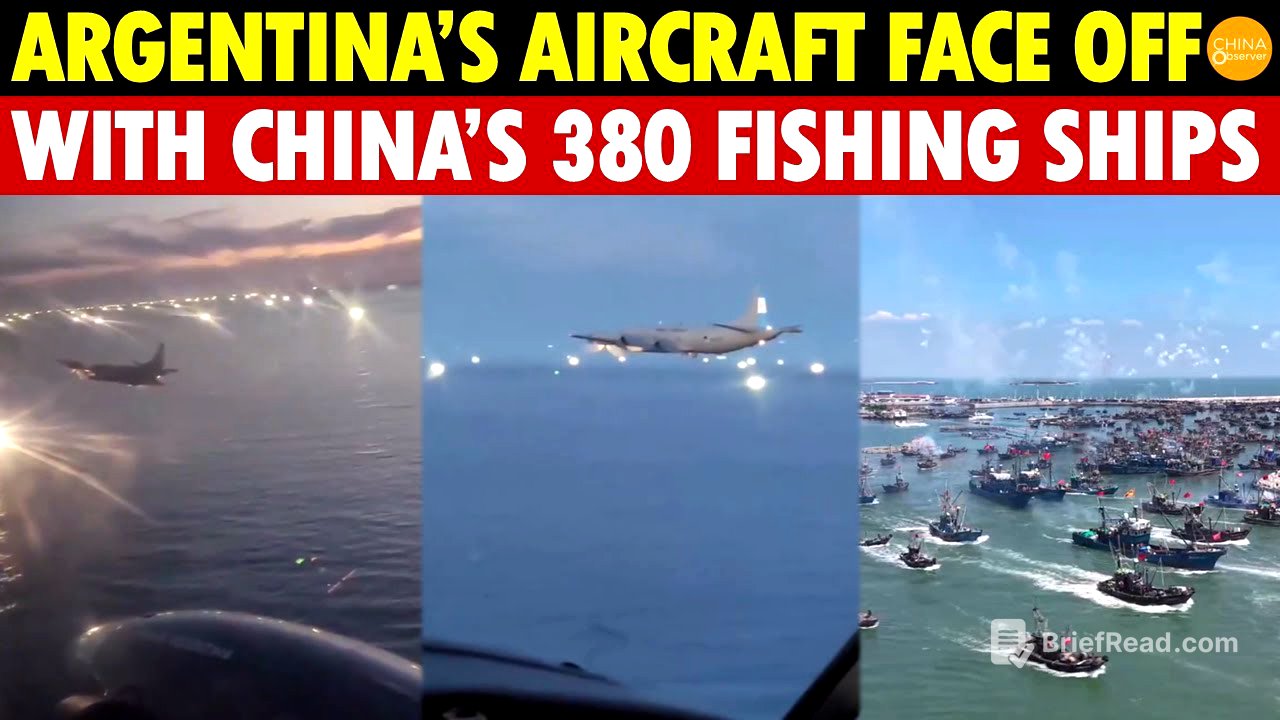
China's extensive fishing fleet, though appearing small, can travel vast distances, reaching areas like Argentina. These fleets have been observed engaging in illegal fishing activities in various global waters, sparking international condemnation. Shocking footage reveals hundreds of Chinese fishing boats illuminating Argentine waters, effectively turning the sea into a Chinese-controlled fishing ground. Argentine military aircraft have been deployed to monitor the situation.
Squid Fishing Tactics and Environmental Impact [0:47]
Industry experts explain that these boats primarily target squid, using bright lights at night to attract them. The crew refer to Argentina's exclusive economic zone as their "fishing grounds," catching dozens of tons of squid nightly. Near Peru's exclusive economic zone, Chinese fishing boats reportedly disable their automatic identification system (AIS) signals to illegally fish at night. These boats, flying the Chinese flag, move like "macrofasages," consuming everything in their path within the resource-rich Peru current (Humboldt current).
Argentine Military Response and Surveillance [2:16]
In late February, the Argentine military released footage of a large fleet near a maritime boundary separating Argentina's regulated exclusive economic zone and international waters. The Argentine Navy reports that this area is notorious for illegal fishing, mainly by Chinese ships targeting abundant squid. Experts warn that the area is nearing environmental collapse. The military deployed a P3C Orion anti-submarine patrol aircraft to monitor the fleet, with Defence Minister Louise Patri stating the surveillance aims to prevent incursions into Argentina's exclusive economic zone.
Scale of Illegal Fishing and Tracking Evasion [3:31]
The military detected 380 fishing boats operating outside Argentina's exclusive economic zone, many en route from Asia to richer fishing areas. Satellite images and ship tracking data suggest these boats, often flying Chinese flags, engage in harmful fishing activities near Argentine waters. Since September 2024, Argentina has acquired aircraft for maritime surveillance. Petri described the situation as a "survival threat" to Argentina's natural resources. CNN's analysis of open-source data confirmed the presence of 198 named fishing boats, with over 80% flying China's flag.
Tracking System Manipulation and International Law [5:15]
Chinese fishing boats are more likely to disable their tracking beacons (AIS) to evade detection, a practice noted by the Argentine Navy among foreign vessels illegally fishing in Argentina's exclusive economic zone. In the past year, about 500 fishing boats have turned off their tracking systems, with over 92% involving boats flying China's flag. This is particularly prevalent off Argentina's coast. Under international law, Argentina has sovereign rights over its natural resources.
US Sanctions and Human Rights Violations [6:07]
The US Treasury Department has sanctioned seven Chinese-flagged vessels linked to the Pingtan Offshore Fishing Group Limited for illegal fishing and human rights violations. The company received a $90 million subsidy from the Chinese government to develop deep-sea fishing capabilities. Reports detail forced labour, physical abuse, and extreme isolation of crew members. One instance involved a crew member being denied the ability to leave the vessel after his wages were withheld and being deprived of food for three days. The Chinese Foreign Ministry and the company have denied these allegations.
Environmental and Economic Consequences [7:17]
Illegal fishing has plagued Argentina's coast for decades, with Chinese vessels frequently violating its exclusive economic zone. Marine conservation expert Milco Schwartzman notes that squid, the primary target, is crucial to the local food chain, and any impact on squid affects the entire ecosystem. The United Nations has stated that illegal, unreported, and unregulated fishing undermines sustainable fisheries management and marine biodiversity protection, potentially leading to the collapse of local fisheries.
Global Implications and Local Impact [8:03]
Argentina's situation reflects China's global unregulated fishing operations, with similar fleets spotted off West Africa and in the South China Sea. Argentine authorities say these fleets travel thousands of miles for commercially valuable fish. The sight of the fishing fleet at night is described as an "overwhelming experience," resembling a floating city. Dario Srate, director of the Argentine Chamber of Jigging Fishing Ship Owners (CAPA), notes that the Argentine fleet is much smaller, harming local fishermen who now catch only half of what they used to.
Lack of Regulation and Ecosystem Disruption [9:35]
Dario Swatchman points out that there is no other place on Earth where over 550 fishing boats operate in such a small area with little to no regulation, leading to severe environmental consequences. Even when fishing boats operate outside Argentina's exclusive economic zone, overfishing disrupts the marine ecosystem. A report by the Washington DC-based nonprofit organisation forc revealed that China's distant water squid jigging fleets in South American offshore waters are involved in illegal fishing supported by a well-organised global network.
Support Network and Transshipment Activities [10:19]
This network includes port agents, supply ships, refueling vessels, and insurers, forming a hard-to-monitor system that enables long-term illegal fishing. Chinese vessels often disable their AIS for invisible operations and spend months or years at sea without docking, making monitoring difficult. The squid fleet relies heavily on offshore refrigerated transport vessels and refueling ships for supplies, allowing them to stay at sea without inspection. Over 90% of squid boat transshipment activities are linked to refrigerator ships owned by China, with 15 ships accounting for 72% of interactions.
Concealed Ownership and Labour Exploitation [11:21]
These 15 ships fly flags of convenience and are registered under foreign names to conceal Chinese ownership, reducing regulatory oversight. Some fishing boats have transformed into floating offshore fisheries bases, providing supplies, medical assistance, and coordination services while concealing labour exploitation issues. Port agents on land assist by using their connections with governments to shield illegal fishing at sea. Insurers play a critical role by providing coverage to high-risk vessels involved in illegal fishing, forced labour, or sanctions violations.
Growing Pressure and International Response [12:10]
Sara Nicks, a natural resource security analyst at C4 ADS, stated that the Distant Water Squid fleet relies on a global network of enablers that allows operations to continue largely unchecked. Growing grassroots pressure, especially in Peru and Argentina, is shifting the tide. In June, the Argentine Navy intercepted and blocked a fleet of about 300 Chinese fishing boats attempting to invade Argentina's exclusive economic zone. These boats operate like floating factories, catching thousands of tons of marine life.
Escalating Tensions in East Asia [13:08]
Chinese fishing boats have greatly increased their illegal fishing activities in South Korean waters, causing several capsizing accidents in November. Experts believe that China's actions in East Asian waters represent a multi-layered crisis involving regional security, marine resources, and international order. South Korea's Coast Guard reports an increase in Chinese fishing boats illegally entering waters outside the northern limit line daily. This scaled, seasonal, and organised illegal fishing pattern has become a long-term challenge for regional countries.
Militarisation of Fishing Fleets [14:08]
The deeper context involves China's strategy of militarising fishing boats as a maritime tool. Studies indicate that China's fishing fleet often engages in reconnaissance, harassment, and provocation, blurring the lines between civilian and military actions. The recent capsizing incidents in South Korean waters are a consequence of this high-risk behaviour. The South Korean government has launched round-the-clock vigilance, deploying large vessels and special law enforcement units, signalling that this issue challenges South Korea's sovereignty, maritime order, and ocean security.
Regional Security Concerns and International Condemnation [15:04]
These patterns align with China's operations in multiple surrounding seas, where illegal fishing and maritime pressure tactics are commonly observed. Recently, China's rare gatherings of a large number of military ships and fishing boats in East Asia have raised significant alarms among neighbouring countries. In early December, China deployed over 100 ships in East Asian waters, operating in the Yellow Sea, East China Sea, South China Sea, and the Pacific Ocean. The scale of this operation was unprecedented.
International Response and Countermeasures [16:06]
In response to China's unusual activities in the East China Sea, the United States, Japan, and Taiwan have all issued clear statements. Japanese Defense Minister Shinjiro Cooumi emphasised that Japan is highly concerned and closely monitoring Chinese military movements. Taiwan's presidential office stated that the military activities have imposed a threat to the Indo-Pacific region. The US House Foreign Affairs Committee approved the Stop Illegal Fishing Act, which aims to counter China's expansion of control over offshore waters using its illegal fishing fleet.
Strategic Intentions and Regional Cooperation [17:25]
Representative Brian Mast stated that China oversees the largest illegal fishing fleet, depleting fish stocks, violating maritime laws, and harming local economies. The bill would give the US President the authority to impose sanctions on foreign vessels involved in illegal fishing activities. Analysts point out that China's illegal fishing is no longer just a fisheries issue but a strategic tool. Regional democratic nations must work together, strengthen law enforcement, and share information to prevent the ocean from being swallowed by asymmetric threats. The only way to deal with China is to abandon all illusions and face it head-on with a counterattack because China does not understand universal values, it only understands force.