TLDR;
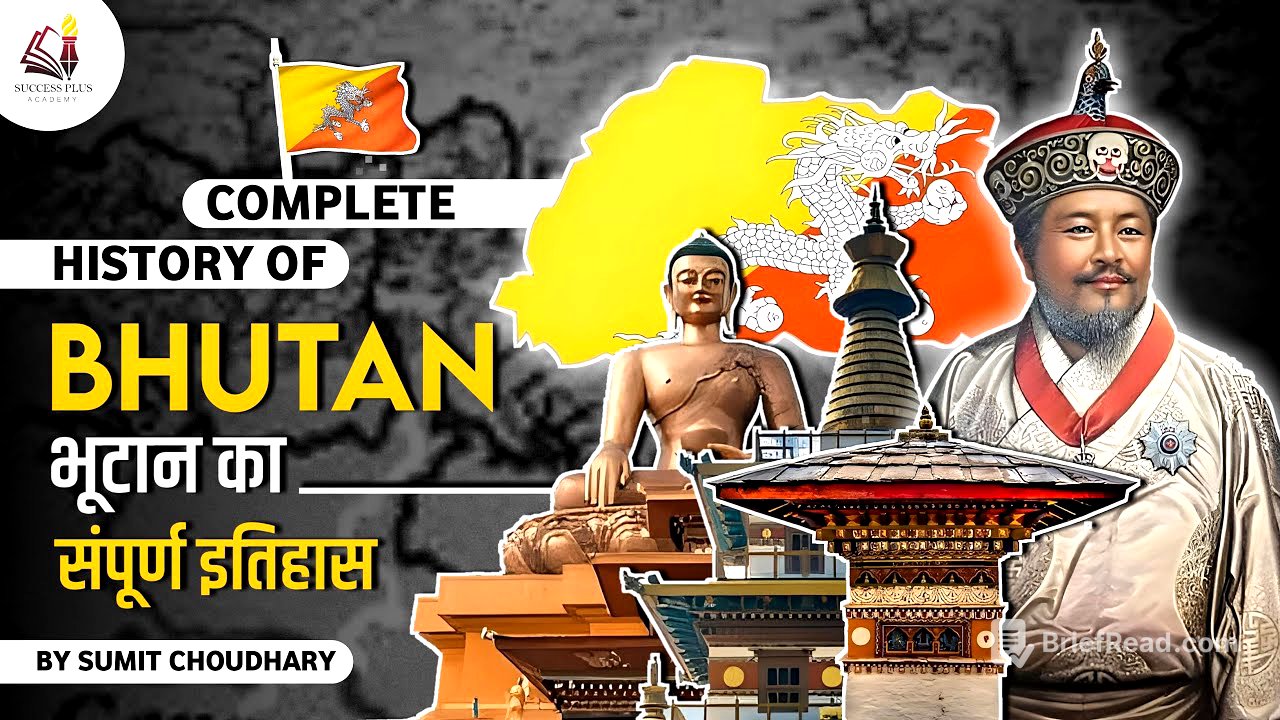
This video provides a comprehensive overview of Bhutan's history, from its early legends to its modern constitutional monarchy. It covers key aspects such as its geography, population, government structure, religious affiliations, and ethnic composition. The video also explores Bhutan's relations with neighbouring countries like India, Tibet, and China, as well as its interactions with British colonial powers. Key takeaways include Bhutan's unique cultural identity, its historical independence, and its modern focus on Gross National Happiness.
- Bhutan's history from ancient times to the present day.
- Key aspects of Bhutanese culture, religion, and society.
- Bhutan's relations with India, Tibet, China, and British colonial powers.
- The evolution of Bhutan's political system to a constitutional monarchy.
Introduction to Bhutan [0:00]
The video introduces Bhutan as a landlocked country bordered by India and Tibet (now part of China), with a geographical area comparable to the Indian state of Kerala. It highlights that Bhutan's capital is Thimphu and its population is approximately 800,000. The form of government is a constitutional monarchy, featuring a king and a bicameral parliament. The official language is Dzongkha, and the predominant religion is Buddhism, specifically Tibetan Buddhism, with a significant Hindu minority. The ethnic composition includes Bhutia (50%), Nepalese (35%), and Sharchop (15%) groups.
Early History and Origins [7:49]
Bhutan's early history is rooted in legends and mythology, with limited archaeological evidence available. The traditional name for Bhutan since the 17th century is Druk Yul, meaning "Country of the Drukpa," referring to a school of Tibetan Buddhism. The presenter notes that the early rulers of Bhutan was Saṅgal Deep, who ruled in the 7th century BC. The history becomes clearer from the 7th century AD with the arrival of Buddhism. The Drukpa Kagyu school of Buddhism became the main religion, and Bhutan remained independent throughout history, never becoming a colony.
Arrival of Buddhism and Sectarian Influences [20:53]
Buddhism arrived in Bhutan in the 7th century, coinciding with its spread in Tibet. King Songtsen Gampo of Tibet played a crucial role in promoting Buddhism in both regions. Padmasambhava, also known as Guru Rinpoche, further propagated Buddhism in the 8th century, integrating it with the existing Bon religion. Various sects of Tibetan Buddhism, including Nyingma, Kagyu, and Gelug, influenced Bhutan, with the Drukpa sect eventually becoming dominant.
Theocratic Government and Consolidation [30:29]
From 1616 to 1907, Bhutan operated under a theocratic government. In the 17th century, Bhutan became independent under the leadership of Ngawang Namgyal, a monk who unified the country and established a legal system known as Tsa Yig. Namgyal took the title of Zhabdrung, a religious and political leader. He implemented a dual system of government, with a Je Khenpo (religious leader) and a Druk Desi (civil leader).
Administrative Integration and Conflicts with Tibet [38:54]
After Ngawang Namgyal's death in 1651, his death was kept secret for 54 years to prevent instability. During this time, his son and stepbrother maintained the system of government. The government became more secular, and powerful regional leaders competed for power. Tibet invaded with Mongolian support in 1714 but was successfully defended. Bhutan also had enclaves in Western Tibet, granted by Ladakh for assistance in a war against Tibet in 1644.
Civil Conflicts and British Influence [43:10]
In the 18th century, Bhutan's influence expanded into Cooch Behar, leading to conflicts with the British East India Company. By 1770, Bhutan controlled Cooch Behar, but the British gained influence after the Battle of Plassey in 1757. A succession dispute in Cooch Behar led to British intervention and a peace treaty in 1774, pushing Bhutan back to its old borders. Despite ongoing border disputes, the British consistently prevailed.
The Anglo-Bhutan War and Treaty of Sinchula [47:59]
Tensions between Bhutan and the British continued, leading to the Anglo-Bhutan War in 1864. Bhutan, with outdated weapons, was defeated, resulting in the Treaty of Sinchula in 1865. Bhutan ceded territories in Bengal and Assam and received an annual subsidy of 50,000 rupees. Internal power struggles persisted within Bhutan.
Emergence of the Wangchuck Dynasty [50:27]
Ugyen Wangchuck emerged as a dominant leader, defeating rivals in civil wars between 1882 and 1885. He aligned Bhutan's interests with the British, serving as a mediator between Tibet and Britain in 1903-04. In November 1907, an assembly established a monarchy, appointing Ugyen Wangchuck as the first hereditary king (Druk Gyalpo) of Bhutan.
Modern Bhutanese Monarchy and Relations with India [54:09]
The Wangchuck dynasty consolidated power, with Ugyen Wangchuck modernising the country. In 1910, Bhutan signed the Treaty of Punakha with the British, ensuring protection from China and increasing the annual payment to one lakh rupees. After Ugyen Wangchuck's death in 1926, his son Jigme Wangchuck continued his efforts. In 1949, a treaty with independent India recognised Bhutan's independence, with India guiding its foreign affairs.
Modernisation and International Relations [1:04:07]
Jigme Dorji Wangchuck, the third king, is known as the "Father of Modern Bhutan." He established a National Assembly in 1953 and initiated constitutional reforms. Following China's annexation of Tibet in 1951, Bhutan strengthened ties with India. Bhutan became a member of the United Nations in 1971. Jigme Singye Wangchuck, the fourth king, introduced the concept of Gross National Happiness (GNH).
Contemporary Era and Conclusion [1:10:36]
Bhutan recognised Bangladesh as a country in 1971. The video concludes by highlighting Bhutan's efforts to maintain its independence and strengthen international relations. A 2007 agreement with India granted Bhutan full autonomy over its foreign affairs. The presenter expresses hope that the comprehensive history of Bhutan was clear and offers to create a separate video on India-Bhutan relations. The video ends with a call to follow the Success Plus Academy platform for more educational content.