TLDR;
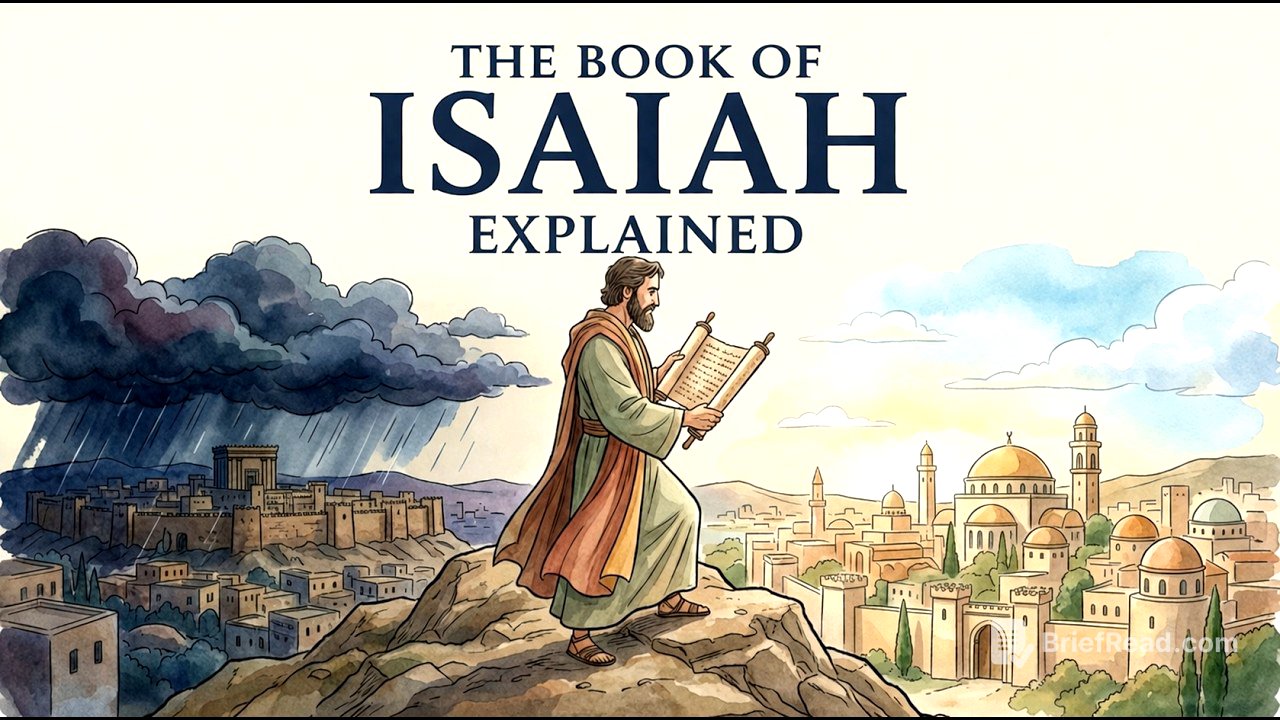
This video explores the profound significance of the Old Testament book of Isaiah, arguing that it serves as a miniature Bible, mirroring the entire arc of scripture. It highlights the book's structure, which parallels the Old and New Testaments, and focuses on key sections such as the turning point in chapter 40, the servant songs, and the vision of a new creation. The video emphasizes Isaiah's role as a foundational text for the New Testament, influencing its authors and shaping its theological landscape.
- Isaiah's 66 chapters mirror the 66 books of the Bible, with the first 39 chapters reflecting the Old Testament's themes of covenant failure and judgment, and the subsequent 27 chapters echoing the New Testament's message of comfort, promise, and renewal.
- Chapter 40 marks a pivotal shift in tone, transitioning from judgment to grace and introducing the figure of John the Baptist.
- The servant songs in Isaiah describe the suffering and sacrifice of a servant figure, which Christians interpret as a prophecy of Jesus Christ's crucifixion.
- Isaiah's vision of a new heaven and a new earth in chapters 65-66 is echoed in the book of Revelation, highlighting the ultimate restoration and renewal of creation.
Introduction: The Significance of Isaiah [0:00]
Isaiah is the longest book in the Old Testament, covering over 700 years of history and containing poetic and dense language. Many readers find it challenging to understand, but early Christians viewed Isaiah as an evangelist who foretold the story of Jesus in detail centuries before his arrival. The book has a deliberate structure and is essential for understanding the rest of the Bible.
Isaiah: A Miniature Bible [2:31]
Isaiah's 66 chapters are divided into two major sections that mirror the structure of the entire Bible. The first 39 chapters focus on covenant failure, indictment, warning, judgment, and exile, reflecting the content and weight of the Old Testament. The remaining 27 chapters bring comfort, promise, the arrival of a servant, and a vision of a new creation, corresponding to the themes of the New Testament. This structural parallel has been recognized by scholars and church fathers throughout history, indicating an intentional architecture rather than a mere coincidence.
The Turning Point: Isaiah Chapter 40 [4:26]
Chapter 40 marks a significant shift in tone, transitioning from warning and judgment to comfort and consolation. The verse "Comfort, comfort my people, says your God" signals a new world of hope and renewal. This chapter also introduces the idea of preparing the way for the Lord, which the Gospel of Mark applies to John the Baptist. Isaiah's prophecy of John the Baptist highlights how the book anticipates the arrival of grace and mirrors the historical moment when Jesus comes after centuries of covenant and consequence.
The Servant Songs: Prophecies of the Messiah [6:33]
Beginning in chapter 42 and continuing through chapter 53, Isaiah introduces the figure of the servant (Eved) in four distinct poems. This servant is described as despised, rejected, a man of sorrows, and acquainted with grief, carrying the suffering of others and remaining silent before his accusers. Chapter 53 provides specific details of the servant's suffering, including being pierced for transgressions, crushed for iniquities, and assigned a grave with the wicked, mirroring the crucifixion of Jesus Christ. The existence of a complete Isaiah scroll dating back to 125 BC, found among the Dead Sea Scrolls, confirms that these prophecies predate Christianity.
Isaiah's Influence on the New Testament [8:57]
Isaiah is the most cited Old Testament book in the New Testament, with over 65 direct quotations and 400 individual references across various books. New Testament authors frequently draw on Isaiah to explain significant events and provide theological foundations. For example, Jesus quotes Isaiah in his first public sermon, Matthew uses Isaiah to explain the virgin birth, and Paul quotes Isaiah to defend taking the gospel to the Gentiles. The New Testament writers assumed their audience was familiar with Isaiah, making it essential for understanding the context and depth of their writings.
The Ending: A New Heaven and a New Earth [11:15]
Isaiah ends with a vision of a new heaven and a new earth, where the former things will not be remembered. This language of complete cosmic renewal is unique in scripture up to this point. The book of Revelation echoes this vision, with John quoting Isaiah in Revelation 21:1, describing a new heaven and a new earth. Isaiah's ending emphasizes restoration, homecoming, and presence, rather than destruction, exile, and separation, providing a trajectory of scripture that culminates in God dwelling with his people in a world set completely right.
Practical Implications and Personal Connection [12:47]
Isaiah serves as a lens through which to understand the rest of scripture, connecting the Old and New Testaments. When the New Testament feels distant or difficult, consulting Isaiah can provide clarity and context. The promises spoken through Isaiah to a broken and exiled people, such as "Do not fear, for I am with you," are relevant and applicable today. Isaiah's God is one who comes down, enters human history, absorbs the cost, and promises to remake the world, offering hope and strength to those who need it.