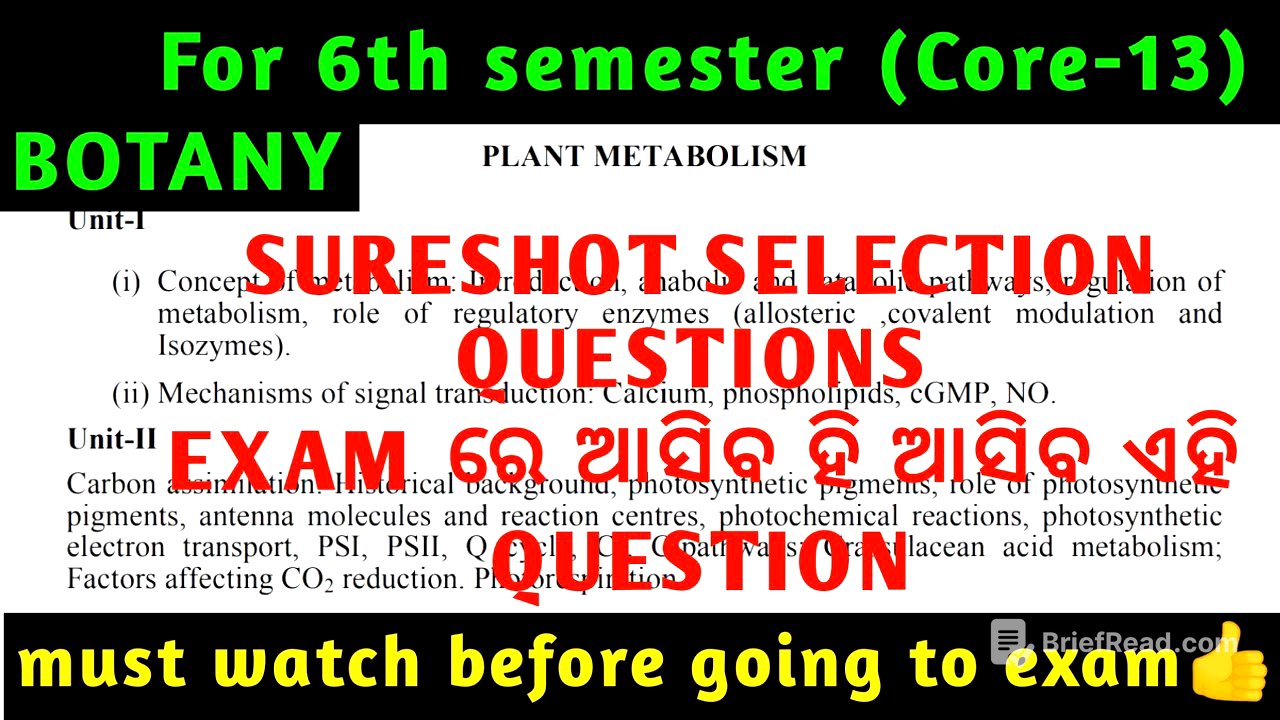
TLDR;
This video provides a comprehensive overview of essential questions for the Botany Honours 6th Semester Plant Metabolism exam. It covers topics from enzyme regulation and calcium-mediated signalling to photosynthetic mechanisms, photorespiration, glycolysis, the Krebs cycle, ATP synthesis, and lipid metabolism. Additionally, it addresses nitrogen metabolism and offers a selection of shorter questions for exam preparation, emphasising the importance of understanding key concepts and practicing answers.
- Key questions for exam preparation are provided.
- Topics range from enzyme regulation to nitrogen metabolism.
- Both long and short answer questions are covered.
Introduction [0:00]
The video introduces a discussion focused on important questions for the Botany Honours 6th Semester Plant Metabolism exam. It aims to provide students with a selection of key questions to aid their exam preparation.
Important Long Questions [0:48]
Several significant long questions are highlighted for exam preparation. These include describing the role of enzymes in the regulation of metabolism, explaining calcium-mediated signal transduction in plants, detailing the mechanism of photosynthetic electron transport, and describing the mechanism of photorespiration in plants.
Further Key Questions [2:01]
Additional important questions are presented, such as describing the C3 cycle or dark reaction mechanism, discussing the mechanism and regulation of glycolysis, explaining the Krebs cycle (also known as the TCA cycle or citric acid cycle), and discussing the chemiosmotic mechanism of ATP synthesis.
Mitochondrial Electron Transport and Lipid Synthesis [3:21]
The discussion moves to describing the mitochondrial electron transport chain and explaining the synthesis of lipids and triglycerides. It also covers the role of lipase in lipid digestion.
Nitrogen Metabolism [4:53]
The video addresses questions related to nitrogen metabolism, including nitrogen fixation.
Additional Topics and Exam Tips [6:29]
The presenter touches on various topics such as photochemical reactions, factors affecting carbon dioxide emission, nitrate assimilation, and the decarboxylation of pyruvate. They advise students to practice these questions and write down the answers to build confidence for the exam.
Short Answer Questions [8:03]
A selection of shorter questions suitable for 1.5 to 2-mark answers is provided. These include defining metabolism and its types, explaining anabolism with examples, discussing the role of enzymes in metabolism, and outlining different signalling pathways in plants, such as phosphoinositide, nitric oxide, and calcium signalling.
Photosynthesis and Photorespiration [9:30]
The discussion covers photosynthesis, including defining it and giving examples, explaining the role of photosynthetic pigments, differentiating between photosystems I and II (PS1 and PS2), defining photophosphorylation, and discussing the products of light-dependent reactions.
Key Enzymes and Metabolic Pathways [10:26]
The presenter asks about RuBisCO, the significance of the CAM pathway, defining photorespiration and the organelles involved, and the significance of respiration.
Glycolysis and Krebs Cycle [10:57]
The video covers glycolysis, including its definition, end products, and the fate of glucose. It also touches on the pentose phosphate pathway (PPP) and the role of molecules in the TCA cycle.
Respiration and ATP Synthesis [11:37]
Different types of respiration and factors affecting it are discussed. The presenter also asks about the products of the Krebs cycle and the complexes involved in the mitochondrial electron transport chain.
Further Definitions and Processes [12:18]
The summary includes questions about the essence of respiration and photosynthesis, defining the glyoxylate cycle, and explaining the active decarboxylation of pyruvate.
Lipid Metabolism and Nitrogen Fixation [13:08]
The presenter discusses triacylglycerol synthesis and beta-oxidation, followed by questions on nitrogen fixation, including symbiotic and asymbiotic nitrogen fixation.
Nitrate Assimilation and Key Differences [14:02]
The video covers nitrate assimilation and asks for differences between various processes, such as anabolism and catabolism, C3 and C4 cycles, cyclic and non-cyclic photophosphorylation, C4 and CAM pathways, PS1 and PS2, light and dark reactions, and aerobic and anaerobic respiration.
Exam Preparation Strategy [15:20]
The presenter advises students to thoroughly understand the topics and practice writing answers. They note that while online exams may allow for more flexibility, offline exams require a solid understanding of the material. The video encourages students to prepare these selection questions for success in their exams.
Conclusion [16:11]
The video concludes by encouraging viewers to share the video with other botany students and to subscribe to the channel for more content.