TLDR;
This video discusses China's population decline, its causes, and its potential consequences. It covers the historical context of China's population policies, including the "Later, Longer, Fewer" campaign and the one-child policy, and examines the reasons why recent efforts to reverse the decline have been unsuccessful. The video also explores the demographic challenges posed by an aging population and the economic implications for China's future as a global superpower.
- China's population decreased in 2022 for the first time in six decades, raising concerns about its manufacturing-based economy.
- The one-child policy, implemented in 1980, led to a rapidly aging population and a shrinking labor force.
- The 4-2-1 family structure, with one child supporting two parents and four grandparents, creates financial and social pressures that discourage larger families.
- Despite the end of the one-child policy and various incentives, birth rates remain low due to high living costs and work pressures.
- China's economic modernization has not translated into equal prosperity for all, and the country lacks adequate social safety nets for its aging population.
China's Population Decline [0:01]
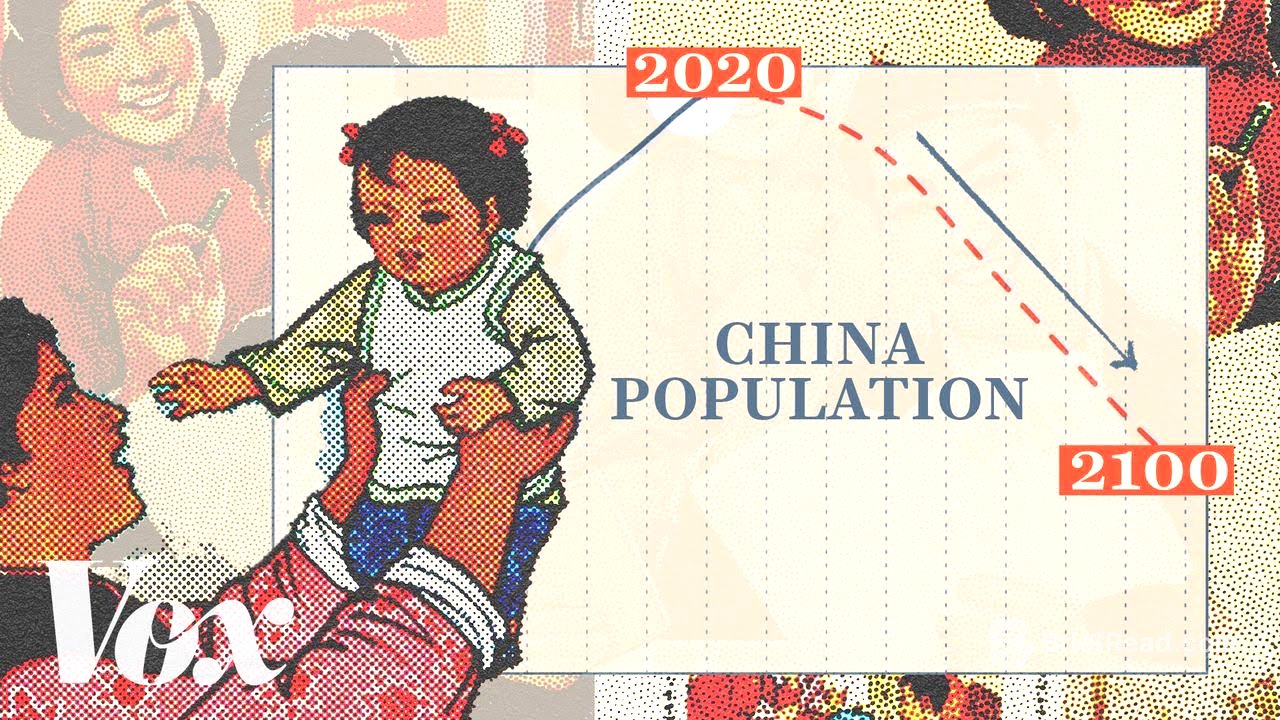
The video starts by highlighting China's declining birth rate and increasing death rate, resulting in a population decrease in 2022 for the first time in 60 years. This is significant because China's manufacturing superpower status is largely due to its massive population, with nearly 30% of its economic output derived from manufacturing. Despite a slight population loss, China still has approximately 1.4 billion people, but projections indicate a potential decrease by nearly half by the end of the century.
Historical Context: Population Policies [0:59]
The video explains that in the 1950s, China experienced a severe famine under Mao, leading to 30 million deaths and a temporary population decrease. However, a subsequent baby boom, combined with medical advancements, resulted in an average of six children per family. The government then introduced the "Later, Longer, Fewer" policy, advocating for later marriages, longer birth intervals, and fewer births. In 1980, the one-child policy was implemented, enforced with harsh measures such as sterilization, IUD insertion, and induced abortions. By the numbers, China sterilized 20 million men and women and induced nearly 15 million abortions in a single year.
Consequences of the One-Child Policy [2:38]
The video points out that for a population to remain stable, the replacement rate is 2.1 children per couple. China's fertility rate has been below 2 for over three decades. In 2016, the one-child policy was ended, and later, a three-child policy was briefly introduced. By 2021, families were allowed to have as many children as they wanted, but these changes have not reversed the declining birth rate.
The 4-2-1 Family Structure [3:15]
The video describes the 4-2-1 family structure, where one child is responsible for supporting two parents and four grandparents. This structure puts immense pressure on the only child, especially with rising living costs, making it difficult to consider having multiple children. Surveys indicate that over 50% of young people do not want more than one child due to financial and work-related pressures. Despite cash subsidies, longer maternal leaves, and kindergarten subsidies, these incentives have been largely ineffective because raising a child is a significant financial and lifelong commitment.
Demographic Imbalance and Aging Population [4:24]
The video highlights that China's population crisis involves not only the number of births but also the balance between young and old. Population pyramids illustrate that China has a narrow base (fewer babies) and a heavy top (more elderly people). By 2050, the pyramid is projected to become even more skewed, further reducing China's population, shrinking its labor force, and placing the country in a challenging position.
Economic Implications and Future Challenges [5:30]
The video notes that China became a major world economy rapidly but remains a middle-income country. Many people, especially in rural areas, have not benefited significantly from China's economic boom, and the country lacks the necessary social safety nets to support its aging population. Building social infrastructure, such as healthcare and pension programs, takes time and is becoming more difficult with a slowing economy. This demographic shift and economic slowdown could redefine China's role as a manufacturing superpower and constrain its global ambitions. While other countries also face population declines, the speed at which this is happening in China is unique. China must rethink its future as a global superpower and address the needs of its citizens.