TLDR;
This video explores Naypyidaw, Myanmar's massive and largely deserted capital city. It examines the city's origins, its unusual design featuring vast empty highways and segregated zones, and the potential reasons behind its construction, including military control and security. The video also touches on the city's poor construction quality and its role as a secure command center during the ongoing civil war.
- Naypyidaw is a sprawling capital city in Myanmar built in secret by the military government.
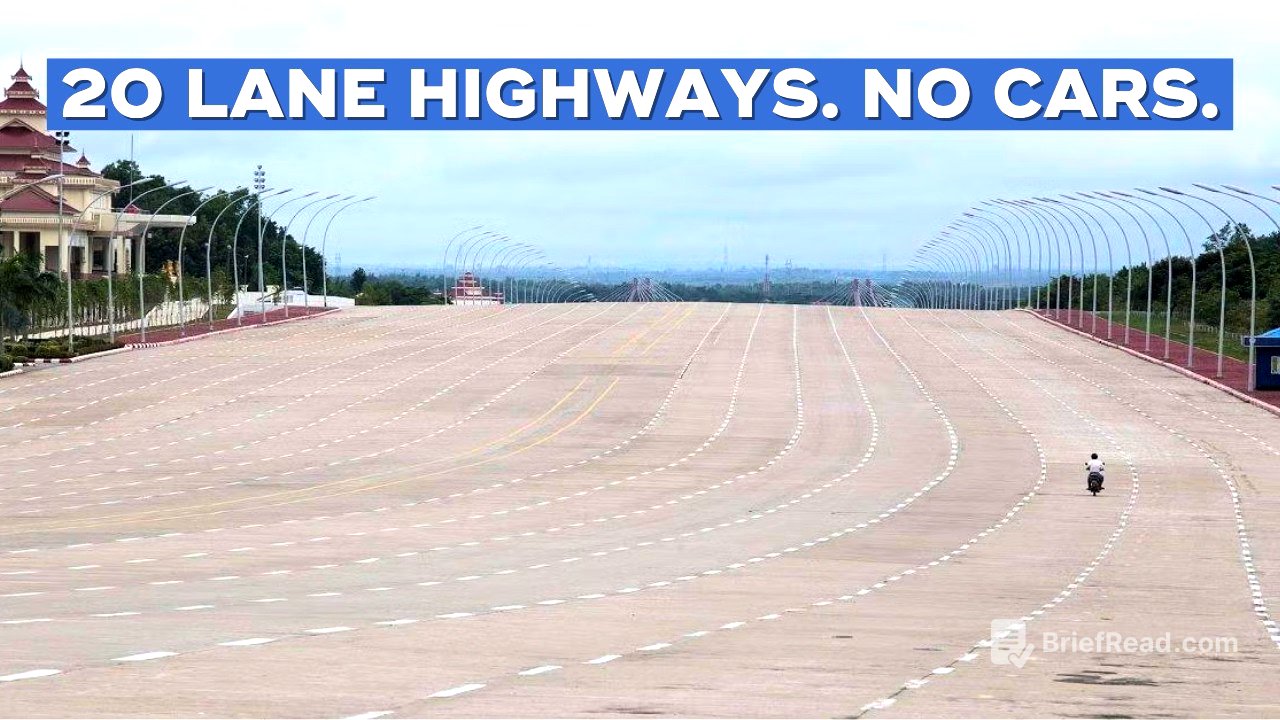
- The city is characterized by its massive size, empty highways, and segregated zones.
- Theories suggest the city was designed as a military fortress to protect the government from uprisings and external attacks.
Introduction to Naypyidaw [0:00]
Naypyidaw, Myanmar's capital, is portrayed as a ghost city with empty roads and colossal buildings. The city spans 7,000 square kilometers, large enough to contain four Londons or nine New York Cities. Despite its size, designed for millions, it houses fewer than 800,000 people. The video poses the question of why a government would construct such a deserted capital.
Historical Context and Construction [1:17]
The video discusses Myanmar's history, including its name change from Burma in 1989 by a military government that took control in the 1960s. The military's rule was marked by harsh actions, such as suppressing student protests. Yangon, the former capital for over 150 years, was deemed too crowded by the military, who then secretly began constructing Naypyidaw around 2002. The new capital was revealed in 2005 and officially announced in March 2006, costing an estimated $4 billion.
City Size and Peculiarities [2:55]
Naypyidaw's vastness is emphasized, covering approximately 7,000 square kilometers, dwarfing cities like London and New York City in comparison. Despite its size, the city's population is less than 800,000, creating a ghost city atmosphere. The video suggests that if the goal was to build a busy capital, Naypyidaw is a failure, but if the goal was to create a safe place for the government and military, the emptiness might be exactly what they wanted.
Infrastructure and "Death Highway" [4:06]
The city features massive highways, some with 20 lanes, that are mostly empty, resembling airport runways. The roundabouts are vast and strangely designed, seemingly impractical for normal traffic. These oversized roads suggest a military purpose, such as allowing planes to land or moving troops. One road, known as "Death Highway," has seen many deadly crashes since its opening in 2010, indicating potential safety design flaws.
Empty Airport and Segregated Zones [6:03]
Naypyidaw's airport, designed to handle 3.5 million passengers annually, sees only a few hundred people on most days. The city also has numerous luxury hotels with empty pools and unused rooms. The Grand Apadasanti Pagoda, a replica of a famous pagoda in Yangon, is often deserted. The city is divided into strict zones, including residential, ministry, military, hotel, shopping, and international zones, which are spread out and disconnected.
Residential Zone and Construction Quality [7:42]
In the residential zone, the color of apartment building roofs indicates the occupants' professions, such as blue for health workers and green for agriculture workers. High-ranking officials reside in large mansions. The city's construction, estimated at $7 billion, was rushed and lacked proper quality control, leading to weak structures. A 7.7 magnitude earthquake on March 28, 2024, caused widespread damage, with many government buildings collapsing or being severely damaged.
Reasons for Building Naypyidaw and Military Fortress Theory [9:42]
The official reason for building Naypyidaw was to alleviate overcrowding in Yangon, but experts believe the real reasons were related to security concerns. The military leaders feared a large-scale uprising in Yangon and a potential attack from the sea. Naypyidaw's inland location, nestled between mountain ranges, provides natural protection. There are rumors of a heavily guarded government complex and a network of underground tunnels, possibly designed with North Korean assistance, for added security. The video proposes that Naypyidaw is not a city but a military fortress.
Current Situation and Conclusion [11:16]
Since the 2021 military coup, Myanmar has been in a civil war, with battles and protests in Yangon and other populated areas. Naypyidaw remains largely untouched by the conflict, serving as a secure command center for the military leaders. The video concludes by asking viewers for their thoughts on the true reasons behind Naypyidaw's construction.