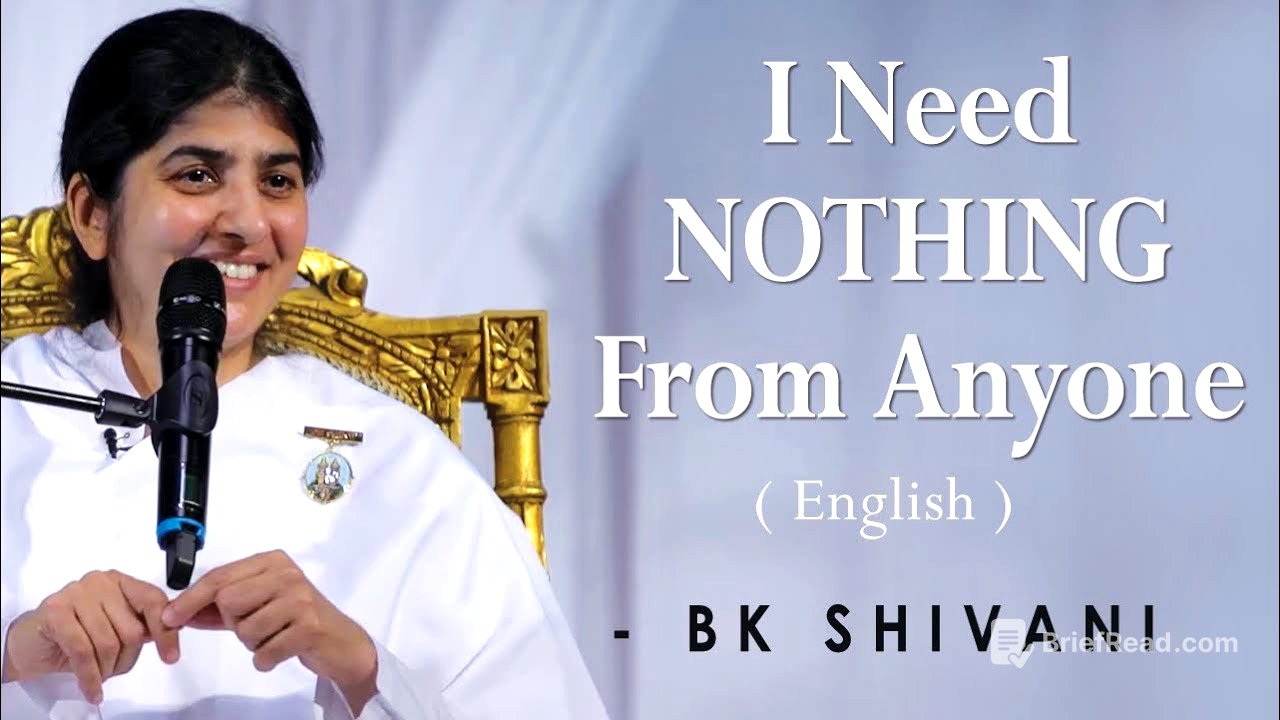
TLDR;
This video explores the importance of self-respect and authenticity, urging viewers to align their thoughts, feelings, words, and actions. It discusses how seeking external approval leads to inauthenticity and inner emptiness, and it emphasizes the need to shift from seeking to giving love, respect, and understanding. The video also addresses reprogramming negative belief systems, particularly around anger, and encourages viewers to embrace their inherent qualities of peace, purity, and love.
- Self-respect is essential for respecting others.
- Authenticity requires aligning thoughts, feelings, words, and actions.
- Seeking external approval leads to inauthenticity and inner emptiness.
- Shifting from seeking to giving love, respect, and understanding is crucial.
- Reprogramming negative belief systems, especially around anger, is necessary for personal growth.
Standing Alone [0:06]
The video begins by questioning whether standing alone with a different opinion means being wrong. It asserts that having a different thought, choice, or decision from others doesn't necessarily indicate being incorrect. Self-respect empowers individuals to respect others, while lacking self-respect makes one dependent on external approval. The speaker emphasizes the importance of being authentic and not projecting a false self to gain acceptance from the world.
Authenticity and Innate Self [1:17]
The speaker illustrates the importance of aligning inner thoughts and feelings with outward expressions. Lying or being inauthentic creates internal conflict and requires constant reinforcement to maintain the facade. The video highlights how projecting a false self to meet perceived expectations leads to a disconnect from one's original, beautiful, and authentic self. People often conform to societal norms in clothing, eating, and drinking habits without questioning what is right for them personally.
The Torn Jeans Example [4:06]
Using the example of torn jeans, the speaker explains how people often follow trends without questioning their personal preferences or comfort. This blind conformity makes self-respect dependent on others' opinions, leading to a need for constant approval to feel good. The speaker emphasizes that peace, love, and happiness come from within, not from external validation.
The Addiction to Approval [6:40]
The speaker references a talk show host who learned that everyone, regardless of their status, seeks approval and acceptance. This addiction to approval can lead individuals to act against their true nature (Dharma). Dharma is defined as one's inherent qualities, such as coolness for water, and for humans, it includes peace, purity, love, power, knowledge, and bliss. The purpose of life is to integrate these qualities into every action (Karma). Forgetting this leads to conflict and straying from the true essence of one's being.
The Vacuum Inside [9:50]
The speaker explains that creating and radiating negative emotions like anger affects the creator first. The recipient has a choice to absorb the energy, but the creator cannot avoid experiencing it. The video highlights the mistake of constantly seeking love and respect from others, which creates a deeper inner vacuum. To fill this vacuum, one must shift from asking to giving love, respect, and understanding.
Changing the Programming [16:26]
Spirituality reverses the equation of seeking external validation. The speaker suggests a daily mantra: "I need nothing from anyone." This reprograms the mind from a belief in needing to receive to a focus on giving. Changing this coding can transform one's life, allowing inherent qualities to flow freely without waiting for external approval. Creating and radiating positive qualities leads to experiencing peace, love, and happiness from within.
Reprogramming Anger [19:41]
The speaker addresses the common belief that anger is normal, especially when people and situations don't go one's way. The video challenges this programming, suggesting a new code: "When people and situations are my way, I'm happy; when people and situations are not my way, I am happier." This shift in perspective acknowledges that external circumstances are beyond control and promotes inner peace regardless of the situation.
The Sonskar of Peace [22:47]
The speaker uses the analogy of teaching a child to illustrate how early programming shapes lifelong beliefs. The video emphasizes that the belief that anger is necessary is a learned behavior, often reinforced from childhood experiences. The speaker encourages viewers to recognize that they also possess the "Sonskar" (latent impression) of peace but may have stopped using it. Values like patience, empathy, and compassion are effective, and treating others with the same kindness one expects can transform interactions. The speaker concludes by reiterating that negative programming can be changed, leading to a more fulfilling and peaceful life.