TLDR;
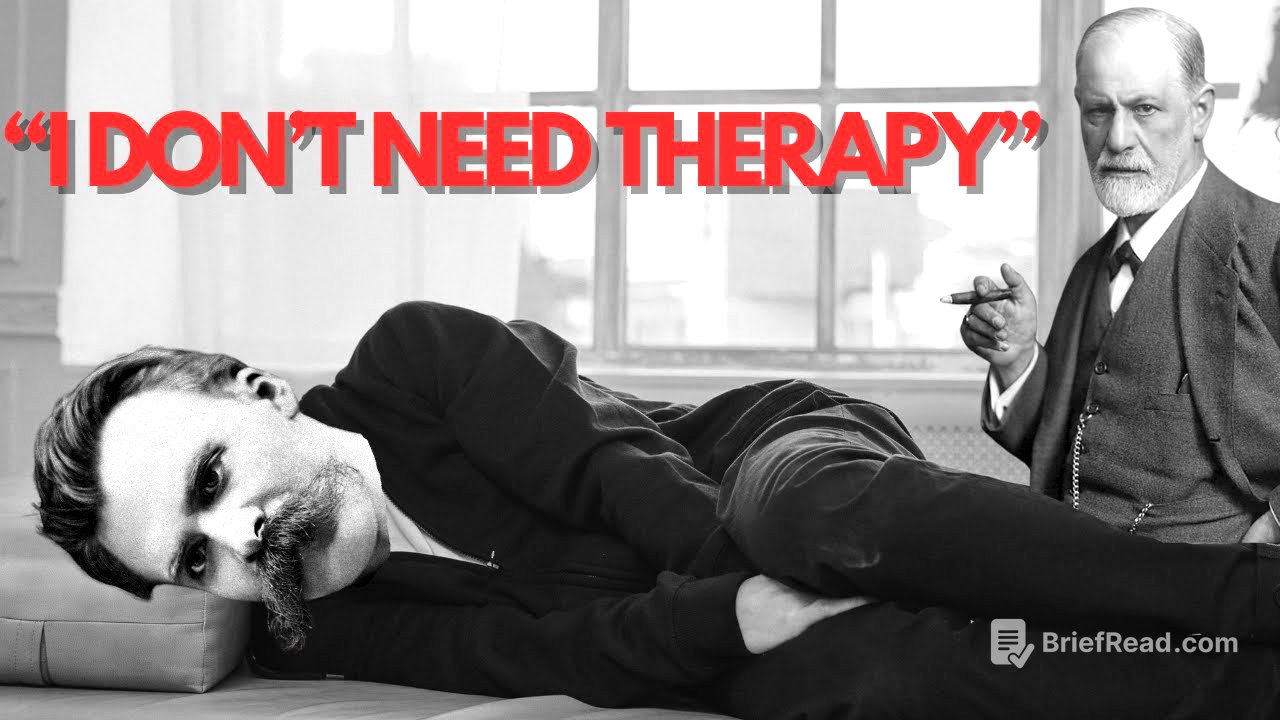
The video explores a hypothetical scenario where Friedrich Nietzsche undergoes therapy with Joseph Breuer, drawing from the book "Nietzsche's Tears" by Irvin Yalom. It examines Nietzsche's philosophical ideals, his personal struggles with loneliness and isolation, and how existential therapy, particularly Yalom's framework, could have addressed his psychological distress. The video suggests that such therapy might have prepared Nietzsche for writing "Thus Spoke Zarathustra."
- Nietzsche's potential therapy with Joseph Breuer is explored.
- Existential therapy addresses concerns like death, freedom, isolation, and meaninglessness.
- Nietzsche's struggles with freedom and isolation are highlighted.
- The therapy is portrayed as a catalyst for Nietzsche's philosophical work.
Introduction [0:00]
The video introduces the concept of Friedrich Nietzsche undergoing therapy with Joseph Breuer, a prominent therapist of his time. It references the book "Nietzsche's Tears" by Irvin Yalom, which explores this hypothetical scenario. The video questions what Nietzsche might have thought of his fame and historical events had he received therapy, given his mental anguish and breakdown in Turin.
Nietzsche the Patient [1:23]
The video discusses a hypothetical meeting between Nietzsche and Breuer in Vienna in 1882, a plausible scenario given Nietzsche's frequent visits to doctors for his health issues. It addresses Nietzsche's concept of the "free spirit," someone who defies cultural and moral constraints, and how therapy might be perceived by him as a form of brainwashing that sacrifices freedom of thought.
Breuer's Deceit [2:21]
Breuer believes deceiving Nietzsche is necessary for him to accept therapy, initially treating him for physical ailments to transition into a therapeutic relationship. Their relationship evolves, with Nietzsche becoming a therapist to Breuer. Breuer hopes to demonstrate therapy's power, believing Nietzsche will benefit and acknowledge its value within his own philosophical ideas. This leads to a reversal of roles, with Breuer immersing himself in Nietzsche's philosophical experiments, confronting aversion, and grappling with concepts like the "Übermensch" and the eternal return.
Existential Therapy [3:38]
The video introduces Irvin Yalom's ideas on existential therapy, identifying four ultimate concerns: death, freedom, isolation, and meaninglessness. These concerns underlie psychological distress and guide individuals to confront and navigate them. Freedom and isolation are particularly relevant to Nietzsche's struggles, as his belief in self-overcoming and the will to power highlights the anxiety of absolute freedom. Nietzsche's resistance to external influence leads to loneliness and difficulty connecting with others, which Breuer identifies as a cause of his physical ailments.
Conclusion [5:02]
The video concludes with Nietzsche admitting to feelings of loneliness and isolation, marking a coming of age and readiness to write "Thus Spoke Zarathustra." The therapy is portrayed as a catalyst for Nietzsche to prepare himself to write this significant work. Existential psychotherapy is presented as a valuable approach that addresses the existential concerns underlying psychological problems.