TLDR;
The video discusses the interstellar object 3I/Atlas, which will make its closest approach to Earth on December 19, 2025. It highlights the object's unusual characteristics, including its anti-tail, unique chemical composition, color shifts, and radio signals, leading to speculation about its nature and purpose. The video explores possibilities ranging from a natural panspermia vessel to an alien probe, emphasizing the importance of upcoming observations to uncover the truth behind this mysterious visitor.
- 3I/Atlas will be closest to Earth on December 19, 2025.
- The object exhibits an anti-tail, high methanol levels, color changes, and radio signals.
- Theories range from natural object carrying life's building blocks to alien probe.
- Observations on December 19th are crucial to understanding its nature.
Introduction: The Enigmatic Arrival of 3I/Atlas [0:00]
On December 19, 2025, the interstellar object 3I/Atlas will make its closest approach to Earth at a distance of 1.8 astronomical units (approximately 269 million km). Unlike previous interstellar visitors like Umuamua and Borisov, 3I/Atlas is exhibiting unusual behavior, baffling astronomers and raising questions about its true nature. The video focuses on recent data from the Hubble Space Telescope and the ALMA Observatory in Chile, which reveal strange and compelling characteristics of the object.
Visual Anomalies: The Anti-Tail Phenomenon [1:29]
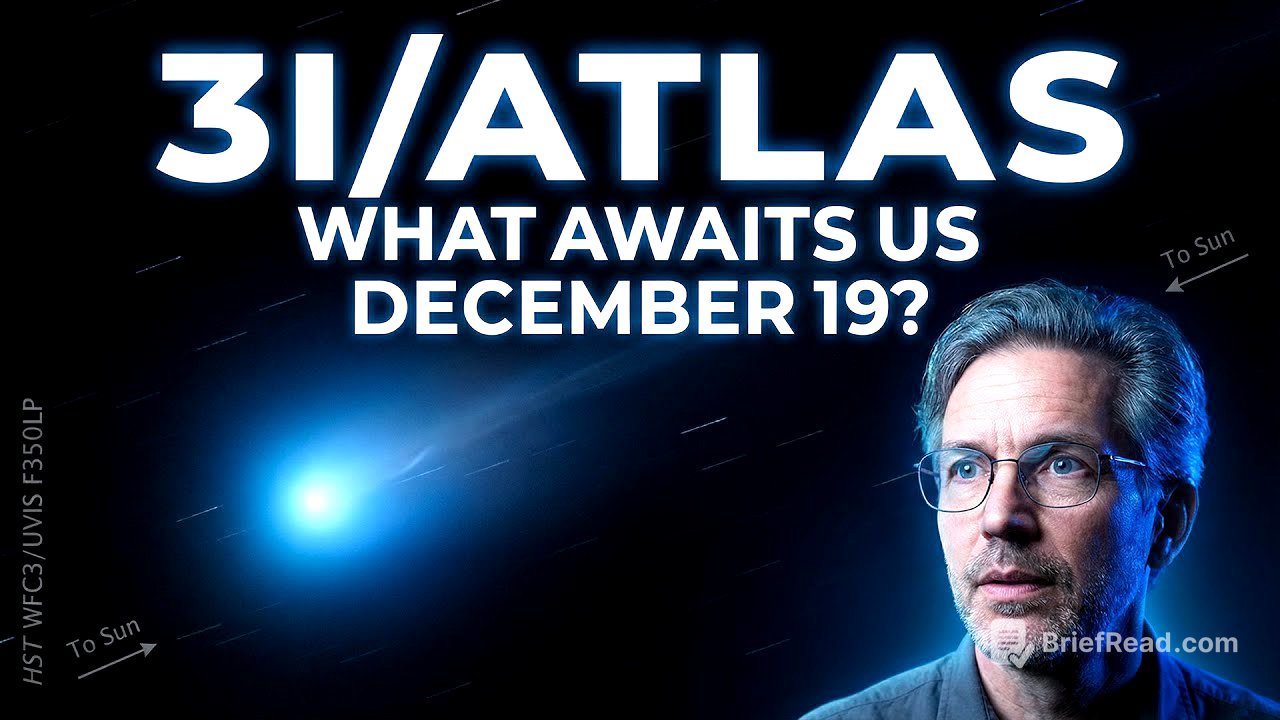
Recent images from the Hubble Space Telescope reveal that 3I/Atlas possesses a distinct anti-tail, a feature that defies conventional understanding of cometary behavior. Typically, an anti-tail is an optical illusion caused by heavy dust particles appearing to point towards the sun. However, in the case of 3I/Atlas, this anti-tail is persistent and points directly at the sun, regardless of the comet's motion. This observation challenges the notion of a standard comet and raises the possibility of alternative explanations, such as exhaust or a counterflow. The presence of two distinct jets, a standard tail and a sunward-pointing lance, further suggests that 3I/Atlas may be a stabilized object rather than a crumbling rock.
Chemical Composition: A Life-Enabling Cocktail? [3:06]
Data from the Atakama Large Millimeter/submillimeter Array (ALMA) reveals that the gas cloud surrounding 3I/Atlas contains massive amounts of methanol (CH3OH) and hydrogen cyanide (HCN). While hydrogen cyanide is a deadly poison, it is also a precursor for amino acids and adenine, essential building blocks of DNA. The ratio of methanol to hydrogen cyanide is exceptionally high, at 124 to 1, a level rarely seen in comets. This unique chemical composition raises the possibility that 3I/Atlas is a natural panspermia vessel, carrying the ingredients for life, or even a probe designed to seed worlds with these chemicals. The anti-tail, pointing towards the sun, could be interpreted as a deliberate effort to direct the spray of these life-enabling molecules.
Color Shifts: Unraveling the Mystery of the Blue Glow [8:18]
3I/Atlas has undergone significant color shifts since its discovery. Initially, it appeared red, typical for interstellar objects due to cosmic ray exposure. As it approached the sun, it turned green, indicating the burning of diatomic carbon and cyanogen. Now, as it moves away from the sun, it has shifted to blue. In cometary terms, blue usually signifies ionized carbon monoxide or nitrogen, indicating high energy and heat. However, since 3I/Atlas is moving away from the sun, it should be cooling down, not glowing blue. This anomaly suggests that the color change may not be solely due to chemistry but could be a byproduct of propulsion or an internal energy source.
Trajectory and Signals: Evidence of Non-Gravitational Acceleration [9:58]
3I/Atlas is on a hyperbolic orbit, moving too fast to be captured by the sun. Its trajectory exhibits non-gravitational acceleration, which, while common in comets due to the rocket effect of gas jets, is unusually smooth and consistent in 3I/Atlas. The anti-tail acts as a stabilizer, maintaining the object's orientation. Furthermore, radio signals picked up by the MeerKAT telescope around 1665 MHz, initially attributed to hydroxyl radicals, are steady rather than sporadic, suggesting a constant emission source. These factors raise the possibility that 3I/Atlas is using the sun for a gravity assist maneuver and that the radio signals are indicative of a running system or carrier wave.
December 19th Observations: Seeking the Truth [12:36]
On December 19th, when 3I/Atlas makes its closest approach to Earth, telescopes like the James Webb Space Telescope and Hubble will be focused on it. Scientists will be looking for the object's nucleus, hoping to determine its shape and composition. There is a hypothesis that the visible comet is merely a shield or camouflage for a hidden object inside. Additionally, a recent paper indicates that the dust being shed by 3I/Atlas consists of unusually large particles, pebbles rather than fine dust. This suggests that if 3I/Atlas is seeding the solar system, it is doing so with heavy seeds that will linger in stable orbits.
The Message in the Debris: Seeds of the Cosmos [15:01]
The large, heavy particles shed by 3I/Atlas are significant because they are more likely to remain in the solar system compared to fine dust, which is easily blown away by solar wind. These particles could be a message in a bottle, millions of tiny capsules dropped precisely where a planet like Earth might encounter them. These could be dormant biological packages protected by a carbon shell. The timing of this material dump, occurring after the object survived its solar passage, suggests a deliberate release mechanism.
The Terrifying Blue: An Internal Energy Source [16:37]
The blue glow of 3I/Atlas is particularly concerning because blue light signifies high energy. While the official explanation points to ionized gas, the intensity and persistence of the blue light, even as the object moves away from the sun, suggest an internal energy source. This raises the possibility that the core of the comet is hot or even radioactive. The blue coma could be exhaust from a drive plume, propelling the object along its non-gravitational trajectory. The coma itself acts as a screen, obscuring the shape of the nucleus and making it difficult to determine whether it is a natural rock or a manufactured object.
Departure and the Silence: A Scout's Mission? [19:51]
3I/Atlas is not stopping; it is on an escape trajectory, moving at 30 km/s relative to the sun. By March 2026, it will cross the orbit of Jupiter, and by the early 2030s, it will leave our solar system entirely. This raises the possibility that 3I/Atlas is a scout, mapping the terrain, taking samples, and dropping markers without engaging directly. The anti-tail could be an antenna, relaying data back to its origin. The heavy gravel it leaves behind could be a payload designed to wake up in the future. The video concludes by emphasizing that the silence following 3I/Atlas's departure will be the most chilling aspect of the encounter, leaving humanity to ponder whether it was visited by a rock, a friendly gardener, a serial killer, or a scout.