TLDR;
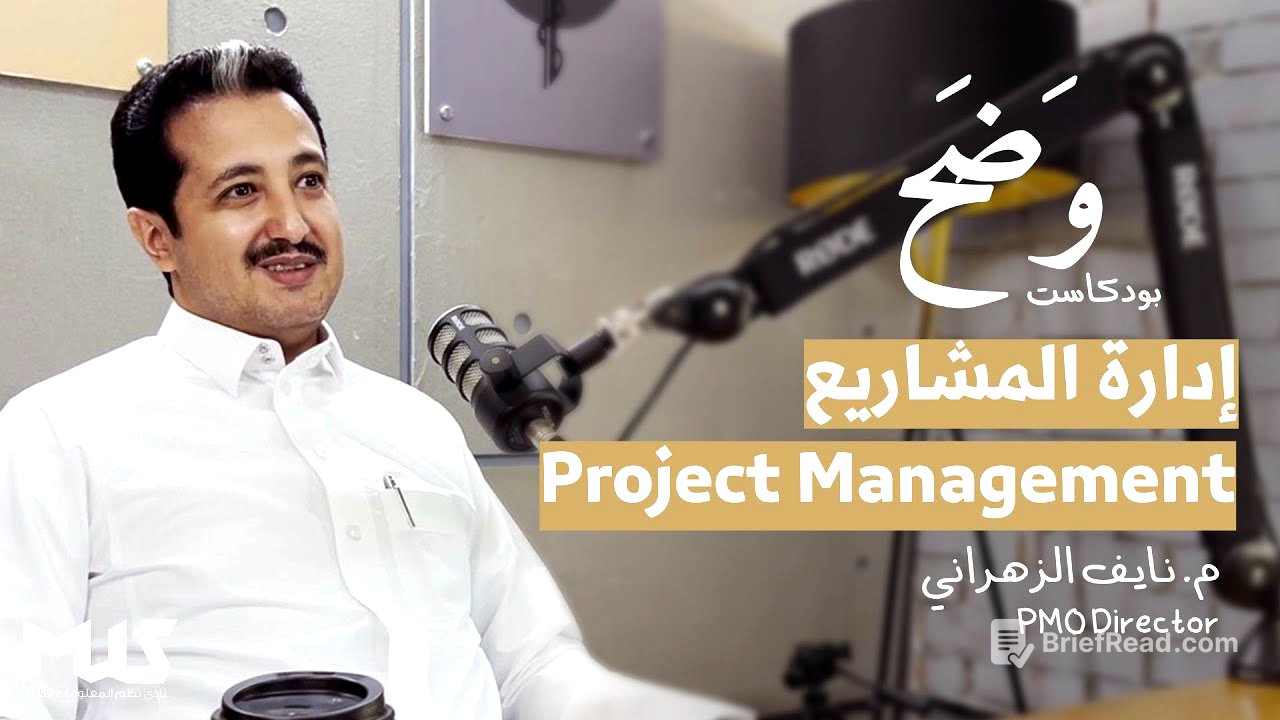
This YouTube video features a discussion on technical project management with Naif Al-Zahrani, who has experience in PMOs at Sahab Company and Elm Company. The conversation covers the definition of technical project management, the role of PMOs, popular methodologies, project lifecycle, change requests, and challenges faced by project managers. Key takeaways include the importance of understanding project scope, selecting the right methodology (Agile vs. Waterfall), managing risks, and developing strong communication and problem-solving skills.
- Project management involves applying skills, knowledge, and tools to project activities.
- PMOs standardize methodologies and provide support to project managers.
- Agile and Waterfall are popular methodologies, each suited for different project types.
- Effective project managers need strong communication, problem-solving, and risk management skills.
مقدمة [0:00]
The podcast "وضح" introduces an episode about technical project management, featuring Naif Al-Zahrani from Sahab Company, who previously worked at Elm Company. The discussion will cover various topics, including the definition of technical project management, the relationship between PMOs and project managers, methodologies, and tools used in the field.
مسيرة الضيف الوظيفيه [1:10]
Naif Al-Zahrani shares his career journey, starting with databases at Elm Company. He transitioned to quality assurance after about eight months, finding his interest in testing systems. After two years, he became a team lead and spent six years in that role. A recommendation from a manager led him to project management, where he managed his first project in 2016. He finds project management enjoyable and beneficial, not only in his career but also in his personal life.
ماهي إدارة المشاريع [4:26]
Project management involves applying skills, knowledge, techniques, and tools to project activities. A project is a series of activities with a beginning and an end, resulting in a unique product or service. Projects are tied to scope, time, and cost. Technical projects involve managing teams that develop software or applications for clients, requiring project managers to have some technical understanding.
مالمقصود بمكتب ادارة المشاريع(pmo) [7:20]
A Project Management Office (PMO) is responsible for organizing project management within an organization. PMOs provide methodologies, procedures, policies, and templates for project managers to use. Previously, without a PMO, project managers would work independently, leading to inconsistencies. PMOs can be supportive, controlling, or directive. Supportive PMOs offer guidance, controlling PMOs monitor compliance, and directive PMOs have authority over project managers.
مكتب ادارة المشاريع ومدير المشروع [11:37]
The ideal relationship between a PMO and project managers involves setting objectives, goals, strategies, and measurements. The PMO sets the strategy in collaboration with management. Each project should have clear objectives, and goals should be measurable using Key Performance Indicators (KPIs) defined from the beginning. These KPIs help track project success and address deviations in schedule or cost.
المنهجيات الاكثر استخداماً في ادراة المشاريع [13:19]
Before 2000, the Waterfall methodology was commonly used. Around 2001, the Agile methodology emerged, better suited for the technical sector. Agile focuses on frequent deliveries to the client, allowing for early error detection. Waterfall is suitable when the project scope is very clear and unlikely to change. Agile welcomes changes and allows adjustments at any stage, while Waterfall can be difficult to modify mid-project.
كيف نختار منهجية المشروع [17:07]
The Agile methodology is now widely used, while Waterfall is applied when the client is certain about the project scope. Clients often don't know their exact requirements, making Agile more suitable. Business analysts play a crucial role in helping clients define their needs and translating them into documentation for developers.
رحلة بناء المشروع [19:42]
There are typically five or six phases in project execution: pre-project, initiation, planning, execution, monitoring, and closure. The pre-project phase involves assessing the project's feasibility and potential benefits. This includes creating a business case with input from project management, sales, and finance to determine the return on investment (ROI) and conduct a feasibility study. The initiation phase involves creating a project charter, which is a document that authorizes the project manager and defines the project scope, constraints, assumptions, and risks. Risk identification is based on past experiences and input from other project managers. The planning phase involves detailing the project scope into phases or sprints, defining deliverables, tasks, costs, and resources, and creating a schedule. Tools like MS Project, SmartSheet, and Jira Agile are used for project planning.
تأثير طلب أمر تغير على المشروع [34:52]
A change request is a client's request to add features or modifications not included in the original project scope. It involves calculating the cost and schedule impact. Change requests affect the project by increasing costs and extending timelines. In Agile, changes are more easily accommodated due to iterative deliveries. In Waterfall, changes can be difficult and costly to implement mid-project.
أبرز التحديات التي تواجه مدير المشروع [39:30]
Project managers face internal and external challenges, including client expectations and organizational structure. Some organizations don't empower project managers to make decisions, limiting their authority. A weak matrix structure can hinder a project manager's ability to control resources. Strong matrix structures, where the team reports directly to the project manager, are more effective.
الشهادات المهنية في ادارة المشاريع [42:08]
The Project Management Professional (PMP) certification is valuable, especially for those with limited experience, as it teaches project execution strategies. Practical experience is more valuable than certification. The Agile Certified Practitioner (PMI-ACP) is beneficial for those using Agile methodologies. Risk Management Professional (RMP) certification focuses on risk management. Entry-level certifications like Certified Associate in Project Management (CAPM) are also useful.
نصيحة للمهتمين بالمجال [45:47]
Students interested in project management should focus on gaining experience in the first few years, even through volunteering. Developing soft skills like communication, motivation, and problem-solving is crucial. Project managers should be patient, avoid being defensive, and strive to find a balance in their interactions.
قصة في ادارة المشاريع [48:05]
Naif shares a story from his early years as a project manager. During a management meeting, he was asked about a software issue and couldn't provide details. He learned that project managers should not be mere intermediaries but should understand the project details, ask the team about issues, and gain knowledge about the software. He advises project managers to treat the project as their own business and be deeply involved in every detail.
خاتمة [50:59]
The episode concludes with thanks to Naif Al-Zahrani for sharing his insights and experiences. The host encourages viewers to share their thoughts in the comments and follow the podcast for more episodes.

!["This is a civilisational failure!" – World's Strictest Headmistress Katharine Birbalsingh [ARC26]](https://wm-img.halpindev.com/p-briefread_c-10_b-10/urlb/aHR0cDovL2ltZy55b3V0dWJlLmNvbS92aS9FcWpfU25USWhOWS9ocWRlZmF1bHQuanBn.jpg)