TLDR;
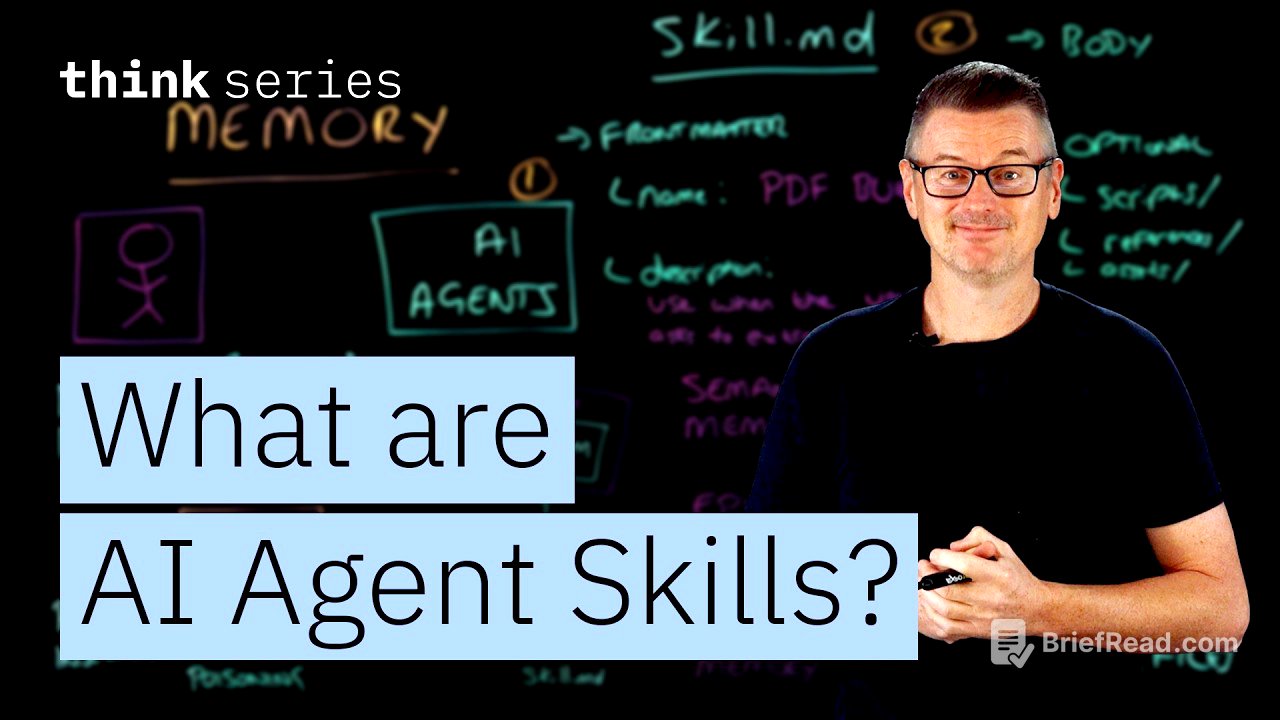
The video explains the concept of AI agent skills and their significance in enhancing procedural knowledge for AI agents. These skills are represented in a simple markdown format, allowing agents to perform specific tasks efficiently and accurately. Key points include:
- AI agents need procedural knowledge to carry out complex workflows.
- Skills enhance AI capability through a straightforward markdown structure, comprising mandatory fields like name and description.
- Skills can be loaded progressively, maintaining manageable memory usage while enabling AI agents to execute tasks effectively and securely.
What are AI agent skills? [0:00]
AI agent skills are crucial for addressing gaps in procedural knowledge that AI agents need to execute tasks effectively. While AI agents, particularly LLMs, are skilled in reasoning and have substantial factual knowledge, they often lack the step-by-step procedures necessary for specific tasks, like generating a compliant financial report.
Understanding the structure of skills [1:30]
A skill is defined in a simple format—a skill.md file. This contains critical elements such as the name and description, which inform the agent when to utilize the skill. The file also encompasses instructions presented in markdown format, detailing workflows and rules necessary for task execution. Optional directories for scripts, references, and assets can further enhance the agent's functionality.
Progressive disclosure of skills [4:12]
Skills utilize a method called progressive disclosure, which helps manage the information loaded into the AI agent's context. This process occurs in three tiers:
- Tier one involves loading only the name and description of each skill upon startup, minimizing token usage.
- Tier two entails the loading of complete instructions when a specific request is recognized.
- Tier three includes optional resources that are only retrieved when necessary, ensuring that the agent operates efficiently without overloading on information.
Comparison of knowledge incorporation methods [6:28]
Several methods exist for incorporating knowledge into AI agents, including Model Context Protocol (MCP), Retrieval Augmented Generation (RAG), and fine-tuning. MCP allows access to external tools, RAG focuses on on-the-go factual knowledge retrieval, while fine-tuning embeds knowledge permanently in the model, albeit at a higher cost and effort. In contrast, skills specifically handle procedural knowledge, detailing the steps and judgment necessary for achieving tasks.
Open standards and procedural knowledge [8:41]
The skill.md format adheres to an open standard, making it compatible across various AI platforms. This standardization allows skills to be easily shared and updated, enhancing procedural knowledge in agents. The concept parallels human memory types: semantic, episodic, and procedural, as skills serve as the procedural memory for agents.
Trust and security considerations [10:29]
Given that skills can include executable scripts capable of running commands in local environments, trust becomes a crucial factor. Security risks like prompt injection and hidden malware present challenges within the open ecosystem. Therefore, it is essential to review and understand any skills installed prior to their usage on local machines.
Conclusion on AI agent skills [11:30]
AI skills replicate procedural memory within agents, enabling them to complete specified jobs by loading instructions conditionally and efficiently through progressive disclosure. This approach allows agents to execute any defined repeatable task, thereby expanding their capabilities significantly.