TLDR;
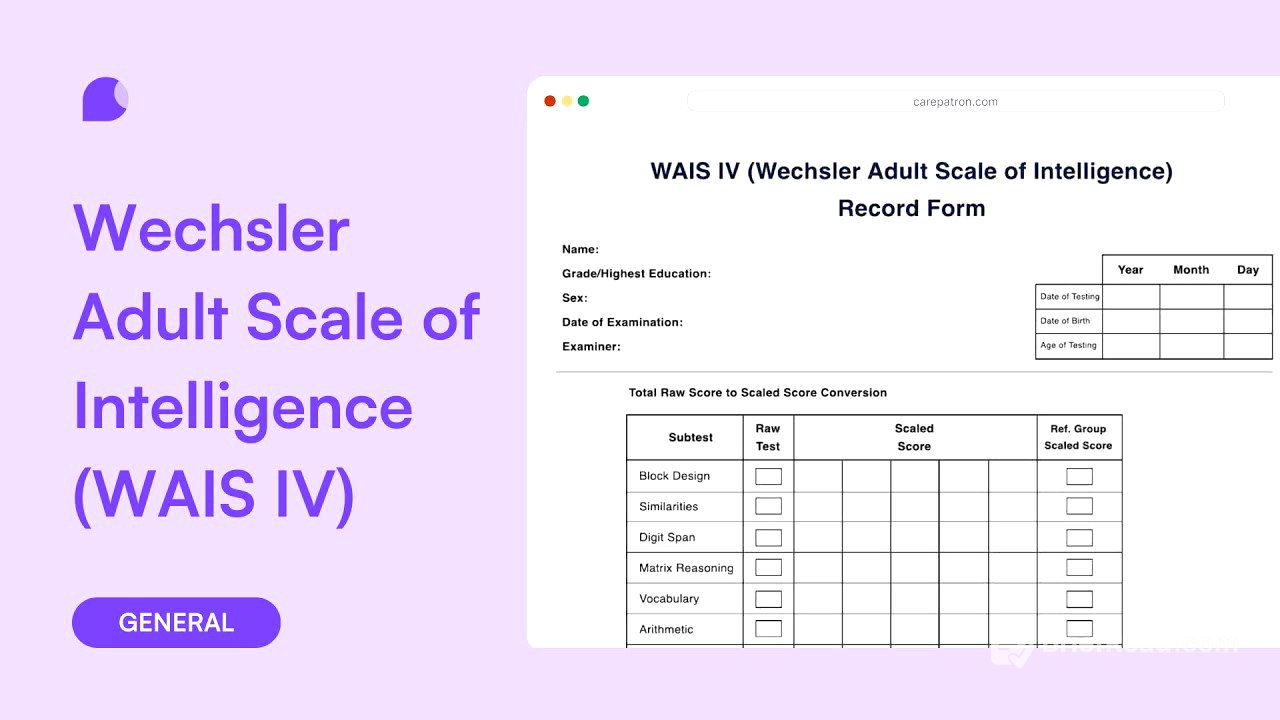
This video provides an overview of the Wechsler Adult Intelligence Scale (WAIS), a widely used test for measuring cognitive abilities in adults. It explains the structure of the WAIS, including its core and supplemental subtests, the four major index scores (Verbal Comprehension, Perceptual Reasoning, Working Memory, and Processing Speed), and the scoring system used to interpret results. The video also mentions Carepatron's practice management software and free templates.
- The WAIS assesses various aspects of intelligence through a series of subtests.
- The WAIS includes 10 core subtests and five supplemental subtests divided into four major index scores.
- The scale scoring provides a comprehensive assessment of cognitive abilities with four main index scores.
Introduction to the WAIS [0:00]
The video introduces the Wechsler Adult Intelligence Scale (WAIS) as a tool designed to measure cognitive abilities and intelligence in adults. Created by psychologist David Wechsler, the WAIS assesses various aspects of intelligence through a series of subtests. The current version, the WAIS fourth edition, includes 10 core subtests and five supplemental subtests, which are divided into four major index scores.
Four Major Index Scores [0:34]
The WAIS fourth edition is structured around four major index scores, each assessing different cognitive abilities. The Verbal Comprehension Index measures verbal reasoning, comprehension, and conceptual abilities through subtests like similarities, vocabulary, and information. The Perceptual Reasoning Index evaluates nonverbal reasoning, spatial processing, and visual-motor integration with subtests like block design, matrix reasoning, and visual puzzles. The Working Memory Index assesses the ability to store and manipulate information in short-term memory using subtests like digit span and arithmetic. Lastly, the Processing Speed Index measures the ability to quickly and accurately process visual information through subtests like coding and symbol search.
Core Subtests in WAIS Fourth Edition [1:14]
The video details the ten core subtests included in the WAIS fourth edition, each designed to assess specific cognitive functions. Similarities measures verbal concept formation, abstract reasoning, and verbal expression. Vocabulary assesses word knowledge and verbal comprehension. Information evaluates acquired general knowledge and long-term memory. Block Design measures spatial perception, visual-motor coordination, and abstract conceptualization. Matrix Reasoning assesses non-verbal abstract reasoning and visual information processing. Visual Puzzles evaluates nonverbal reasoning and visual-spatial processing. Digit Span measures auditory short-term memory, attention, and concentration. Arithmetic assesses numerical reasoning, attention, and mental manipulation. Coding measures processing speed, short-term memory, and visual-motor coordination. Symbol Search evaluates processing speed, visual perception, and concentration.
Supplemental Subtests in WAIS Fourth Edition [2:09]
In addition to the core subtests, the WAIS fourth edition includes five supplemental subtests that provide further insights into cognitive abilities. Figure Weights measures quantitative and analogical reasoning. Comprehension assesses social judgment and common sense reasoning. Letter-Number Sequencing evaluates working memory and attention. Cancellation measures processing speed and visual attention. Picture Completion evaluates visual perception and visual recognition.
Scale Scoring and Interpretation [2:32]
The WAIS scoring system provides a comprehensive assessment of cognitive abilities, including the four main index scores and a Full Scale IQ score representing overall intellectual ability. The standard scoring scale has a mean of 100 and a standard deviation of 15, where scores between 85 and 115 are considered average, above 115 are above average, and below 85 are below average. The scale also offers composite scores for specific cognitive domains and subtest scale scores, providing detailed insights into cognitive strengths and weaknesses.
Carepatron and Additional Resources [3:06]
The video mentions a sample WAIS intelligence scale and encourages viewers to explore Carepatron's templates library for more free resources. Carepatron is described as a practice management software with comprehensive features, and viewers are invited to sign up for free. The video concludes by encouraging viewers to like and subscribe for more content.