TLDR;
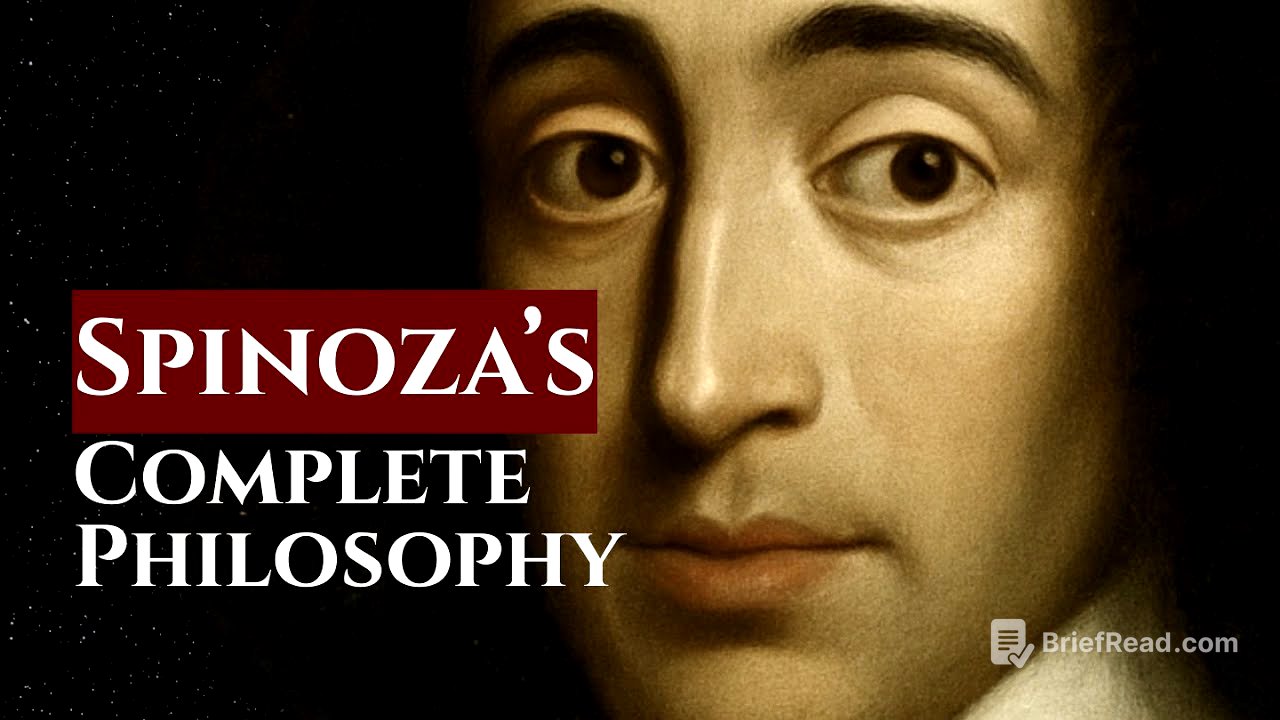
Baruch Spinoza, a radical and revolutionary philosopher, challenged fundamental beliefs about God, nature, freedom, and authority. His unique approach lies in the systematic unity of his vision, where metaphysics, human nature, emotions, ethics, and political philosophy are interconnected. Spinoza's influence extends beyond academia, shaping modern intellectual life, from naturalistic religion to democratic theory.
- Spinoza's revolutionary ideas challenged established beliefs and continue to influence modern thought.
- His systematic approach integrates metaphysics, ethics, and political philosophy.
- Spinoza's work offers a compelling vision of human flourishing through reason and passion.
Intro [0:00]
Baruch Spinoza is introduced as a radical philosopher who challenged established beliefs about God, nature, human freedom, and political authority. His ideas were considered dangerous, leading to his excommunication and the banning of his books. However, beneath this radicalism lies a constructive vision aimed at liberating individuals from superstition and oppression through reason and knowledge. Spinoza's unique contribution is the systematic unity of his vision, where each element supports and illuminates the others, integrating metaphysics, human nature, emotions, ethics, and political philosophy. Understanding any aspect of Spinoza's thought requires grasping its place within the larger whole, as his metaphysics serves as the foundation for a practical philosophy of human liberation.
The Making of a Revolutionary Mind [4:38]
Bento Spinoza's transformation from a Jewish law scholar to a revolutionary philosopher is explored, highlighting his upbringing in Amsterdam's Portuguese Jewish community amidst religious tradition, commercial innovation, and political experimentation. His early education in Hebrew, Latin, and Talmudic interpretation marked him as a potential community leader, but his intellectual curiosity extended to new philosophy and science, including Decart, Hobbes, and Renaissance humanists. This broader engagement created tensions with orthodox religious belief, as new science and philosophy questioned divine intervention, substance, causation, and the divine origin of Jewish law. The crisis culminated in Spinoza's excommunication at age 23 for his heretical ideas, which he welcomed as liberation to pursue philosophical investigations, leading him to settle in Reinsburg, learn lens grinding, and begin developing his systematic philosophy.
The Revolutionary Metaphysics God or Nature [13:57]
Spinoza's philosophical system rests on substance monism, the radical claim that reality consists of one substance, identified as both God and nature. This insight demolishes the medieval and early modern architecture of philosophy, which posited multiple distinct substances. Spinoza argues for substance monism through logical steps, defining substance as existing in itself and conceived through itself, implying that two substances cannot share the same attribute or have causal interaction. The only way to avoid this conclusion is to recognize one substance with infinite attributes and modes, equating God with nature (Deos Sive Natura). This reconceptualization eliminates the distinction between creator and creation, transforming our understanding of divine causation from volunteeristic to geometric necessity, where everything follows from the divine nature with logical necessity.
The Architecture of Reality Attributes and Modes [22:06]
Spinoza explains how the single infinite substance manifests in the diversity of finite things through attributes and modes. Attributes are fundamental ways substance can be conceived, with human cognition accessing only extension (spatial, temporal, mechanical properties) and thought (cognitive, conceptual, rational properties). These attributes are not separate substances but distinct expressions of the same underlying substance, like different languages describing the same reality. Within each attribute, substance expresses itself through infinite modes, ranging from universal principles to particular modifications. Infinite modes are eternal principles governing all manifestations, while finite modes include particular things and events. This framework resolves classical philosophical problems by showing apparent contradictions arise from illegitimate abstractions, though it also generates new puzzles about the distinctness and reality of attributes and modes.
The Unity of Mind and Body Solving the Cartesian Problem [30:32]
Spinoza addresses the persistent problem of the relationship between mind and body, challenging Descartes' dualistic framework. Instead of viewing mind and body as distinct substances, Spinoza posits them as different ways of conceiving the same individual reality. Every individual thing is simultaneously a mode of extension and a mode of thought, a physical body and a mental idea, without being separate entities. This reconceptualization eliminates the mind-body problem by showing it rests on a false premise, as mental and physical phenomena are different attributive expressions of the same substantial reality. There is a thoroughgoing correspondence or parallelism between mental and physical events because they are the same events described in different vocabularies. This solution has profound implications for understanding human nature and knowledge, as the complexity of the mind reflects the complexity of the body, and mental and physical cultivation are inseparable aspects of human flourishing.
The Ladder of Knowledge From Imagination to Intuition [38:59]
Spinoza's analysis of human knowledge distinguishes three kinds of cognition: imagination, reason, and intuition, representing ascending levels of adequacy and power. Imagination, the lowest form, includes confused information from sensory experience and hearsay, characterized by dependence on circumstances and false beliefs. Reason, the intermediate form, proceeds through systematic investigation of universal principles and necessary relationships, focusing on commonalities and logical necessity. Intuition, the highest form, grasps the essential nature of particular individuals in their concrete singularity, combining immediacy with systematic adequacy. The progression from imagination to intuition represents a qualitative transformation of consciousness, increasing the mind's power of thinking and generating characteristic emotional accompaniments and practical consequences.
The Essential Drive Understanding Conatus [47:59]
At the heart of Spinoza's understanding of human nature lies the concept of conatus, the fundamental striving or endeavor that constitutes the essence of every individual thing. This metaphysical principle applies to every finite mode of substance, from physical particles to human institutions. Conatus is the expression of a thing's essential nature under its conditions, not a teleological principle with predetermined goals. In humans, conatus manifests through cognitive, emotional, and practical capacities, involving striving for specifically human fulfillment beyond mere biological needs. When conatus operates through adequate ideas and active emotions, it enhances individual development and social cooperation, generating active affects like joy and love. Conversely, inadequate ideas and passive emotions diminish development, leading to passive affects like sadness and hatred. The ethical task is to redirect conatus toward expressions that enhance rather than diminish our essential nature.
The Emotional Life From Passion to Action [55:49]
Spinoza's analysis of human emotions treats them as natural phenomena understood through the same methods as physical and biological processes. Emotions are specific kinds of thoughts accompanied by an awareness of changes in the body's power of acting. Joy arises from increased capacity, sadness from decreased capacity, and love and hatred from awareness of external sources of these changes. The crucial distinction is between passive affects, caused by external circumstances and reflecting limitations, and active affects, flowing from understanding and creative activity and expressing essential nature. Transformation from passive to active affects requires developing more adequate ideas about ourselves and our environment, leading to emotional wisdom and resilience. This process is both individual and social, requiring communities that support the transition from passive to active forms of life.
Freedom Within Necessity Determinism and Human Agency [1:03:52]
Spinoza's commitment to determinism, the view that everything follows necessarily from prior causes, appears to eliminate human freedom and moral responsibility. However, he argues that understanding necessity provides the foundation for a more adequate conception of freedom. He distinguishes between alien necessity, where actions flow from external causes that constrain our nature, and self-determination, where actions express and develop our essential nature. True freedom lies not in exemption from causal determination, but in being determined by causes that express our own deepest nature. This reconceptualization shifts the focus from blame to education, emphasizing how people can be helped to develop the character and understanding that lead them to act in ways that express their essential nature.
The Art of Living Ethics and Human Flourishing [1:11:17]
Spinoza's ethical philosophy departs from traditional approaches by focusing on what promotes human flourishing rather than external duties or obligations. He argues that self-interest, properly understood, involves concern for the well-being of others and commitment to shared conditions of flourishing. Central virtues enhance our capacity for thinking, action, and relationship, with wisdom integrating these virtues. The highest form of flourishing is achieved through the intellectual love of God, arising from understanding our relationship to existence. This ethics extends to social organization and political arrangement, requiring institutions that support shared commitments to rational and creative life.
The Political Vision Democracy and Human Liberation [1:18:47]
Spinoza's political philosophy defends democratic governance and intellectual freedom, grounding his analysis in what supports rational thought, creative activity, and cooperative relationships. He argues for popular sovereignty, religious tolerance, and rational criticism, viewing political institutions as justified by their success in enhancing collective capacity. Spinoza favors democratic arrangements, believing large deliberative bodies are more rational than elites and emphasizing the transformative potential of democratic participation. Political and intellectual freedom are central, requiring governments to cultivate social conditions where dissent can be expressed and evaluated.
The Critique of Religion and Scripture [1:26:24]
Spinoza's analysis of religion and sacred texts critiques traditional theological authority, applying rational analysis to biblical texts and religious practices. He demonstrates that Hebrew scriptures are human documents with complex histories, compiled by later editors, rather than direct revelations. This historical approach reveals the Bible as a repository of human wisdom, while his analysis of prophecy explains it as a natural psychological phenomenon. Practically, this undermines claims to comprehensive authority, opening space for autonomous rational inquiry and intellectual freedom.
Miracles, Prophecy, and Natural Order [1:33:53]
Spinoza systematically eliminates supernatural phenomena, arguing that miracles and prophecies are either natural events with unknown causes or fictional narratives. He rejects miracles as violations of natural law, which expresses the necessary nature of God or nature itself. Instead, he seeks naturalistic explanations for events interpreted as supernatural, attributing them to limited scientific understanding and psychological needs. Similarly, he treats prophecy as a natural psychological phenomenon involving moral sensitivity and imaginative creativity. This approach promotes intellectual method and social organization, compelling the development of empirical investigation and rational justification.
Social Contract and Natural Right [1:42:01]
Spinoza's political philosophy analyzes the relationship between individual natural right and collective political authority, differing from social contract theories. He argues that political community emerges from the need for cooperation, grounding authority in its success at enhancing members' capacities. Natural right is the power to preserve and enhance one's existence, with political society emerging when individuals recognize cooperation achieves goals better than competition. Legitimacy derives from enhancing collective power, with the best government harnessing diverse talents for shared goals.
Education and the Transformation of Society [1:50:17]
Spinoza's philosophical framework implies that education is a transformation of consciousness, enabling individuals to move from dependence to participation. This extends beyond schooling to encompass social institutions and cultural practices. Education involves developing more adequate ideas, requiring both intellectual development and character formation. Effective education creates environments where students discover principles themselves, with teachers as facilitators. Social dimensions are crucial, with learning communities bringing together diverse individuals.
The Problem of Evil and Suffering [1:58:38]
Spinoza addresses evil and suffering by rejecting absolute moral categories, viewing them relationally as diminishment of human capacities. Evil arises from collisions between finite beings, with the solution lying in understanding and social organization that minimizes harmful conflicts. Suffering arises from the gap between desires and power, with the path to reduction involving understanding, compatible desires, and self-dependent satisfaction. Socially, inadequate institutions generate conflicts, requiring structural reforms.
Eternity and the Mind's Immortality [2:07:15]
Spinoza teaches about the eternity of the mind, suggesting humans can achieve immortality through adequate knowledge. He distinguishes between duration, the temporal sequence of states, and eternity, the timeless relationships defining essential natures. The mind achieves eternity by understanding things under the aspect of eternity, grasping mathematical truths and essential nature. Immortality is achieved through cultivating reason and intuitive knowledge, with those dedicated to understanding developing minds that participate in eternal activity.
The Geometric Method and Philosophical Demonstration [2:15:32]
Spinoza presents his system in geometric form, reflecting convictions about philosophical knowledge and certainty. The method provides rigorous reasoning, eliminates rhetorical appeals, and demonstrates systematic unity. Inspired by mathematical sciences, it generates necessary truths from self-evident principles. It protects philosophical reasoning from distortions by presenting only logical structure. Despite challenges, the geometric method has influenced subsequent philosophy, inspiring rigorous approaches to fundamental questions.
Spinoza's Influence on Later Philosophy [2:23:25]
Spinoza's philosophical system has profoundly influenced subsequent intellectual development, shaping debates in metaphysics, ethics, political theory, and religious thought. Initially suppressed, his ideas gradually found their way into mainstream philosophical discussion. German idealist philosophers drew inspiration from his substance monism, while 19th and 20th-century thinkers found resources in his naturalistic approach to human psychology and social organization. Contemporary philosophy has found new relevance in his work for addressing questions about consciousness, emergence, and the relationship between mental and physical phenomena.
Contemporary Relevance and Modern Applications [2:31:55]
Spinoza's philosophical system continues to offer valuable resources for addressing contemporary challenges. His naturalistic approach to human psychology anticipated insights of modern cognitive science and neuroscience. His analysis of political democracy provides frameworks for participatory governance and collective intelligence. His approach to environmental questions offers alternatives to anthropocentric exploitation and romantic withdrawal. His vision of human flourishing provides a compelling alternative to consumer individualism and fundamentalist collectivism.
The Unity of Spinoza's System Final Integration [2:41:00]
The true genius of Spinoza's achievement lies in the systematic unity that integrates all aspects of his thought into a coherent vision. Every element supports and illuminates the others, creating a conceptual architecture of remarkable stability and explanatory power. This systematic integration embodies Spinoza's conviction that reality itself is fundamentally unified and that genuine understanding requires grasping the connections among apparently disparate phenomena. The metaphysical foundation of substance monism provides the conceptual framework within which all other aspects of Spinoza's system find their proper place and significance.