TLDR;
The Sentinel Network's investigation reveals critical vulnerabilities and unusual patterns across the US defense and aerospace sectors. Key findings include the mysterious deaths or disappearances of individuals linked to a crucial super alloy, confirmation of carbon dioxide as the propulsion method for a space object, a synchronized and accelerated defense space build, and an unprecedented surge in fireball events. These signals, independently verified, highlight significant gaps between initial reporting and institutional acknowledgment, raising concerns about supply chain security, information management, and planetary defense capabilities.
- Deaths/disappearances of key personnel linked to super alloy development.
- Confirmation of carbon dioxide propulsion for space object.
- Accelerated and synchronized defense space build.
- Unprecedented surge in fireball events.
Attrition Series: Deaths and Disappearances [0:46]
The Sentinel Network investigated a series of deaths and disappearances within the US defense aerospace ecosystem, starting on March 9th. The investigation focused on 12 individuals, including material scientists, astrophysicists, plasma physicists, and military officers across five states. A key case was that of retired two-star General Massand, former commander of the Air Force Research Laboratory (AFRL), who vanished on February 27th, leaving behind his phone and other personal items. Massand oversaw a $4.4 billion portfolio. The investigation connected another missing person, Monica Reiza, to General Massand through AFRL contracts dating back to 1999. Reiza co-invented Mandeloy, a super alloy crucial for America's next-generation rocket engines, along with Dallas Hardwick, who later ran AFRL materials research under Masslan's command. The investigation highlighted that all three individuals linked to the alloy were either dead or missing. The Sentinel Network compiled a full roster of the 12 individuals and exposed forensic gaps in the Monica Raza case, documenting digital forensics. They also added a 12th name, a Lockheed Martin vice president who died Memorial Day 2018.
FBI Request and International Attention [2:30]
Following the Sentinel Network's investigation, Representative Burlesan filed a formal FBI request on March 30th. The issue gained international attention when Chairman Hamada opened the UAP Parliamentary Federation's fourth general meeting in the Japanese diet on March 31st, presenting six attrition names on a slide, noting that three were dead and three had vanished. Former Prime Minister Ishiba was present at the meeting. The investigation gained traction due to its solid documentary evidence, with every claim traceable to patents, press releases, court filings, or obituaries. The fact that a foreign parliament used this information to open a national security session underscores the severity of the issue, framing it as a supply chain vulnerability with a body count rather than a mere human interest story.
Carbon Dioxide Propulsion Thesis [3:18]
Between January and March, The Sentinel Network published four briefings identifying carbon dioxide as the primary thrust medium for threei Atlas, predating the European Space Agency's (ESA) Juice results. Scientists tested three thrust scenarios against the rocket equation, finding that the water model required a surface area larger than the object itself, while the carbon dioxide model worked effectively. JWST pixel maps revealed five chemicals venting in multiple directions simultaneously, with carbon dioxide and methane concentrated anti-sunward, aligning with the direction of travel. This directional exhaust confirmed carbon dioxide as the driving medium. Spectral data measured the exhaust velocity at 0.37 km/s, which is half of what comets typically produce at similar activity levels, and the velocity was asymmetric, faster sunward and slower anti-sunward, indicating a breaking profile.
ESA Confirmation and Information Management [4:39]
On April 2nd, the European Space Agency (ESA) published Juice results confirming carbon dioxide from orbit at the closest approach to the sun, but only gave it a brief mention in a caption. The PEP particle detector data, which included 12 days of continuous data inside the 400,000 km interaction surface, was omitted and replaced with a navigation camera. The Sentinel Network emphasizes that this is not mere editing but deliberate information management. By the time ESA confirmed the presence of carbon dioxide, Sentinel Network readers already had access to the relevant math, maps, and breaking signature, while mainstream media focused on less significant details.
Space Force Mobilization Audit [5:36]
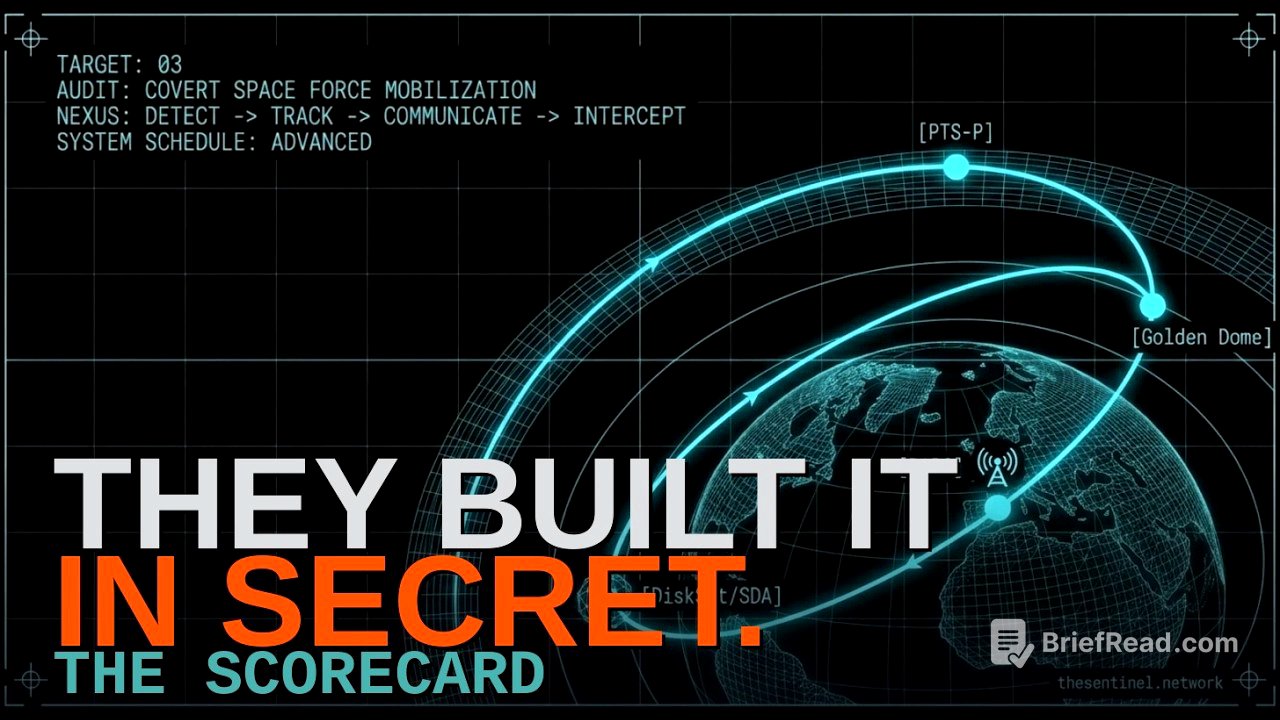
On February 28th, The Sentinel Network documented a synchronized $30 billion+ defense space build, identifying the programs, performers, and concept: detect, track, communicate, intercept. Rocket Lab launched four disk sat spacecraft five months ahead of schedule, aligning with the three eyes approach window. Sierra Space delivered tracking satellite structures three months early, and Northre Grumman delivered anti-jam prototypes. The Secretary of Defense completed a three-week supply chain tour at Sierra Space, directing the release of government files on alien life, UAP, and unidentified flying objects. Contract data validated the analysis, revealing that Dark site one completed three months early, and a second site involved half a billion in deep space radar across two allied nations, structured to avoid congressional reporting. The simultaneous acceleration of these separate programs and contractors indicates pressure from above, rather than standard project management.
Fireball Pattern [6:58]
On March 22nd, The Sentinel Network reported on a pattern of 11 fireball events across four continents within 20 days, including three meteorite falls, three structures struck, and two daylight detonations over American cities, all without advance warning. The network compiled the full timeline, including the Ohio air burst (a 7-ton object with 250 tons of TNT equivalent, codenamed "chicken little" by NASA) and the Houston strike (a meteorite through a woman's ceiling). An audit of the NASA fireball database showed no link to threei Atlas.
Institutional Response and Confirmation [7:43]
Three days after the Sentinel Network's report, the American Meteor Society published their statistical analysis, noting that the first quarter saw more than double the baseline, with a peak in March instead of February, and nearly 80% of large fireballs produced sonic booms, describing the situation as "unprecedented." NASA published a blog post attributing the increase to seasonal effects, but the data contradicted this explanation. NASA's acting planetary defense officer admitted that the current detection infrastructure would have provided very little time, if any, for warning before the Houston strike. This sequence demonstrates independent publication, institutional confirmation, institutional deflection, and institutional admission within a three-day period.
Assessment and Conclusion [8:37]
The Sentinel Network's assessment highlights four independent signals across four domains. In each case, the publication produced a forensic analysis before the relevant institutions caught up, with deltas ranging from three days to three months. This includes a patent chain reaching the Japanese diet, an exhaust profile confirmed from orbit, a defense architecture confirmed to the dollar, and a fireball pattern confirmed by the body that tracks them. The key takeaway is the gap between initial reporting and institutional acknowledgment.