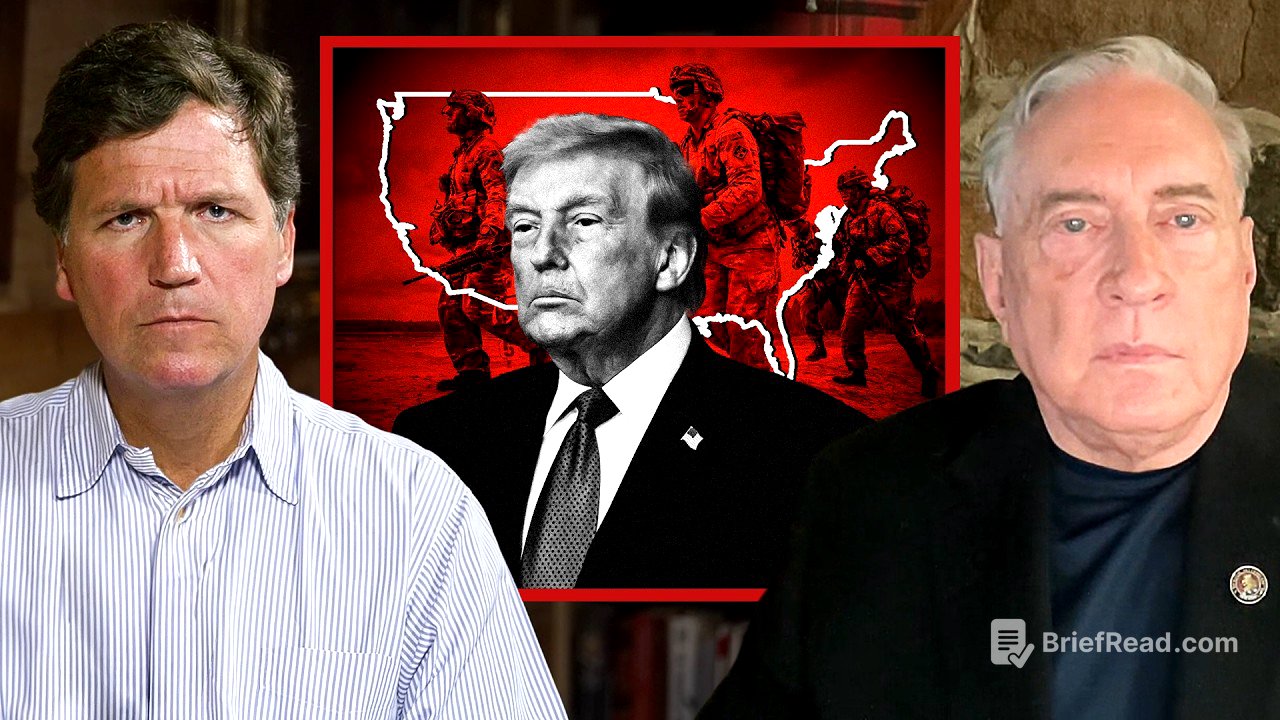
TLDR;
This video features a discussion on the likelihood of the U.S. committing ground troops, the state of the military, and potential nuclear weapon usage. It also addresses the role of political influence and lobbying, the possibility of resignations in protest within the government, and the potential for structural changes in the country due to governmental overreach and corruption.
- The U.S. military is not as strong as it once was, and rebuilding it takes considerable time and resources.
- The use of nuclear weapons is more likely to originate from Israel than the U.S., particularly if Iran does not submit to certain demands.
- The current political system is influenced by powerful lobbyists and financial interests, making it difficult for officials to act against these interests.
- Government intrusion and corruption are significant problems, potentially leading to financial disaster and the need for structural changes in the country.
Likelihood of US Committing Ground Troops [0:00]
The speaker assesses the likelihood of the U.S. deploying ground troops as zero, questioning the pretense maintained around this possibility. He argues that the U.S. Army is not as strong as it was 30 years ago, dismissing claims of a rebuilt military. Building a capable army takes about 10 years, while a navy takes over 20 years due to the time, resources, and training required. He also suggests that civilians often underestimate what it takes to build effective military power.
The Draft and Modern Warfare [1:15]
The speaker expresses a private desire for a selective draft, believing that young men with an IQ of 100 or above and who are physically fit should spend a couple of years in the military. However, he acknowledges that this idea is not widely accepted in the U.S. He also notes that ending the draft during the Vietnam War led to a decline in anti-war demonstrations. Modern warfare has changed dramatically due to persistent surveillance and targeting capabilities, making it difficult to concentrate large numbers of troops without facing ballistic missile attacks. Current air and missile defense systems are inadequate against modern hypersonic missiles.
Potential Use of Nuclear Weapons [3:16]
The speaker believes that if a nuclear weapon is used, it will likely be by Netanyahu's government in Israel, not by the U.S. He does not believe President Trump would be convinced to use nuclear weapons by Netanyahu. He suggests that the military establishment would question the timing and reasons for using nuclear weapons. Nuclear weapons are increasingly viewed as a means to protect territorial integrity, and while the U.S. would use them to defend against invasion, the situation with Iran is different. The more desperate Israel becomes if Iran does not submit, the more likely they are to consider using nuclear weapons.
Political Influence and Preventing Nuclear Use [5:02]
The speaker discusses the difficulty of preventing Netanyahu from taking action, given the influence of Zionist billionaires who pour money into the political process. He questions whether anyone will confront Trump and acknowledge that the situation has gone too far. He notes that military advisors understood the goals in question were unachievable, but none threatened to resign.
Resignations in Protest [6:23]
The speaker observes that resignations in protest are rare in the military. He mentions General Decker, who was removed from his position as chief of staff of the army because he didn't support the policy in Southeast Asia. While officers theoretically have the right to refuse orders based on conscience, resigning in protest results in the loss of retirement benefits and pensions. Cabinet members have more flexibility to resign, but it is unlikely they will do so. There is a fear of poisoning future career prospects by resigning in protest.
Escalation and Potential Consequences [8:55]
The speaker predicts that without a change in course, the situation will escalate, leading to increased bombing and missile strikes. Eventually, the consequences will become clear, either due to reactions from Russia and China or due to economic catastrophe within the U.S. This could lead to widespread resignations.
Systemic Problems and the Need for Change [10:07]
The speaker describes a system that does not serve the country and has been revealed as useless. He anticipates structural changes to the country after the current conflict. The federal government is a significant part of people's lives, accounting for over 30% of the gross domestic product. Corruption in Washington is a long-standing problem, with government officials often focused on financial opportunities. The speaker likens these officials to parasites on the body of a shark. He believes that when the financial system and economy suffer, the American people will demand answers, and the current path is leading to disaster. The speaker concludes that the U.S. was dragged into the current situation by a foreign government, possibly with the aim of weakening the United States.