TLDR;
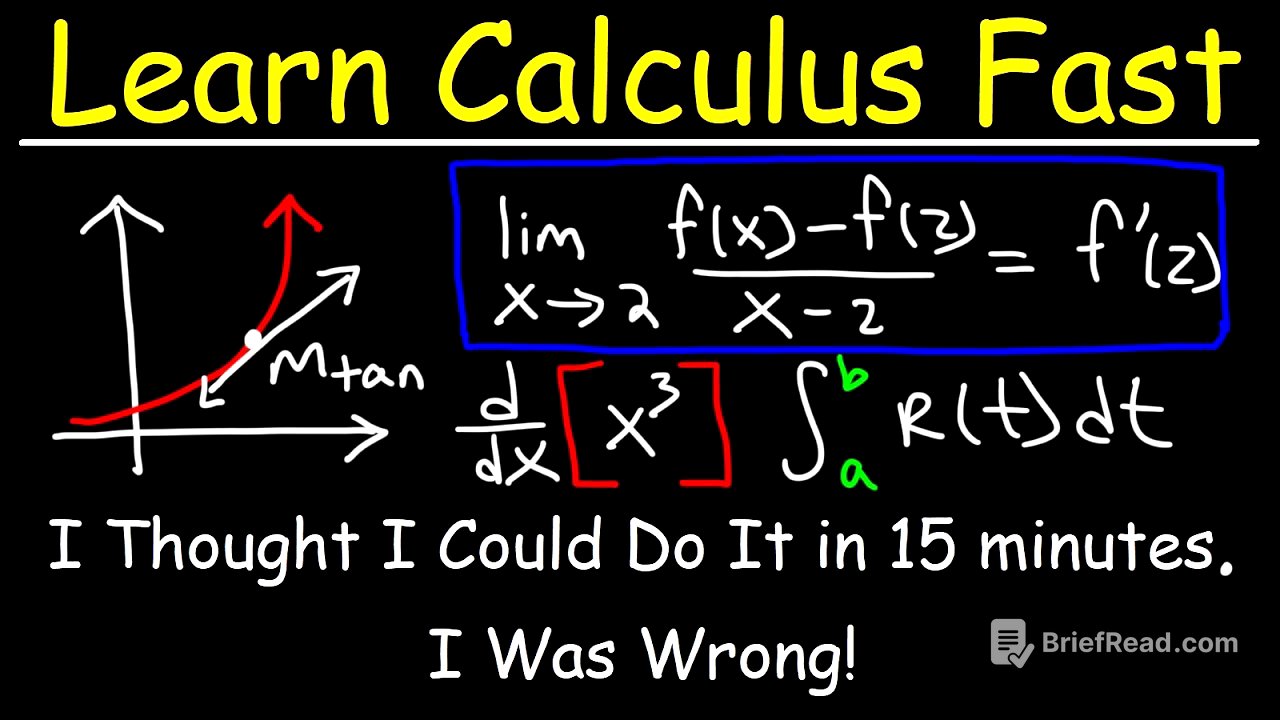
This video provides a concise overview of the fundamental concepts in calculus: limits, derivatives, and integration. It explains how limits help evaluate functions as x approaches a certain value, derivatives provide the slope of a function at a given point (instantaneous rate of change), and integration calculates the accumulation of a quantity over time (area under the curve). The video also demonstrates the relationship between derivatives and integration as inverse processes.
- Limits: Evaluating functions as x approaches a value.
- Derivatives: Finding the slope of a function (instantaneous rate of change).
- Integration: Calculating accumulation over time (area under the curve).
Introduction to Calculus [0:01]
The video introduces the three core concepts of calculus: limits, derivatives, and integration. Limits help evaluate functions when direct evaluation is not possible, by examining the function's behavior as x approaches a specific value. Derivatives are functions that determine the slope of an original function at any given point, indicating the rate of change. Integration, the opposite of differentiation, calculates the area under a curve, representing the accumulation of a quantity over time.
Limits Explained [1:21]
Limits are useful when a function is undefined at a particular point. For example, the function f(x) = (x^2 - 4) / (x - 2) is indeterminate at x = 2. By using limits, we can observe the function's behavior as x approaches 2. As x gets closer to 2 (e.g., 2.1, 2.01), f(x) approaches 4. The limit as x approaches 2 for this function is found by factoring and canceling terms, resulting in lim (x→2) (x + 2) = 4.
Derivatives and the Power Rule [5:49]
Derivatives are functions that give the slope of a tangent line to a curve at a specific point. The power rule, d/dx(x^n) = nx^(n-1), is a fundamental tool for finding derivatives. For instance, the derivative of x^2 is 2x, of x^3 is 3x^2, and of x^4 is 4x^3. A tangent line touches a curve at one point, while a secant line intersects at two points. The slope of the tangent line at a point is the derivative of the function at that point.
Tangent vs Secant Lines [7:11]
The slope of a tangent line represents the instantaneous rate of change of a function at a single point, while the slope of a secant line represents the average rate of change between two points. Using the example f(x) = x^3, the derivative f'(x) = 3x^2. At x = 2, the slope of the tangent line is f'(2) = 12, meaning for every one unit increase in x, the curve increases by 12 units in the y-direction.
Estimating Slope with Secant Lines and Limits [8:44]
The slope of the tangent line can be approximated by the slope of the secant line as the two points on the secant line get closer to the point of tangency. For f(x) = x^3, the slope of the secant line between x = 1 and x = 3 is 13, which is close to the tangent line's slope at x = 2 (which is 12). Using limits, the slope of the tangent line can be found by evaluating lim (x→2) (f(x) - f(2)) / (x - 2), which simplifies to lim (x→2) (x^3 - 8) / (x - 2). Factoring x^3 - 8 using the difference of cubes formula and canceling terms yields a limit expression that evaluates to 12.
Integration as Anti-Differentiation [14:35]
Integration is the reverse process of differentiation, also known as anti-differentiation. If the derivative of x^4 is 4x^3, then the integral of 4x^3 should be x^4. The power rule for integration is ∫x^n dx = (x^(n+1)) / (n+1) + C, where C is the constant of integration. For example, ∫4x^3 dx = x^4 + C.
Derivatives vs Integrals [17:22]
Derivatives provide the slope of the tangent line and the instantaneous rate of change, while integration determines the accumulation of a quantity over time and the area under a curve. Differentiation involves dividing y-values by x-values (slope = y/x), whereas integration involves multiplying y-values by x-values (area = y * x).
Application of Derivatives: Rate of Change [18:22]
Given a function A(t) = 0.01t^2 + 0.5t + 100 representing the amount of water in a tank at time t, the rate of change of water in the tank is found by taking the derivative A'(t) = 0.02t + 0.5. At t = 10 minutes, the rate of change is A'(10) = 0.7 gallons per minute. This result can be verified by approximating the instantaneous rate of change with the average rate of change (slope of the secant line) between t = 9 and t = 11, which also yields approximately 0.7 gallons per minute.
Application of Integrals: Accumulation [26:05]
Given a function R(t) = 0.5t + 20 representing the rate of water flowing into a tank, the amount of water accumulated between t = 20 and t = 100 minutes is found by evaluating the definite integral ∫[20 to 100] (0.5t + 20) dt. The anti-derivative is 0.25t^2 + 20t, and evaluating this from 20 to 100 gives a net change of 4000 gallons. This can also be visualized as the area under the curve of R(t) from t = 20 to t = 100, which can be calculated geometrically by dividing the area into a rectangle and a triangle, yielding the same result of 4000 gallons.
Conclusion [33:20]
The video concludes by summarizing the core concepts: limits, derivatives, and integration. Limits help evaluate functions as x approaches a value, derivatives calculate instantaneous rates of change (slope of the tangent line), and integration determines the accumulation of quantities over time (area under the curve). The video encourages viewers to practice with additional problems and explore the channel's calculus playlist for more specific topics.