TLDR;
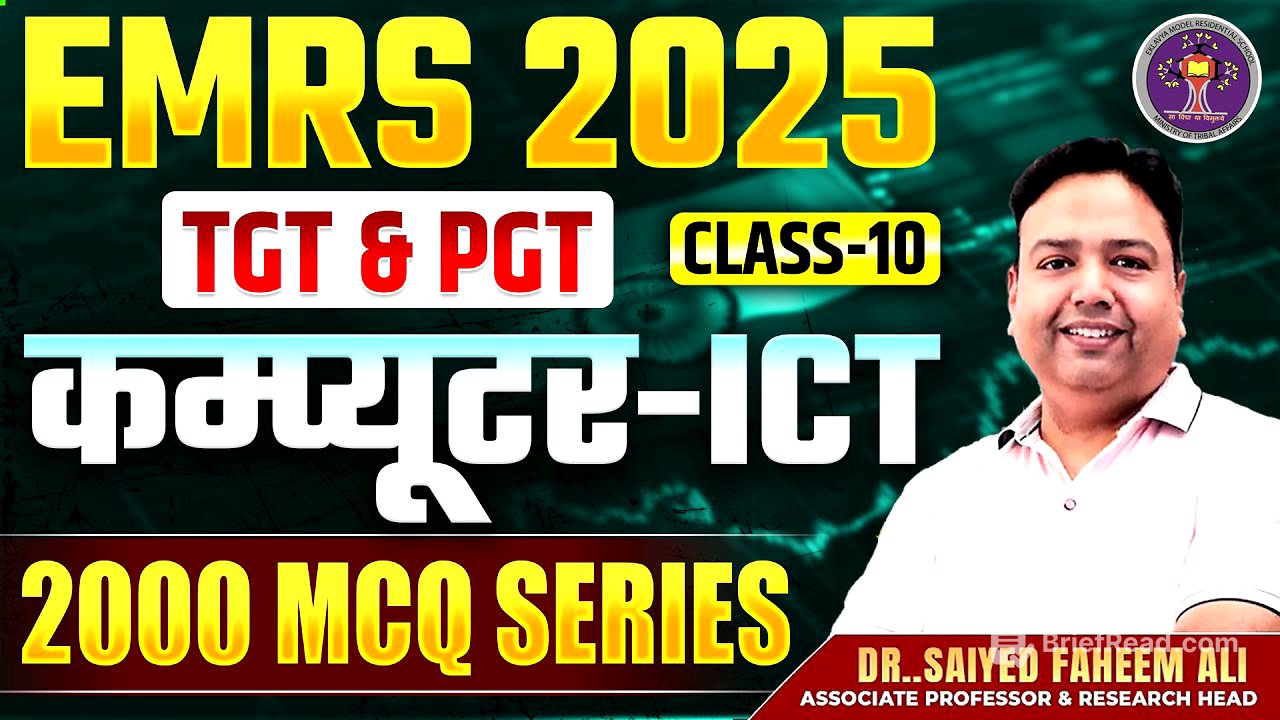
This video provides an overview of the EMRS exam dates, the importance of ICT in the exam, and a series of ICT-related questions with detailed explanations. It also highlights resources available on the Teachers Adda By TARGET ABHI channel for exam preparation.
- EMRS exam dates announced for December.
- ICT is a crucial topic for all EMRS exams.
- Free classes available on Teachers Adda By TARGET ABHI for various subjects.
Introduction and Exam Dates [0:00]
The speaker welcomes viewers and announces the official EMRS exam dates for Tier 1, which are scheduled in December. The specific dates are the 13th, 14th, and 21st of December. With approximately two months remaining, the speaker emphasises the need to focus on Tier 1 preparation, particularly on Information Communication Technology (ICT), which carries 15 marks in the TGT exam. The channel also offers free classes for general awareness, reasoning ability, and teaching aptitude to aid in exam preparation.
System Tools and Utility Software [2:20]
The discussion begins with the question of identifying which of the given options is not a system tool. System tools are essentially utility software that perform tasks such as backup, disk defragmentation, and disk scanning. While virus scanning is a utility, it's considered a third-party function, unlike the other system tools that are integral to computer maintenance.
Radio Button Functionality [4:10]
The function of a radio button is explored, contrasting it with a check box. Radio buttons are used to select a single option from a list of multiple choices, such as choosing a gender (male or female), where selecting one option automatically deselects the others.
Excel and Numeric Values [5:49]
In Excel, numeric values by default appear with right alignment within a cell. While this alignment can be changed, the default setting is to the right. In contrast, alphabetical values align to the left by default.
Computer Viruses and How to Avoid Them [8:23]
A computer virus is defined as a program that causes malfunction. Viruses can be transmitted through downloading files, email attachments, and infected pen drives. However, typing on the keyboard is not a way to get a computer virus.
Email Content Description [10:40]
When sending an email, the subject line describes the content of the message, allowing the recipient to understand the email's purpose quickly. The speaker also asks the audience to comment on how many times the selection will be this time.
Interpreters and Programming Languages [13:06]
An interpreter is a language translator, similar to an assembler and a compiler. These are related to programming languages, facilitating the conversion of code into a readable format.
Audit Trails and Computer Security [14:15]
A computer file that records both successful and unsuccessful access attempts is called an audit trail. This file tracks details such as incorrect credentials entered multiple times, which can lead to account lockout.
Memory Units in Descending Order [15:59]
Arranging memory units in descending order, the correct sequence is TB (Terabyte), GB (Gigabyte), MB (Megabyte), and KB (Kilobyte). Memory units are a common topic in exams.
Classification of Computer Generations [17:12]
Computer generations are classified based on the devices used in memory and processors. The evolution includes vacuum tubes, transistors, integrated circuits (ICs), large-scale integrated circuits, and very large-scale integrated circuits (VLSIC).
Increasing Computer Security [18:42]
Computer security can be increased by using anti-virus software, firewalls, and strong passwords. All these methods contribute to a more secure system.
EMRS Exam Information and Resources [20:04]
The speaker reiterates the importance of the EMRS exam dates and promotes the resources available on the Teachers Adda By TARGET ABHI platform. A live batch for Tier 1 preparation has already started, and a special fee is available for the first 100 students.
Active Cell Content in Excel [21:22]
The content of an active cell in Excel is displayed in the formula bar. This bar shows either the formula used in the cell or the content itself.
Infrared Waves and Their Uses [23:19]
Infrared (IR) waves are used for indoor Local Area Networks (LANs). This wireless technology, predating Bluetooth and Wi-Fi, is commonly found in devices like TV remotes.
Client Computers in Client-Server Systems [24:30]
In client-server systems, client computers are typically microcomputers. These are the basic computers used to access services from a server.
Saving Files for the First Time [26:49]
When a file is saved for the first time, it must be given a name to identify it. This name helps in recognising and accessing the file later.
Primary vs. Secondary Storage [29:06]
Primary storage is faster and more expensive compared to secondary storage. This is because primary storage, like RAM, needs to provide quick access, making it costlier.
Identifying the Odd Group [30:41]
Among compact disc, digital versatile disc, floppy disc, and hard disc, the hard disc is the odd one out because it is fixed, while the others are removable.
Bytes in a Petabyte [33:04]
There are 2 to the power of 50 bytes in a petabyte. The speaker explains how to arrive at this answer through understanding the powers of 2.
Sending Computer Signals Between Different Networks [35:43]
A gateway is used to send computer signals between networks of different environments, such as Windows, Linux, and Mac. It facilitates communication despite the different systems.
International Encoding Standards [38:10]
Unicode is the international encoding standard used with different languages and scripts, enabling the exchange of information across various linguistic systems.
Chronological Order of Storage Devices [39:18]
The correct chronological order of the development of storage devices is magnetic core, magnetic drum, magnetic tape, and magnetic disc.
Data Structure and Format [41:02]
The term that refers to the structure and format of data is syntax, which defines the way data is organised and presented.
Nodes in a Network [42:13]
Nodes are independent units in a network, such as computers, printers, and scanners. These devices are connected and can communicate with each other.
Star Topology [44:25]
Star topology is used in Local Area Networks (LANs). In this setup, all nodes are connected to a central computer.
Firewalls in Computer Networks [45:18]
A firewall in a computer network is a system designed to prevent unauthorised access. It can be implemented as hardware or software.
Full Form of IoT [46:36]
The full form of IoT is Internet of Things, which refers to the network of physical objects ("things") embedded with sensors, software, and other technologies for the purpose of connecting and exchanging data with other devices and systems over the Internet.
Conclusion and Additional Resources [48:14]
The speaker concludes by emphasising the importance of ICT in various exams and encourages viewers to utilise the resources available on the Teachers Adda By TARGET ABHI platform. He also provides information about the combined Tier 1 and Tier 2 batch for Library Science and shares contact details for further assistance.