TLDR;
This video explains three key periodic table trends: atomic radius, ionization energy, and electronegativity. It details how atomic radius increases down a group (due to more electron shells) and decreases across a period (due to increasing nuclear charge). Ionization energy, the energy to remove an electron, increases across a period and decreases down a group, correlating with atomic size and electron shielding. Electronegativity, an atom's attraction to electrons, increases across a period and decreases down a group, influenced by atomic size and the desire to achieve a stable electron configuration.
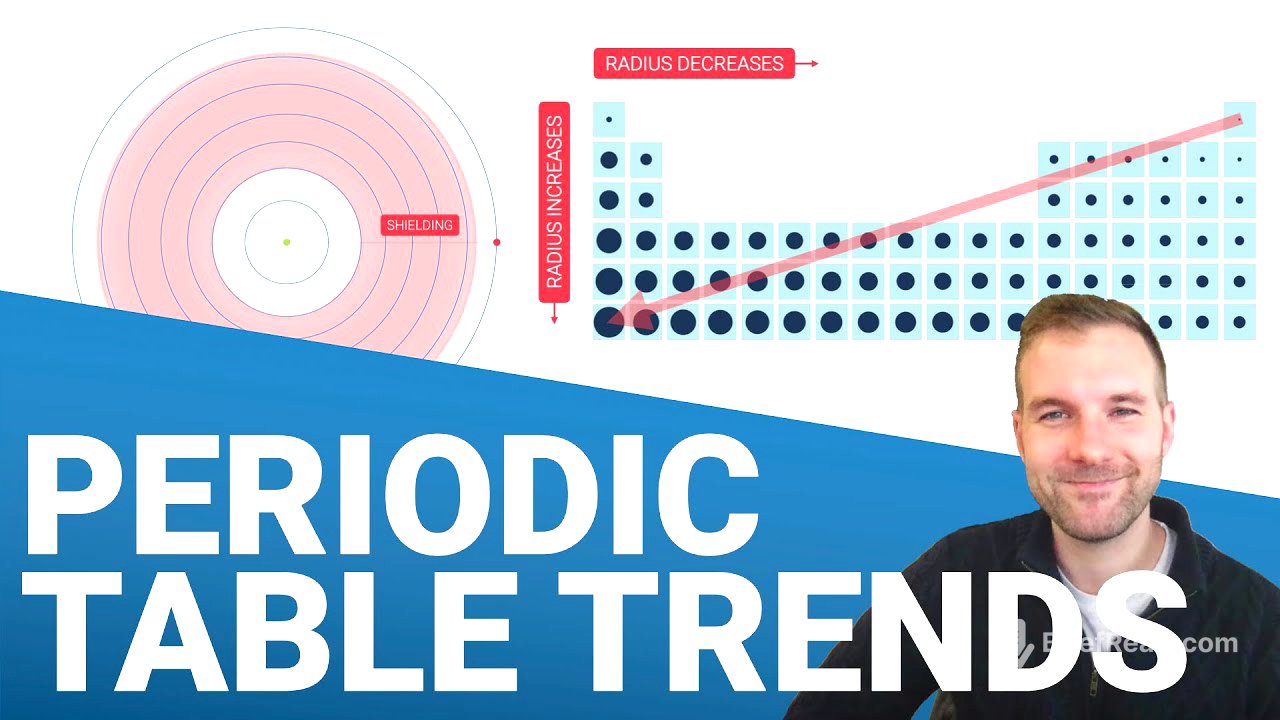
- Atomic radius increases down a group and decreases across a period.
- Ionization energy increases across a period and decreases down a group.
- Electronegativity increases across a period and decreases down a group.
Introduction to Periodic Table Trends [0:03]
The video introduces the concept of trends in the periodic table, defining a trend as a pattern observed in element properties either down a group or across a period. The video will cover three specific properties: atomic radius, ionization energy, and electronegativity. These properties exhibit predictable patterns that can be understood by examining the arrangement of elements in the periodic table.
Atomic Radius: Size of Atoms [0:28]
Atomic radius is defined as the size of an atom, specifically the distance from the nucleus to the outermost electron. As you move down Group 1 (hydrogen to cesium), the number of electron shells increases, leading to a larger atomic radius. This is because each element adds more electrons, requiring additional electron shells to accommodate them. The increasing number of electron shells directly contributes to the larger size of the atom.
Atomic Radius Trends Across the Periodic Table [1:50]
While atomic radius increases down a group, it decreases from left to right across a period. Although electrons are added across a period, the increasing number of protons in the nucleus results in a stronger attraction to the electrons. This greater nuclear charge pulls the electron cloud closer to the nucleus, causing the atomic radius to decrease. For example, in period 2, lithium is the largest atom, while neon is the smallest due to this effect.
Ionization Energy: Removing Electrons [3:24]
Ionization energy is the amount of energy required to remove an electron from an atom. A low ionization energy indicates that it is easy to remove an electron, while a high ionization energy means it is difficult. Smaller atoms have higher ionization energies because their valence electrons are closer to the nucleus and more tightly held. Larger atoms have lower ionization energies because their valence electrons are farther from the nucleus and shielded by inner electrons, making them easier to remove.
Ionization Energy Trends [5:26]
Ionization energy increases from left to right across a period because the atomic size decreases, making it harder to remove electrons. Conversely, ionization energy decreases from top to bottom within a group because the atomic size increases, making it easier to remove electrons. The trend in ionization energy is directly related to the size of the atom; larger atoms have lower ionization energies, and smaller atoms have higher ionization energies.
Electronegativity: Atom's Attraction to Electrons [5:58]
Electronegativity measures how strongly an atom attracts electrons in a chemical bond, rated on a scale from 0 to 4. Fluorine, with a value close to 4, has the highest electronegativity, meaning it strongly attracts electrons. Elements on the left side of the periodic table, like lithium, have low electronegativity values, indicating they do not strongly attract electrons and prefer to lose them.
Electronegativity Trends and Atomic Size [7:55]
Electronegativity increases from left to right across a period because atoms are closer to achieving a full valence shell and have a stronger pull on electrons. Electronegativity decreases from top to bottom within a group because the valence electrons are farther from the nucleus in larger atoms, reducing their attraction to neighboring electrons. Although larger atoms still want to gain electrons to achieve a stable configuration, their ability to attract them is diminished due to their size.
Conclusion: Understanding the Trends [8:56]
The video concludes by emphasizing the importance of understanding why these trends exist, rather than just memorizing them. The trends in atomic radius, ionization energy, and electronegativity are all related to the size of the atom and the distance between the nucleus and the valence electrons. Understanding these fundamental relationships provides a deeper insight into the behavior of elements in the periodic table.