TLDR;
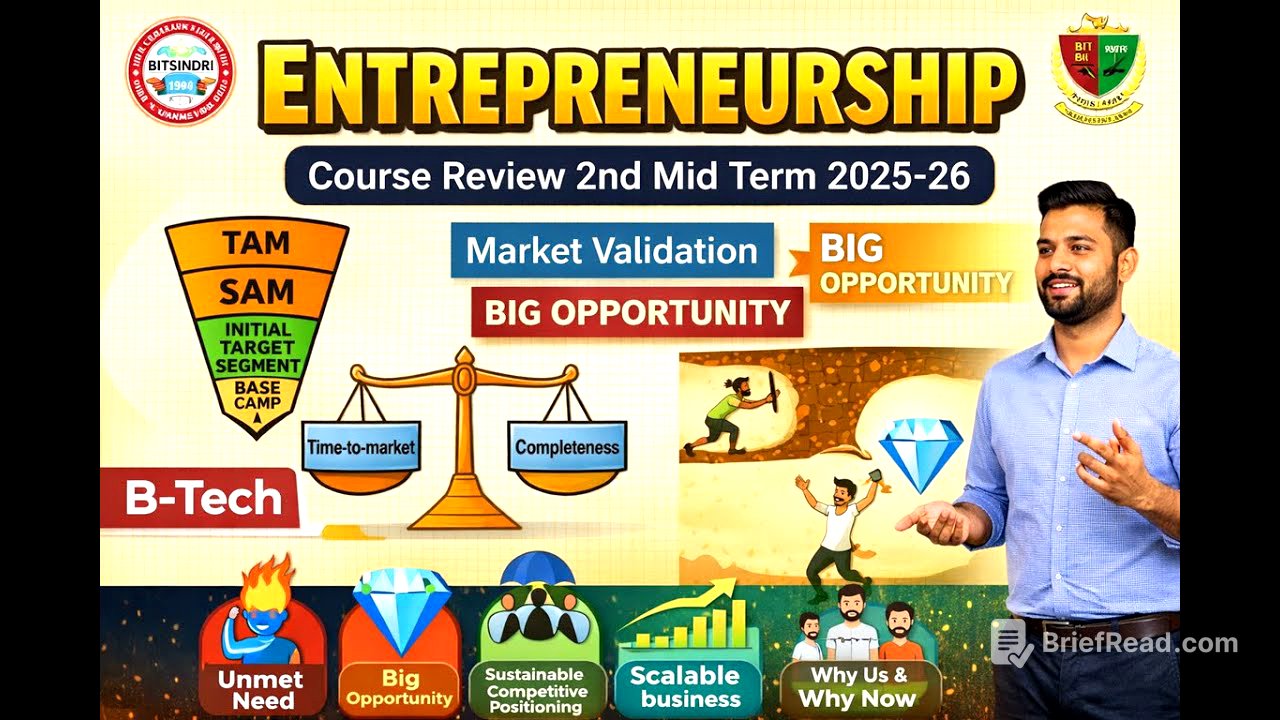
This video is a review of key concepts for a second midterm, focusing on filters for market validation, essential elements for a successful business, and the Business Model Canvas (BMC). It also covers legal aspects of startups, exponential growth, and a real-world example of an entrepreneur's journey.
- Market validation filters: unmet need, big opportunity, sustainable comparative positioning, scalable business, and "why us, why now."
- Importance of time to market and product completeness.
- Key components of the Business Model Canvas and their significance.
- Legal considerations for startups, including debt instruments and partnership types.
- Exponential growth is fueled by convergence of technologies and data analysis speed.
Time to Market and Completeness [0:38]
Time to market refers to the speed at which a product is launched, while completeness relates to the thoroughness of the product design. A minimum viable product (MVP) balances these two aspects. Delaying market entry can lead to competitive disadvantage, as competitors may capture the market first.
Market Validation Filters: Unmet Need [3:23]
The first filter for market validation is identifying an unmet need. This involves understanding the target market segment and who specifically needs the product. Testing the product to ensure it meets this need is crucial.
Market Validation Filters: Big Opportunity [5:25]
A big opportunity requires assessing the market size, including the total available market (TAM), serviceable addressable market (SAM), and target market (TM). Startups should focus on an initial target market, often starting locally. Data sources like economic reports and proxy modeling can help determine market size.
TAM, SAM, and Target Market [10:12]
The total available market (TAM) represents the entire market demand for a product or service. The serviceable addressable market (SAM) is the portion of TAM that a company can realistically reach. The target market (TM) is the specific segment the company aims to serve initially. Focusing on a smaller, initial target market is crucial for startups to avoid spreading resources too thin.
Market Validation Filters: Sustainable Comparative Positioning [16:11]
Sustainable comparative positioning involves creating a defensible advantage over competitors. This can be achieved through patents, unique services, or proprietary processes. Being different and offering unique value is essential, even if cheaper alternatives exist.
Market Validation Filters: Scalable Business Model [18:33]
A scalable business model allows for growth without a proportional increase in costs. This involves efficient processes, well-trained employees, and high product quality, leading to lower costs and greater profitability. Scalability also means adapting to different customer segments and evolving market needs.
Market Validation Filters: Why Us, Why Now [21:03]
"Why us" focuses on the team's unique knowledge, domain expertise, and customer validation. "Why now" emphasizes the importance of timing, considering exponential growth and the convergence of technologies. The future is evolving faster than anticipated, necessitating quick adaptation.
Exponential Growth [22:22]
Exponential growth is accelerating due to the convergence of technologies and the rapid pace of data analysis. Companies like Nvidia, with their advanced GPUs, play a significant role in processing vast amounts of data quickly, fueling this growth.
Business Model Canvas (BMC) [26:06]
The Business Model Canvas (BMC) includes nine key components: value proposition, customer segments, channels, customer relationships, key resources, key activities, key partnerships, cost structure, and revenue streams. The value proposition identifies customer unmet needs and provides solutions. Customer segments define the target audience. Channels outline how the product reaches customers. Customer relationships focus on maintaining customer satisfaction and repeat orders.
BMC: Key Resources, Activities, Partnerships, Cost, and Revenue [30:32]
Key resources are the assets required to deliver the value proposition. Key activities are the essential actions needed to operate the business. Key partnerships involve collaborations with other businesses or consultants. The cost structure details all expenses, including customer acquisition costs. Revenue streams identify the sources of income, such as asset sales or recurring licensing fees.
Importance of Fundamentals [36:47]
Understanding the first five market validation filters, TAM, SAM, target market, team building, and the Business Model Canvas are fundamental for any startup.
Entrepreneur Story: Punjar Renewable [37:27]
Aditi Kumar, founder of Punjar Renewable, initially aimed to help his village by converting bicycles to electric vehicles. He later shifted to solar installation, focusing on a niche market between 50 kilowatts and lower, which was underserved in Bihar and Tarkan. He expanded into maintenance services and eventually pivoted to manufacturing solar appliances after facing increased competition.
Legal Aspects: Debt Instruments and Startup Definition [44:56]
Debt instruments are tools to raise capital, requiring specific contracts with binding obligations and defined responsibilities. The Indian government defines a startup as a company that is no more than 10 years old with an annual turnover not exceeding ₹100 crore. This status provides certain benefits but is temporary.
Types of Partnerships [48:47]
General partnerships provide unlimited liability to partners, while limited liability partnerships offer protection up to a defined limit.
Q&A: High Debt, Startup License, and Unfair Advantage [52:36]
High debt affects cash flow and decision-making in early-stage startups, requiring careful financial planning. In India, a startup license is needed to avail of startup advantages, which expire after 10 years. The term "unfair advantage" is debated, with "competitive advantage" being a preferred term, referring to unique assets like patents.
Q&A: Determining a Profitable Business and Finding Funding [1:00:01]
To determine if an idea can become a profitable business, validate the unmet need with customers and ensure the product is scalable. The easiest initial funding comes from friends and relatives. Investors want to see a working prototype.
Q&A: Factors That Can Kill a Company and the Role of Morale [1:04:18]
Factors that can kill a company include running out of money, poor time to market, and team issues. Morale is crucial; a passionate team with a "can-do" attitude is essential for proving hypotheses and achieving success.
Q&A: Avoiding Perfectionism and the Importance of Repeatability [1:13:04]
Avoid being a "me-too" company and focus on providing a product that customers need. Repeatability is vital for scalability and manufacturability. A product must meet specifications consistently across multiple locations.
Q&A: Serial Entrepreneurs and Managing Risk [1:27:26]
Serial entrepreneurs gain real-time experience, learning from each startup. To manage risk, founders must foster strong team relationships, ensuring passion and capability.
Q&A: Entrepreneurship's Contribution to Economic Growth and Lowering Coordination Costs [1:35:16]
Entrepreneurship contributes significantly to economic growth and employment generation. To lower coordination costs, team members often work without pay initially, contributing their time and technology.
Q&A: Execution vs. Ideas and Learning from Failure [1:38:01]
Execution matters, but it must be the right thing being executed. Focus on doing the right things rather than just doing things right. Failure is a learning opportunity; analyze the reasons for losses and pivot when necessary.
Final Comments: The Garage Analogy and Gratitude [1:45:25]
Many successful companies start in a garage, symbolizing the spirit of innovation and storytelling. The session concludes with gratitude to Professor Mahmud Alam for his support and encouragement to the attendees.