TLDR;
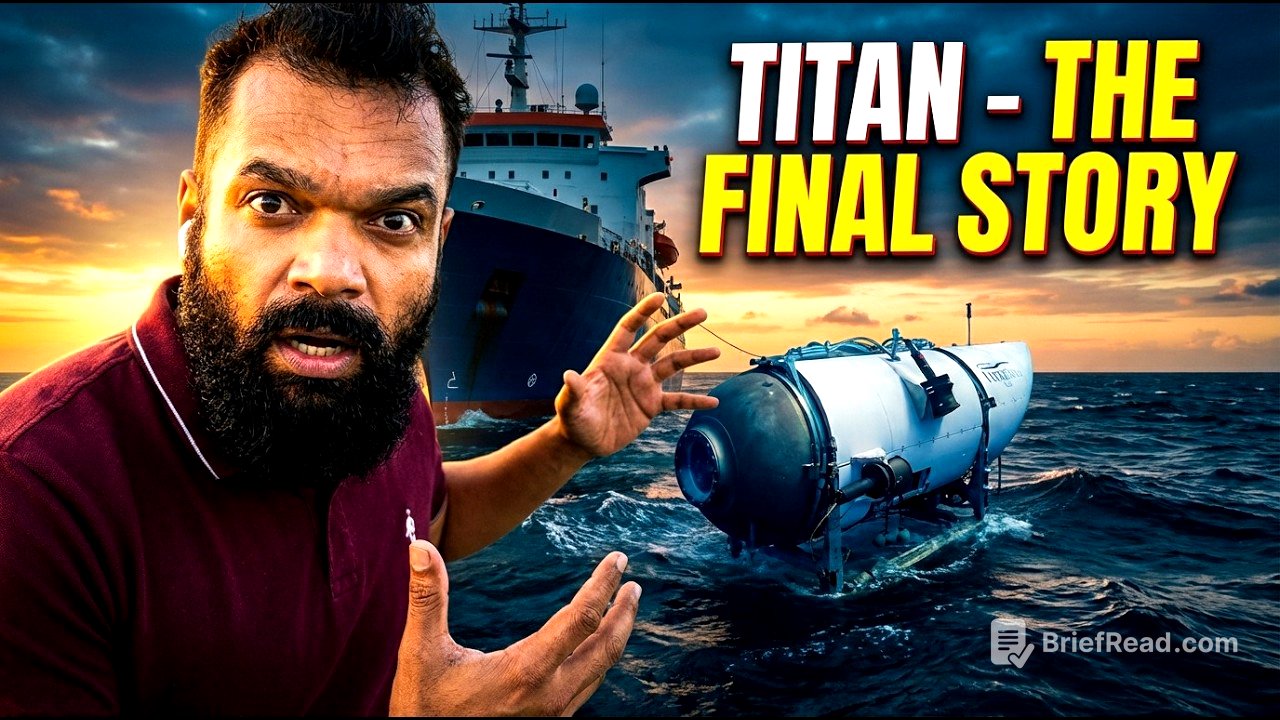
This video summarizes the tragic implosion of the Titan submersible during its expedition to the Titanic wreck site on June 18, 2023. It identifies the five passengers, including Stockton Rush (CEO of OceanGate), Paul Honoré, Hamish Harding, and Pakistani millionaires Daud and his son Suleiman Daud. The video highlights critical failures in the submersible's design and construction, including the use of carbon fiber and titanium, viewport limitations, and inadequate environmental controls during storage. It also discusses the ineffectiveness of the Real Time Health Monitoring System and OceanGate's prioritization of speed and money over safety, as well as the company's work culture.
- The Titan submersible imploded on its way to the Titanic wreck, killing all five passengers.
- Design flaws, including the use of carbon fiber and titanium, contributed to the implosion.
- OceanGate prioritized speed and cost savings over safety, leading to the disaster.
Introduction [0:00]
The video introduces the event of June 18, 2023, where five people in the Titan submersible were on an expedition to the Titanic wreck. The submersible, launched at 8:00 AM, imploded at 10:00 AM. The video references three previous videos on the topic, promising to share the links for viewers who want a more detailed understanding.
Passengers and Purpose [0:54]
The video identifies the five passengers on the Titan: Stockton Rush, the CEO of OceanGate; Paul Honoré, a deep-sea explorer and Titanic expert; British millionaire Hamish Harding; and Pakistani millionaire Daud and his 19-year-old son Suleiman Daud. Each passenger paid $500,000 to visit the Titanic wreck, located 3.8 km underwater. OceanGate created the Titan submersible to take passengers to the wreck site. The expedition launched on January 18th, with the submersible deploying at 8:05 AM and going overdue by 10:47 AM, prompting a search by the United States Coast Guard. The wreck of the Titan was found 500 meters from the Titanic.
Investigation and Key Failures [2:40]
The video discusses the ongoing investigation into the Titan's implosion, led by the United States Coast Guard and the National Transportation and Safety Bureau (NTSB), with a report expected in August 2025. The investigation aims to determine the causes of the implosion and identify who was at fault. The video highlights that the incident was not a single failure but a series of failures. One key issue was the cycle loading on the carbon fiber hull. Each dive to 3.8 km caused the hull to compress under pressure and expand upon return, weakening the material over time.
Material and Design Flaws [4:39]
The video details several design flaws in the Titan submersible. The hull was made of carbon fiber, while the end caps were made of titanium. These materials don't mix well under pressure, and the glue used to bind them was weak. The viewport was only certified for 1,300 meters, while the Titanic wreck is at 3,800 meters. Acrylic, being flexible, could have been a better alternative. The titanium end caps' seals were prone to bending and displacement.
Environmental Factors and Monitoring System [6:33]
The video explains that the Titan's structure was stored in a parking lot in Canada, exposing it to freeze-thaw cycles that weakened the carbon fiber layers. Water trapped in the carbon fiber would freeze and thaw, further compromising the structure. The Real Time Health Monitoring System (RTM) advertised by Stockton Rush was essentially useless, only able to detect carbon fiber breakage seconds before implosion, leaving no time for corrective action.
Regulatory Loopholes and Work Culture [8:24]
The video reveals that OceanGate exploited regulatory loopholes by not declaring passengers as such to avoid needing permits and inspections from the US government. The company prioritized speed and cost savings over safety. The cylindrical design of the submersible was not properly implemented, leading to uneven pressure distribution and potential weak points. Stockton Rush reportedly dismissed safety concerns raised by employees, creating a work culture where safety was not prioritized.
Conclusion [10:15]
The video concludes by noting that if Stockton Rush were alive, he could have faced manslaughter charges. The video encourages viewers to watch the linked videos for more information and thanks them for watching.