TLDR;
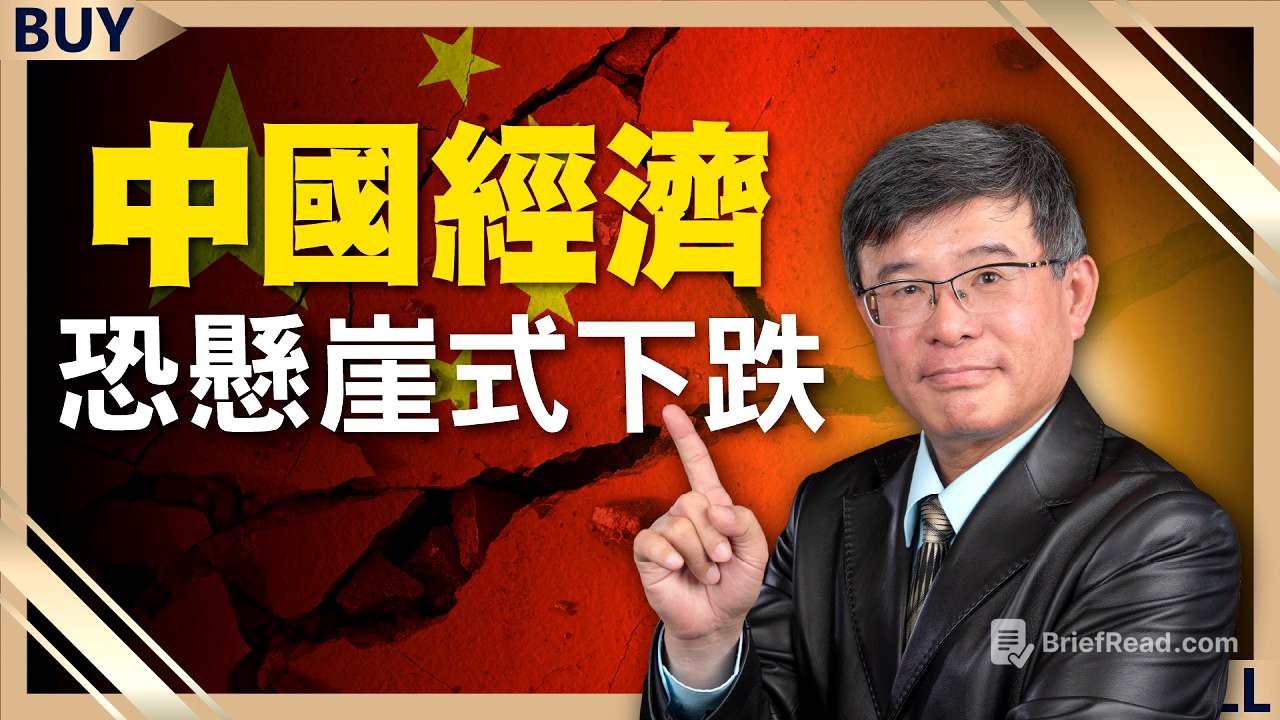
This video features an interview with economist Wu Jialong, who discusses the economic outlook for China in 2026. He expresses concerns about a potential "cliff-style decline" due to unresolved real estate issues, deflation, export challenges, and geopolitical tensions. The discussion covers China's "15th Five-Year Plan," the real estate crisis, the impact of China's economic policies on Japan, the electric vehicle market, and the struggles of Chinese youth.
- China's economic growth may face a "cliff-style decline" due to unresolved issues.
- The "15th Five-Year Plan" focuses on upgrading industries but may not address fundamental cultural and structural issues needed for innovation.
- The real estate crisis, overproduction, and external relations are significant challenges.
- The struggles of Chinese youth, exemplified by the "lying flat" and "rat race" mentalities, reflect deeper socio-economic problems.
精彩開場 [0:00]
The host introduces the topic of China's economic situation in 2026, noting that while IMF forecasts suggest a 4-5% growth rate, there are underlying concerns related to real estate, deflation, exports, and international relations. The host introduces economist Wu Jialong to discuss these issues. An online poll reveals that 73% of respondents believe China's economy will not improve by 2026, reflecting widespread pessimism.
2026中國經濟更好或更壞?吳嘉隆給出答案 [1:41]
Wu Jialong believes China's economy is likely to worsen, potentially experiencing a "cliff-style decline" as confidence erodes. He suggests that initial optimism has waned, leading to a widespread abandonment of hope for economic recovery. This shift in sentiment could trigger a sudden and sharp downturn.
中國十五五押注4大領域 能挽救經濟? [2:45]
China's "15th Five-Year Plan" focuses on upgrading traditional industries (mining, metallurgy, chemicals, textiles, machinery, shipbuilding, construction, and potentially consumer sectors like catering, retail, tourism, and education), developing strategic emerging industries (new energy, new materials, aerospace, and low-Earth orbit satellites), and advancing future industries (quantum technology, biotechnology, hydrogen energy, nuclear fusion, and brain-computer interfaces). While the plan aims to foster innovation and technological advancement, it may not generate sufficient employment opportunities. Wu Jialong points out that China's focus on advanced technology, driven by concerns over the tech war with the U.S., may neglect traditional industries that provide more jobs but face suppressed wage growth due to overcapacity and intense competition. He emphasizes that true innovation requires a culture that respects diversity, individual freedom, and intellectual property rights, which may conflict with China's current political system.
最後一張骨牌也倒?中國房市變經濟拖油瓶 [9:09]
The real estate sector has transformed from a commodity to an asset, linking the real economy with finance. Overinvestment in real estate has led to issues with local government finances, which rely on land sales for revenue. Declining property sales have reduced this income source. Additionally, banks face a surge in mortgage defaults, leading to foreclosures and further depressing property prices. The oversupply of housing, with estimates suggesting enough vacant properties to house the entire population of Germany, exacerbates the problem. The real estate crisis, combined with capital outflows, unemployment, and financial instability, makes it difficult to revive China's economy.
自身經濟差!中國制裁日本反而內傷? [14:14]
China's attempts to economically retaliate against Japan are likely to backfire, given its own economic vulnerabilities. Wu Jialong likens this to a businessperson arguing with a client. Japan is both a supplier of raw materials and a market for Chinese goods, so strained relations harm China's interests. Japanese companies are already relocating from China with government support. China's actions, such as restricting tourism and disrupting cultural events, are seen as disproportionate and ineffective, described as "infant diplomacy." These actions may push Japan to rearm, undermining China's strategic goals.
中國電動車捲到出事!只剩比亞迪賺錢? [17:11]
The electric vehicle (EV) market in China is experiencing intense competition and overcapacity. As government subsidies decrease, companies are exporting excess production, leading to price wars. This situation results in reduced profits, layoffs, and potential bankruptcies. Many companies rely on government subsidies rather than sales revenue. Wu Jialong notes that this pattern is common in other industries in China, such as steel, solar energy, and petrochemicals. He also warns that China's push into mature semiconductor manufacturing could create oversupply and price competition, impacting Taiwan's semiconductor industry.
從躺平到老鼠人!反映中國年輕人困境 [20:57]
China's economic problems have led to social issues, including the rise of the "lying flat" (tang ping) and "rat race" (laoshu ren) mentalities among young people. "Laoshu ren" refers to young people who withdraw from social interaction and limit their activities due to a lack of opportunities and bleak prospects. This reflects a sense of disappointment and hopelessness, leading to a lack of motivation to pursue education, employment, or social connections.
年輕人看不到未來 中國恐失落兩個世代 [22:31]
Wu Jialong believes that China risks losing two generations (50-60 years) due to the current economic and social challenges. He attributes this to strained relations with key economic partners like Taiwan, Japan, and the U.S. The decision-makers in power are insulated from the struggles faced by the lower classes, leading to ineffective policies. He concludes that many underlying problems are being masked and will be exposed as the economy continues to decline. Issues such as falsified accounting and debt defaults will surface, leading to a "cliff-style decline" as multiple crises erupt simultaneously. The younger generation faces difficulties in maintaining social connections and pursuing upward mobility, leading to a sense of despair.