TLDR;
This video explains Charles Darwin's theory of evolution based on natural selection. It describes how organisms adapt and change through random DNA mutations, leading to certain traits becoming beneficial for survival and reproduction. The concept of "survival of the fittest" is clarified as the process where organisms with advantageous traits reproduce more successfully, eventually leading to the emergence of new species. The video uses the example of peppered moths in the UK to illustrate how environmental changes can influence which traits are considered "fit," demonstrating the dynamic nature of natural selection.
- Natural selection drives adaptation and change in living organisms.
- Random DNA mutations can lead to beneficial traits that improve reproduction.
- "Survival of the fittest" means that organisms with advantageous traits reproduce more.
- Environmental changes influence which traits are considered "fit".
Introduction [0:00]
In the early 19th century, the prevailing belief was that a single creator formed all creatures. However, in 1831, a young student embarked on an expedition that would challenge this view. This man spent years on remote islands, studying living organisms and meticulously documenting their differences. After nearly five years, he returned home, organized his findings, and began developing his own theory on the origin of species. Decades later, in 1859, Charles Darwin, with support from Alfred Wallace's work, introduced his theory of evolution based on natural selection, challenging the established understanding of the origin of species.
Natural selection theory [1:00]
Natural selection is the process by which populations of living organisms adapt, reproduce, and change over time. This adaptation is driven by random mutations in the DNA of reproductive cells. DNA, stored within cells, contains the instructions that determine an organism's characteristics from conception. When organisms reproduce, these mutations can lead to offspring with unique traits. In environments where resources, territory, and mates are limited, certain traits become advantageous, while others are not. When survival is challenged, some organisms adapt to specific ecological niches to survive and reproduce. Mutations that enhance reproductive ability can provide a reproductive advantage if they are heritable, meaning they can be passed from parent to offspring. This reproductive advantage is what modern evolutionary theory defines as fitness.
Survival of the fittest [2:33]
The phrase "survival of the fittest" describes the process where organisms with fit variants reproduce more, while less fit variants reproduce less or disappear altogether. Over generations, advantageous traits become dominant within a population, potentially leading to the emergence of a new species. A species is defined as a group of similar organisms that interbreed exclusively with each other. The natural environment plays a crucial role in "selecting for" reproductive success, as it constantly changes and influences the fitness of a species. This entire process is known as natural selection.
Real life example [3:27]
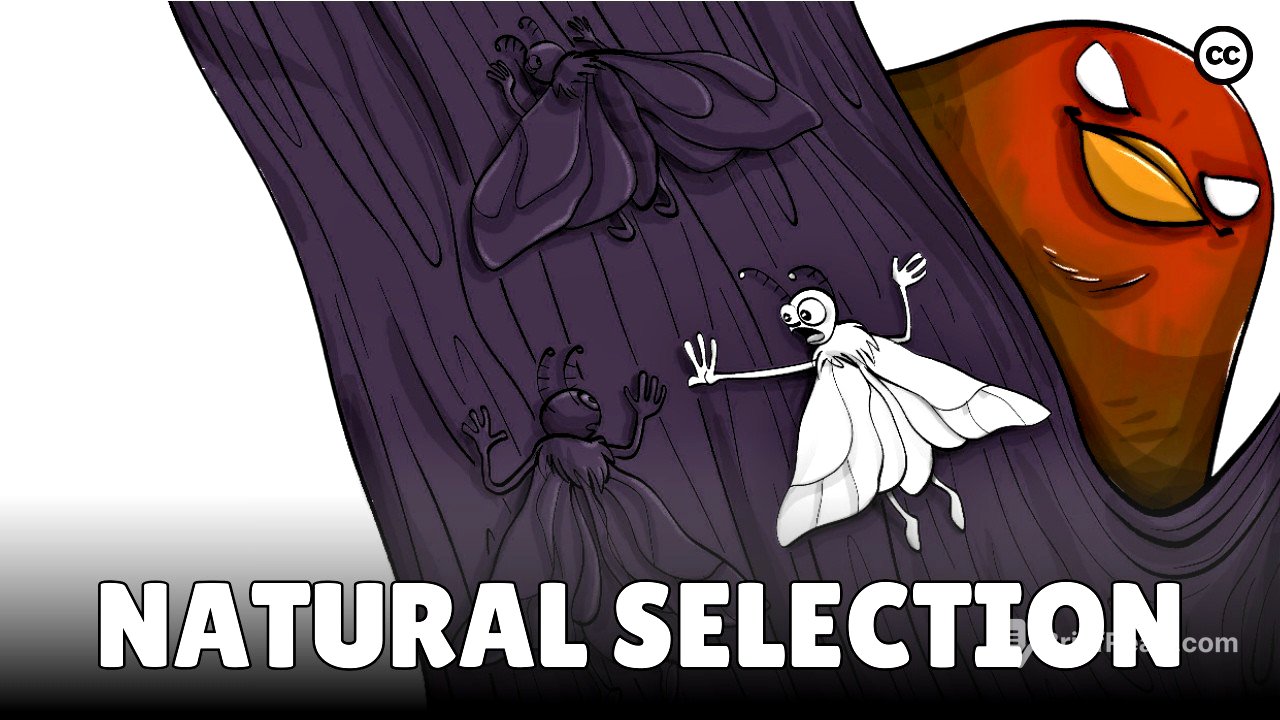
The story of peppered moths in the United Kingdom serves as a real-life example of natural selection. Initially, these moths had a texture that allowed them to blend perfectly into their natural environment. However, the Industrial Revolution in the 1800s brought significant changes. Factories and homes released smoke that darkened the skies and blackened the environment, including the tree barks. As the tree barks became darker, the white moths became more visible to predators, while the less common black moths became less visible. Consequently, peppered moths were more likely to be eaten, giving the dark moths a reproductive advantage. By 1970, dark-winged moths dominated in some regions. These moths were not stronger, faster, or smarter, but simply fitter for their changed environment. As humans began to address environmental concerns, this trend reversed, and today, white moths are once again the dominant type in the UK. Random genetic mutations gave dark moths a reproductive advantage in a specific environment for a limited time.
What do you think? [4:48]
The video prompts viewers to consider whether all species are related and if they originate from a single source. It also poses the "chicken and egg" problem, encouraging viewers to share their thoughts in the comments section.
Ending [5:08]
The video encourages viewers to support the channel through Patreon and invites parents and educators to explore the sproutsschools.com website for additional video lessons, resources, and classroom activities.