TLDR;
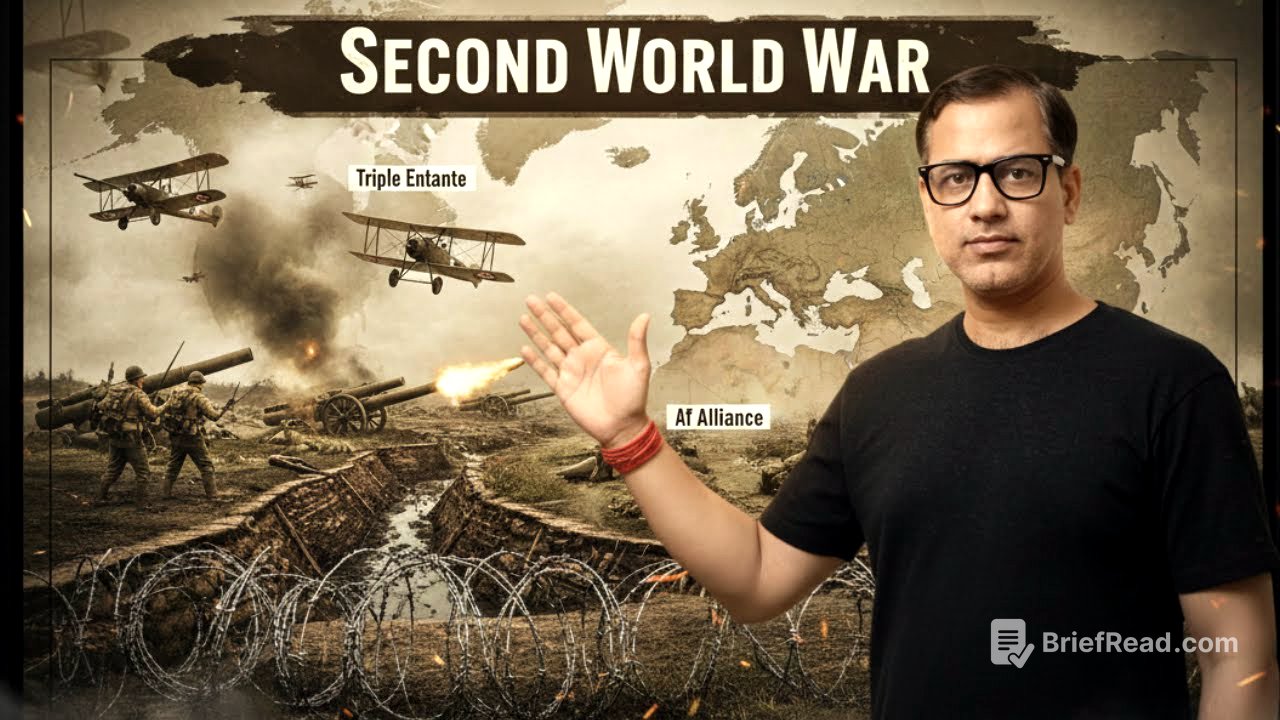
This video by Sir Tarun Rupani provides a comprehensive overview of World War II, focusing on its causes, key players, and significant consequences. The lecture breaks down the complex historical events into simple terms, making it easy to understand the underlying factors that led to the war and its global impact.
- The video highlights the failures of the Treaty of Versailles and the League of Nations.
- It explains the rise of aggressive ideologies like Fascism and Nazism.
- It discusses the policy of appeasement and the immediate causes of the war, such as Germany's invasion of Poland.
Introduction [0:01]
The session will cover the chapter on the Second World War, emphasizing its importance for board exams. The aim is to simplify the chapter, covering it from basic to advanced levels, so students won't need to consult their textbooks afterward. The content aligns with the latest syllabus, and notes will be provided in simple language.
Differences Between World War I and World War II [3:45]
World War I (1914-1918) involved European countries fighting for colonies and driven by aggressive nationalism. World War II, however, was an ideological battle between Fascism (Italy), Communism (Russia), and Nazism (Germany). The Second World War had a global impact, involving countries directly or indirectly, and occurred from 1939 onwards, approximately 21 years after the end of World War I.
Treaty of Versailles [6:12]
The Treaty of Versailles, signed in a suburb of Paris, blamed Germany for World War I, imposing harsh penalties and restrictions to prevent it from becoming a world power again. Germany lost colonies, such as Alsace-Lorraine (given to France), and territories like the Rhine Valley were demilitarized. A new country, Poland, was created from German territories, and Germany was required to pay $33 billion in war reparations. Its military was limited to 100,000 soldiers, a small navy, and no air force, fostering resentment and a desire for revenge among the German population.
Rise of Fascism and Nazism [10:49]
Fascism, originating in Italy under Benito Mussolini, promoted a one-leader, one-nation concept, glorifying war and aiming to restore Italy to the glory of the old Roman Empire. Mussolini signed the Anti-Comintern Pact, a 10-year agreement with Germany, forming a mutual defense pact. In Germany, Adolf Hitler, another dictator, promised to restore Germany's prestige and power, leading to a pact between the two dictators. Both leaders defied the League of Nations and began rearming their countries, with Hitler initiating attacks on other countries, such as Austria and Czechoslovakia, before the start of World War II.
Policy of Appeasement [16:47]
The policy of appeasement involved powerful countries allowing aggressive nations to attack others, thinking it wouldn't affect them directly. Britain and France did not stop Germany and Italy's rearmament or attacks on other countries, believing these actions addressed their grievances from World War I and would eventually lead to peace. They also saw Germany and Italy as a buffer against the spread of communism from Russia, which they opposed due to their capitalist ideologies.
Japan's Expansion [21:16]
Japan, growing technologically and industrially after World War I, attacked Manchuria (a Chinese territory) in 1931 and later China. Despite sanctions from the League of Nations, Japan continued its aggression, with Britain and France not intervening due to the policy of appeasement. This inaction allowed Japan to grow more powerful, leading to the formation of the Rome-Tokyo-Berlin Axis, uniting Germany, Italy, and Japan with the goal of expanding their territories.
World Map Before World War II and Attack on Poland [25:02]
Before World War II, countries like Yugoslavia, Hungary, and Romania existed, and Germany attacked Poland on September 1, 1939. This attack became the immediate cause of World War II. Germany's invasion of Poland triggered the war because Poland had agreements with Britain and France, who then declared war on Germany on September 3, 1939.
Failures of the League of Nations [26:48]
The League of Nations, created to prevent future wars, failed because the United States, despite President Woodrow Wilson's advocacy, did not join. Member countries, including Britain, France, Germany, Italy, and Japan, did not believe in collective security. The League lacked a standing army and the authority to enforce its decisions, as seen when it failed to prevent Poland from occupying Lithuania or Italy from attacking Greece. Japan's invasion of Manchuria and Italy's attack on Ethiopia further demonstrated the League's ineffectiveness, leading to its collapse by the start of World War II in 1939.
Immediate Cause: Germany's Attack on Poland [30:57]
Germany's attack on Poland was the immediate cause of World War II. Poland had treaties with Britain and France, ensuring their support if attacked. Germany's reasons for attacking included reclaiming territories lost in the Treaty of Versailles and protecting German citizens in the city of Danzig. On September 1, 1939, Germany invaded Poland, leading Britain and France to declare war on Germany on September 3, marking the beginning of World War II.
Early Stages of the War and Germany's Successes [36:42]
Some countries, like Sweden, Switzerland, and Spain, remained neutral during the war. Germany quickly conquered Norway, Denmark, Belgium, and Holland. It then captured Paris, the capital of France, with such speed and force that the campaign was termed "Blitzkrieg" (lightning war). However, Germany failed to defeat Britain in the Battle of Britain, an air campaign.
Turning Points: Germany's Mistakes and America's Entry [40:20]
Hitler made a mistake by attacking Russia (the Soviet Union) after signing a non-aggression pact. The German army suffered heavy losses at the Battle of Stalingrad due to the harsh winter conditions. Russia then began to push back against Germany. The Battle of Berlin marked a turning point, with Russia attacking from one side and the combined forces of America and Britain attacking from the other. Germany surrendered on May 8, 1945, and Hitler committed suicide.
Pearl Harbor and US Entry into World War II [42:56]
The United States, initially neutral, entered World War II after Japan attacked Pearl Harbor on December 7, 1941. The attack resulted in significant damage to American naval ships and the loss of 3,700 lives. The Japanese made two critical errors: they did not destroy the ship repair facilities or the US carriers. The US declared war on Japan on December 8, 1941, joining the Allied forces.
End of the War and Surrender of Japan [45:48]
Even after Germany and Italy surrendered, Japan continued to fight, employing kamikaze tactics. The US warned Japan to surrender at the Potsdam Conference, but Japan refused. On August 6, 1945, the US dropped the first atomic bomb on Hiroshima, followed by a second on Nagasaki on August 9. These bombings resulted in approximately 180,000 deaths and long-term health issues due to radiation. Japan surrendered on September 2, 1945, marking the end of World War II, which had lasted six years.
Impacts and Results of World War II [48:22]
The Axis powers (Germany, Italy, and Japan) were defeated. The Allied powers, particularly the United States, gained prominence. Germany was divided into two parts: the Federal Republic of Germany (West Germany), controlled by Britain, France, and the USA, and East Germany, controlled by the USSR (Russia). Japan and Italy were weakened but not divided. The US occupied Japan until 1952, after which Japan was allowed to rebuild under a democratic government.
The Big Three and Formation of the United Nations [53:04]
The "Big Three" leaders—Stalin (Russia), Roosevelt (USA), and Churchill (Britain)—met in Yalta in February 1945 to plan the formation of a new world body. A conference was held in San Francisco, where 50 nations created the Charter of the United Nations. The United Nations was officially formed on October 24, 1945, to prevent future world wars, succeeding the League of Nations.
Emergence of Superpowers and the Cold War [55:38]
The United States and Russia emerged as superpowers after World War II, diminishing the power of European countries like France, Britain, Germany, and Italy. The two superpowers had conflicting ideologies, leading to the Cold War—a period of tension and suspicion without direct military conflict. The US, advocating for capitalism and democracy, led the Western Bloc, while Russia, promoting communism, led the Eastern Bloc. This division created a tense global atmosphere until the dissolution of the Soviet Union in 1991.