TLDR;
This video presents five key reasons why Tesla vehicles are considered among the safest in the world, supported by safety ratings and unique design features. It also touches on security features that contribute to overall safety.
- Tesla's achieve top safety ratings due to rigorous testing and innovative design.
- The absence of a traditional engine, a low center of gravity, a robust roof structure, and advanced safety technology contribute to occupant safety.
- Software updates enhance safety by improving autopilot, hazard detection, and vehicle maintenance alerts.
Intro [0:00]
The video introduces the topic of Tesla vehicle safety, highlighting that while Teslas are known for their style, performance, and environmental friendliness, safety is a crucial factor for car buyers. The presenter aims to provide five reasons why Teslas are among the safest vehicles globally.
Important Facts [0:31]
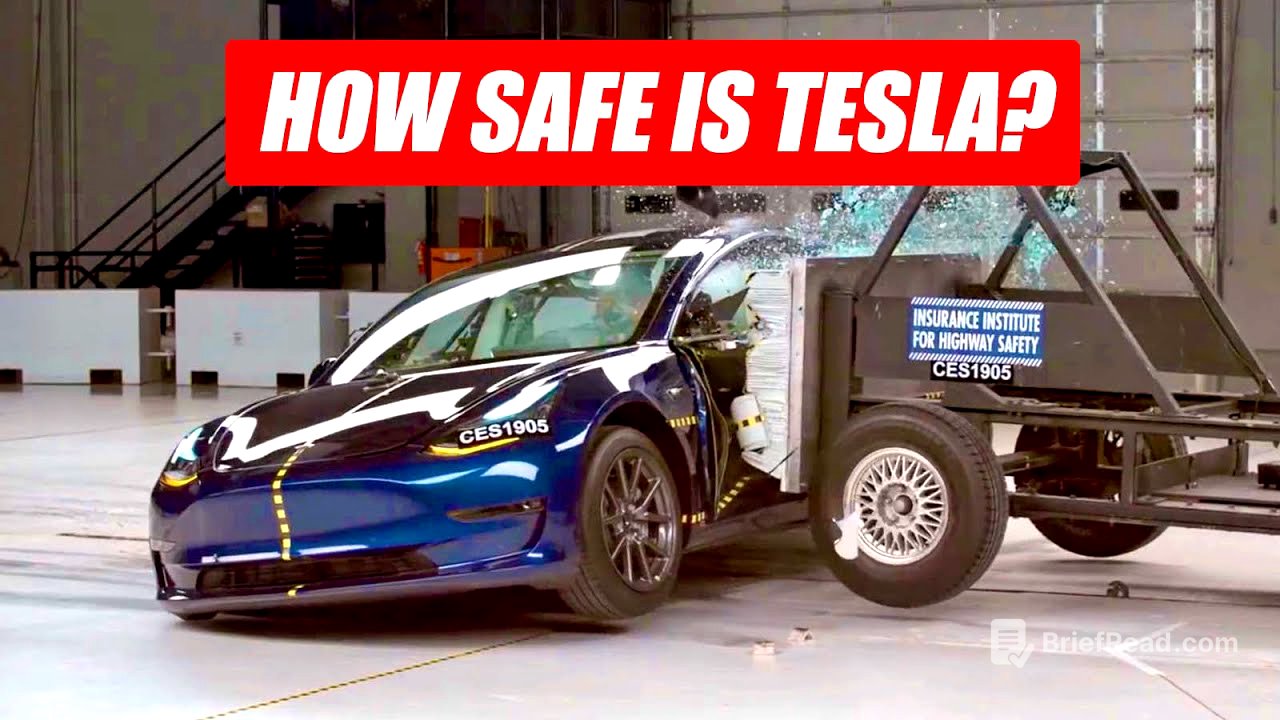
Tesla vehicles have earned 5-star ratings across all categories and subcategories from the National Highway Traffic Safety Administration (NHTSA) and the Insurance Institute for Highway Safety (IIHS). The Model 3 and Model Y have the lowest probability of injury among all vehicles tested.
No Engine [0:58]
One primary safety feature of Teslas is the absence of a traditional engine. Without an engine in the front, the steel and aluminum structure is designed to crumple and absorb impact during a collision. This design prevents the force of the impact from reaching the driver and passengers, enhancing their safety.
Low Rollover Risk [1:17]
Tesla vehicles have a low rollover risk due to the placement of the battery pack and electric motors along the floor of the vehicle, creating a low center of gravity. The Model Y has a rollover risk of only 8%, which Tesla claims is the lowest for any SUV ever built. This design helps the vehicle resist rolling over, even when struck from the side or pushed off a hill.
The Roof [1:51]
Tesla roofs can withstand over 20,000 pounds of force, which is about six times the vehicle's weight. This makes it one of the most durable roofs on any car. Tesla's roof has earned a "Good" rating for its strength-to-weight ratio from the IIHS, surpassing all other electric vehicles tested. This robust roof protects occupants in rollover accidents or if objects fall on the vehicle.
Structure and Air Bags [2:29]
The pillar structures and side sills of Tesla vehicles are reinforced with high-grade steel to resist crumpling and absorb energy during collisions. The side of the car crumples less than the front upon impact. The airbag system includes heavy curtain airbags covering all four side windows and a uniquely shaped front passenger airbag to protect the head from hitting side pillars and the infotainment screen.
Safety Technology [3:05]
Tesla vehicles are equipped with safety technology, including cameras, radars, and ultrasonic sensors, to detect obstacles and react accordingly. The Autopilot system features automated emergency braking, earning a "Superior" rating in front crash prevention tests. Tesla received a 94% score in the safety assist category, which includes lane assistance and automatic pedestrian braking.
Software Updates [3:41]
Tesla's over-the-air software updates enhance safety by adding new features and improving existing functions. These updates improve the Autopilot system, enhance object recognition, detect emergency vehicle lights, and provide low tire tread notifications. The updates can resolve safety issues because the computer is linked to nearly every mechanical component.
No Spare Tire [4:17]
One downside is that Teslas, like many new cars, do not come with a spare tire, and the tires are not run-flat. In case of a tire-related incident, Tesla's roadside assistance is required. The presenter recommends carrying a tire repair kit and a portable air compressor powered by the Tesla's 12-volt battery for peace of mind.
Security [5:03]
Tesla's security features contribute to its overall safety.
Sentry Mode [5:17]
Sentry Mode allows users to monitor suspicious activity near their parked and locked car. The vehicle reacts to potential hazards and records events to the car's hard drive. Users can remotely inspect the area around the vehicle and use the car's exterior speaker to communicate if equipped. Teslas also have a car alarm that triggers if locked doors are opened without a key.
Warning System [5:50]
The interior camera in the Model 3 and Model Y can detect driver inattentiveness and provide audible warnings to encourage drivers to keep their eyes on the road while using Autopilot.
Final Thoughts [6:09]
The presenter shares that vehicle safety was a primary concern when researching the Model 3. They express confidence in the car's safety features and overall quality.