TLDR;
This video provides a step-by-step guide on how to properly assess the head and neck of a patient. It covers the necessary equipment, patient interaction, and detailed examination techniques, including inspection, palpation, and auscultation. The assessment includes checking for symmetry, masses, lesions, and the function of cranial nerves, as well as evaluating the thyroid gland and lymph nodes.
- Proper assessment of the head and neck involves inspection, palpation, and auscultation.
- Checking cranial nerve function is crucial for identifying neurological issues.
- Palpating lymph nodes helps detect potential infections or abnormalities.
Introduction [0:09]
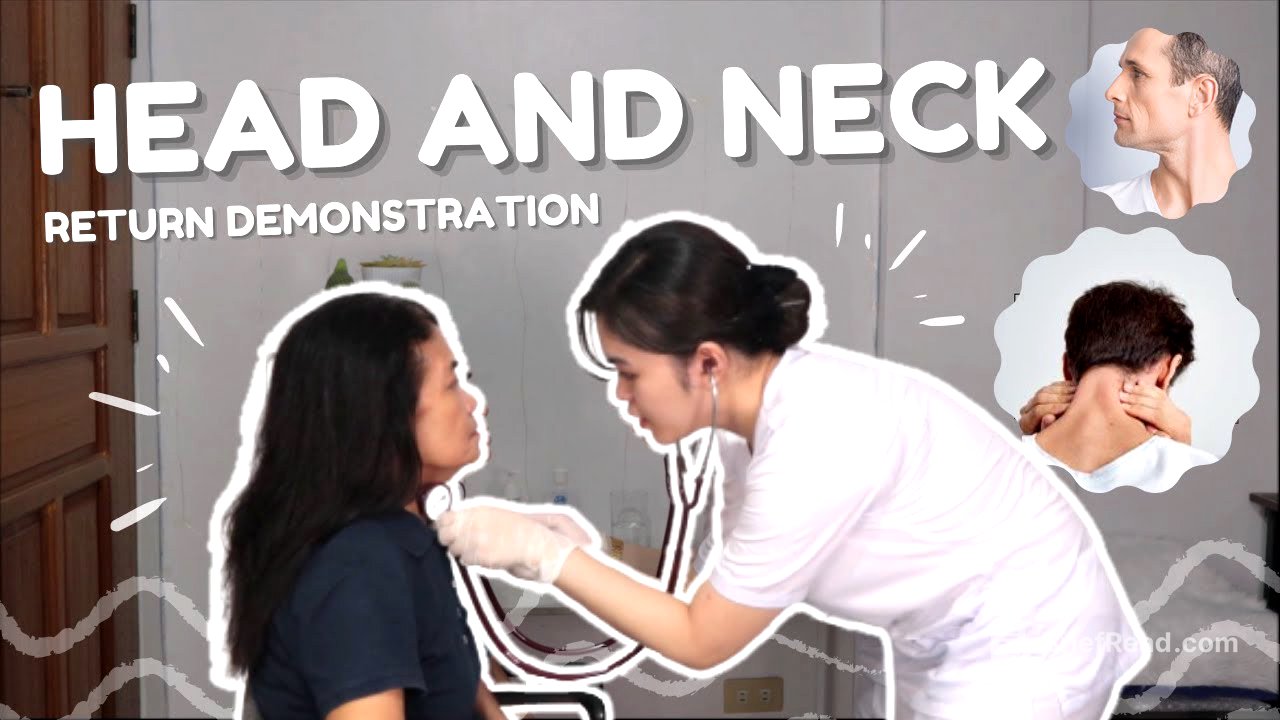
The video introduces a demonstration of how to properly assess the head and neck of a patient. The presenter, Shantal Lati, a student nurse, outlines the equipment needed for the assessment and prepares to begin the procedure.
Patient Interaction and History Taking [0:47]
Shantal introduces herself to the patient, verifies her identity (name: Erlinda, birthday: October 10, 1957, age: 64), and explains the procedure, ensuring the patient's consent. She assures the patient of confidentiality and asks about any discomfort or language preferences (Tagalog). A brief medical history is taken, including questions about lumps, lesions, difficulty moving the head and neck, facial or neck pain, headaches, dizziness, past head or neck problems, family history of thyroid or neck cancer and migraine headaches, and lifestyle factors such as hat or helmet use and recreational activities.
Initial Preparations [3:18]
Before starting the physical assessment, Shantal performs hand hygiene and ensures the patient's privacy by closing the curtain. She puts on gloves in preparation for the hands-on examination.
Head Inspection and Palpation [4:01]
Shantal begins by inspecting and palpating the patient's head. She observes the scalp for lesions, scars, masses, and parasites like lice, and notes the absence of alopecia. The head is symmetrical, round, erect, and in the midline, with a normal head size (normocephalic).
Facial Symmetry and Cranial Nerve Assessment [5:18]
The assessment moves to facial symmetry and the function of cranial nerve number seven (facial nerve). The patient is asked to perform various facial movements, including raising eyebrows, blinking, closing eyes tightly, smiling, frowning, and puffing cheeks. Shantal observes for any abnormalities or drooping of the face.
Temporal Artery and Temporomandibular Joint (TMJ) Palpation [6:21]
Shantal palpates the temporal artery and checks the temporomandibular joint (TMJ). The patient is asked to bite down to check the temporal artery. For the TMJ, the patient opens and closes her mouth, and Shantal listens for any clicking, swelling, pain, or tenderness. The patient reports no recent headaches.
Neck Inspection [7:18]
The assessment transitions to the neck, where Shantal observes the trachea's position and asks the patient to swallow a small amount of water to assess thyroid movement. She notes that the trachea is in the midline and there are no visible bulges or swellings.
Cervical Vertebrae and Neck Range of Motion [8:34]
Shantal checks the cervical vertebrae and the patient's neck range of motion. The patient is asked to look up, down, and side to side. Shantal inquires about any pain or tenderness during these movements, to which the patient reports none.
Trachea Palpation and Thyroid Auscultation [9:29]
The trachea is palpated to ensure it is in the midline. The patient is asked to swallow to assess the movement of the tracheal rings. Shantal then auscultates the thyroid gland to check for any bruits, instructing the patient to inhale, hold their breath, and exhale. No bruits are detected, indicating proper function of the carotid artery.
Lymph Node Palpation [11:14]
The final step involves palpating the lymph nodes, including the preauricular, postauricular, occipital, tonsillar, submandibular, submental, superficial cervical, deep cervical chain, posterior cervical, and supraclavicular nodes.
Conclusion and Recommendations [12:31]
Shantal concludes the assessment, noting that there are no apparent abnormal findings. She advises the patient to consult her attending physician if she has any questions or health concerns. She also provides general health advice, including taking vitamins, drinking enough water, and eating a balanced diet.