TLDR;
Having many interests does not mean you lack discipline or need to choose one identity for life. The key is to manage curiosity: focus deeply on one skill or field for a defined period, preserve other interests for later, and let different areas of knowledge connect over time.
- Build depth in one area at a time rather than collecting endless beginnings.
- Treat career and learning choices as seasons, not permanent decisions.
- Record new ideas instead of trying to pursue every interest immediately.
- A stable job can support the time and energy needed to explore other goals.
The Graveyard of Hobbies and the Value of Curiosity [0:00]
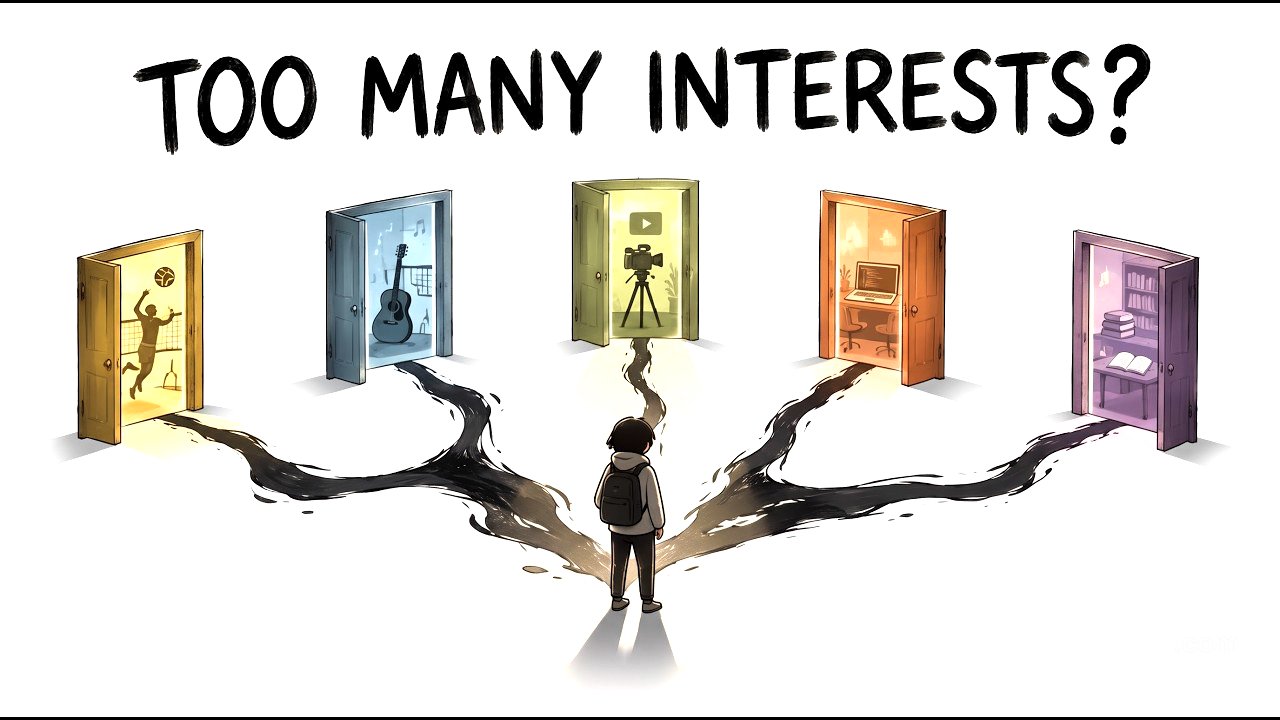
A person can start the day focused on a career goal, then become excited about volleyball, guitar, content creation, or other possibilities. The result can feel like having too many possible selves: many interests begin, but few become completed achievements. This pattern is not necessarily proof of poor discipline; it may mean curiosity needs better management.
Deep expertise remains important in fields that require years of practice, but a changing world also rewards people who can connect knowledge across different areas. A data scientist who can explain findings through storytelling, for example, may be more effective because they combine technical skill with communication. In stable environments with clear feedback, repeated practice can work well; unpredictable situations also demand judgment, flexibility, and the ability to apply knowledge in new contexts.
Build Multiple Deep Skills and Connect Them [4:10]
Breadth without depth can leave someone with scattered knowledge but no dependable expertise. The video contrasts a “dash-shaped” person, who knows a little about many subjects, with an “I-shaped” person, who has deep knowledge in one field. An “M-shaped” person develops more than one deep area of expertise, such as software engineering and psychology, or finance and writing. The combinations vary, but the value comes from building real competence in each area.
These skills can reinforce one another. Someone with knowledge of psychology and marketing may better understand why advertisements work, while someone combining design and programming can create products that are both attractive and functional. Applying learning from one field to another is called far transfer: for example, ideas about rhythm, repetition, tension, and contrast from music can shape how someone designs a website. Seemingly unrelated interests may give the mind patterns that later combine in useful ways.
Choose a Learning Season and Leave Strategically [6:26]
Trying to build ten deep skills at once is unrealistic, so the choice does not need to be “What will I do for the rest of my life?” A more manageable question is, “What will I work to become good at over the next six months?” Choose one area—such as coding, writing, design, or a useful foundation for a career—and stay with it long enough to move beyond the initial excitement and reach genuine competence.
Leaving a field after a deliberate period of learning is different from quitting as soon as it becomes difficult. Strategic quitting means practicing, struggling, building skill, and understanding what the experience taught you before choosing a new direction. By contrast, repeatedly abandoning a subject when its novelty fades can be avoidance disguised as a fresh plan. Before moving on, consider whether you actually built something, practiced consistently, and learned what you set out to learn.
Save Ideas and Let Some Interests Stay Hobbies [9:01]
New interests can generate so many ideas that trying to keep them all in mind becomes exhausting. A simple external record—a notebook, Notion, Obsidian, or a folder—can hold ideas until they become relevant. When something captures your attention, write down what you learned, what surprised you, what questions arose, and what it reminds you of. The specific tool matters less than making the habit consistent.
Not every interest needs to become a career or identity. Someone can enjoy astronomy without becoming an astronomer, cook without opening a restaurant, or play guitar without becoming a professional musician. Interests can enrich life on their own, and ideas saved now may become useful years later in an unexpected context. Treat interests like seeds: grow one or two seriously at a time and let the others wait. “Not now” does not have to mean “never.”
Use Work as a Platform and Organize Your Possibilities [11:39]
A job does not have to be a person’s ultimate passion; it can provide income, experience, stability, and enough remaining energy to pursue other interests. A job that consumes all of a person’s attention may leave little room to learn or create, while a stable role that preserves time and energy can support meaningful work outside the workplace. There is no single right arrangement: some people should pursue a passion as their main career, while others may prefer a side project or a gradual second career.
Comparing unfinished possibilities with other people’s completed achievements can make someone feel behind, even when the real issue is simply having many options to organize. The goal is to build depth without giving up breadth: focus on one pillar now, explore around its edges, and save other ideas for later. Over time, multiple areas of expertise can strengthen each other and help a person notice connections others miss. Discipline determines what receives attention now; curiosity points toward what may be worth exploring next.