TLDR;
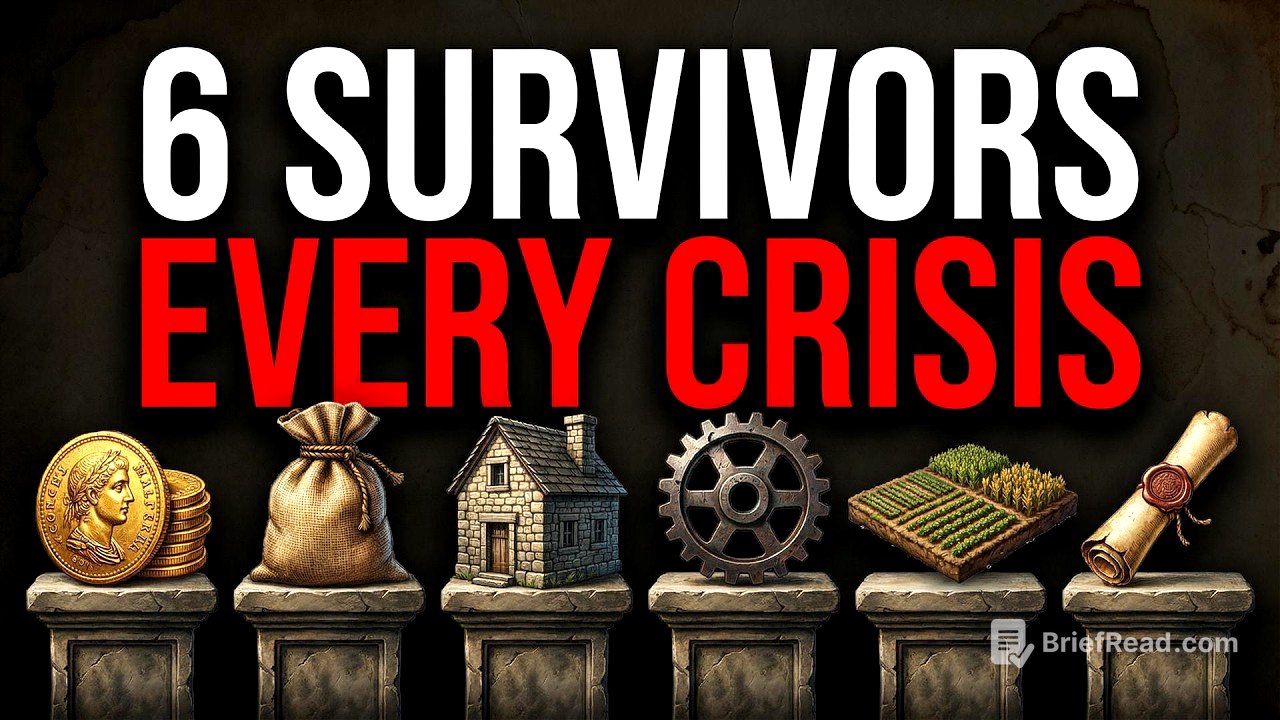
This video discusses six types of assets that have historically survived currency crises across 4,000 years. It contrasts these with assets typically considered "safe," like savings accounts and government bonds, which often fail during such times. The key assets highlighted are productive land, gold, businesses with pricing power, foreign currency, real estate, and essential skills.
- Productive land provides essential resources like food and water, maintaining value regardless of currency fluctuations.
- Gold serves as a default currency due to its recognizability, portability, and limited supply.
- Businesses with pricing power can adjust prices to keep pace with inflation, maintaining margins.
- Foreign currency, particularly in stable economies, allows wealth to be preserved outside of the failing local currency.
- Real estate offers intrinsic value as a physical structure that people need.
- Essential skills provide negotiating power in a barter economy.
A Banker and a Farmer — 1923 [0:00]
In 1923 Germany, a banker's life savings became worthless due to hyperinflation, while a wheat farmer prospered. The banker's assets, including government bonds and savings, all denominated in marks, lost their value. The farmer's grain became increasingly valuable, with people trading valuable possessions for it. This contrast highlights that the type of assets held, not luck or timing, determined financial survival during the crisis.
Asset #1: Land [1:47]
Productive land is the most ancient asset that survives crises. This refers to land that grows food, holds minerals, or has water access. During currency collapses, people still need essential resources, and those who control these resources hold real power. In Weimar Germany, farmers who owned their land became wealthy, demanding payment in gold or foreign currency. Similarly, in Zimbabwe's collapse in 2008, farmers with land and livestock had valuable assets, while those with savings in Zimbabwean dollars had nothing. Land produces things that have value independent of any currency, making it a crisis-proof asset.
Asset #2: Gold [3:20]
Gold is a crucial asset during currency failures because societies need an immediate alternative to money. Throughout history, gold has been the default choice due to its recognizability, divisibility, portability, and the inability of governments to print more of it. During the French Revolution, paper currency lost over 99% of its value, but those who converted to gold preserved their wealth. This pattern repeated in Argentina, Russia, and Venezuela. Gold's value lies in its role as a reliable monetary technology when official currencies fail, making its holders influential. Central banks hold significant gold reserves, indicating their awareness of its importance during financial instability.
Asset #3: Businesses With Pricing Power [5:17]
Businesses with pricing power are those that sell essential goods or services that people cannot stop buying and can raise prices as fast as the currency falls. While most businesses don't survive crises, these companies thrive. Examples include producers of cooking oil, electricity, medicine, or fuel. During Brazil's hyperinflation in the 1980s, supermarket chains repriced their shelves multiple times a day, allowing companies producing essential goods to maintain their margins. The ability to quickly pass costs to consumers is crucial for survival in inflationary environments.
Asset #4: Foreign Currency [6:52]
Holding foreign currency, specifically claims denominated in stable currencies, is a key asset during a currency crisis. The wealthy often move their money offshore into dollar-denominated assets before a collapse accelerates, while the middle class, holding local currency, watches their wealth evaporate. During Latin America's debt crisis in the 1980s, wealthy families with dollar accounts in Miami and holdings in Swiss francs were protected, while those with peso-denominated accounts lost everything. Denominating wealth in a failing currency leads to its failure, while holding stable foreign currency provides insulation. Capital controls, restricting the movement of money abroad, often signal an accelerating crisis as people try to leave.
Asset #5: Real Estate [8:46]
Real estate protects you during a currency crisis because a building is a physical thing that people need, and its replacement cost rises with everything else. Unlike currency, you can't print an apartment building or inflate away the materials and labor required to build it. In Weimar Germany, apartment owners saw the nominal value of their buildings skyrocket, and when a new currency was established, their buildings retained real purchasing power. Similarly, in post-Soviet Russia, apartment owners found their real estate to be their most valuable possession as the ruble disintegrated. Real estate works because it exists outside the currency system and has intrinsic utility.
Asset #6: The One Nobody Talks About [10:29]
Essential skills are a crucial asset during currency crises. Those with skills like doctors, electricians, mechanics, and engineers often come through unscathed because their services are essential and payment can be negotiated in real time. During Hungary's 1946 hyperinflation, factory workers demanded daily wage adjustments, while government employees on fixed salaries were wiped out. A skilled plumber could set his own price for each job and thrive. In a breakdown of currency, the economy reverts to barter, where those who can fix essential things have more negotiating power than those holding worthless government bonds. Skills require zero capital to acquire and cannot be confiscated, inflated away, or taxed into nothing.
The 4,000-Year Pattern [12:00]
Across 4,000 years of currency crises, the same six categories of assets absorb the wealth that flows out of the collapsing currency: productive land, gold, businesses with pricing power, foreign currency holdings, real estate, and essential skills. Those who held savings accounts, government bonds, pensions, and fixed income instruments were the ones who got destroyed. These are the assets that financial advisors call safe, right up until they aren't.
Why "Safe" Assets Fail [12:58]
Monetary stability is not the default state of civilization; it's the exception. Most currencies in human history have eventually failed or been dramatically devalued. The dollar has lost over 96% of its purchasing power since the Federal Reserve was created, indicating a slow erosion that precedes every crisis in the historical record.
The Only Question That Matters [14:04]
The timing of the next crisis is unknown, but the pattern of what survives and what doesn't is 4,000 years old and has never been wrong. The question is whether the things you hold right now are the things that have historically made it through to the other side. When the next crisis hits, it will only matter what you held.

![[Why series] Earth Science Episode 3 - High Air Pressure and Low Air Pressure](https://wm-img.halpindev.com/p-briefread_c-10_b-10/urlb/aHR0cDovL2ltZy55b3V0dWJlLmNvbS92aS9EcXVYTzJGRWwwUS9ocWRlZmF1bHQuanBn.jpg)