TLDR;
This lecture provides an overview of California's government and political landscape. It covers the structure of the California Constitution, the functions of local governments (counties, cities, and special districts), the legislative and executive branches, and the state's court system. The lecture also addresses key challenges facing California, such as rising crime, homelessness, housing costs, and education, while also highlighting the state's strengths, including its higher education system and natural resources.
- Overview of California's government and political landscape.
- Discussion of the California Constitution and its key articles.
- Examination of local governments, including counties, cities, and special districts.
- Analysis of the legislative and executive branches, including term limits and powers.
- Review of the state's court system and its structure.
- Identification of challenges facing California, such as crime, homelessness, and housing costs.
- Highlighting the state's strengths, including its higher education system and natural resources.
Introduction to California's Government and Politics [0:01]
The lecture introduces California as the "Golden State," highlighting its significant size, economic power (ranking as the fifth-largest economy in the world if it were a country), and diverse geography and population. The state boasts a population between 35 and 40 million people and features varied landscapes from deserts and mountains to fertile valleys and beautiful beaches. The speaker, an elected official in California, expresses pride in the state, having lived there since 1983.
The California Constitution [2:56]
The California Constitution is one of the largest in the country, containing over 100 printed pages and 35 separate articles, compared to the U.S. Constitution's seven articles. Article One outlines the rights of California citizens. Article Two details the initiative, referendum, and recall processes, allowing citizens to create laws and remove officials. Article Four describes the powers and organization of the state legislature, including the Assembly and the Senate. Article Five covers the executive branch, including the governor and other statewide officeholders. Article Six pertains to the California court system, which adjudicates state law. Article 18 lays out the process for amending the Constitution, which requires a majority vote by the citizens.
Local Government: Counties [5:09]
Counties are the largest political subdivisions in California, with 58 counties in total: 45 General Law counties and 13 Charter counties, with Los Angeles County being the largest Charter county. County governments perform three primary functions: contracting with cities to provide municipal services like policing and fire services, providing countywide services such as the Sheriff's Department, the District Attorney, and administering the jail and court systems, and administering state programs at the local level, such as welfare programs and public health services. Los Angeles County is run by five supervisors who serve four-year terms and are termed out after two terms.
Local Government: Municipalities (Cities) [7:37]
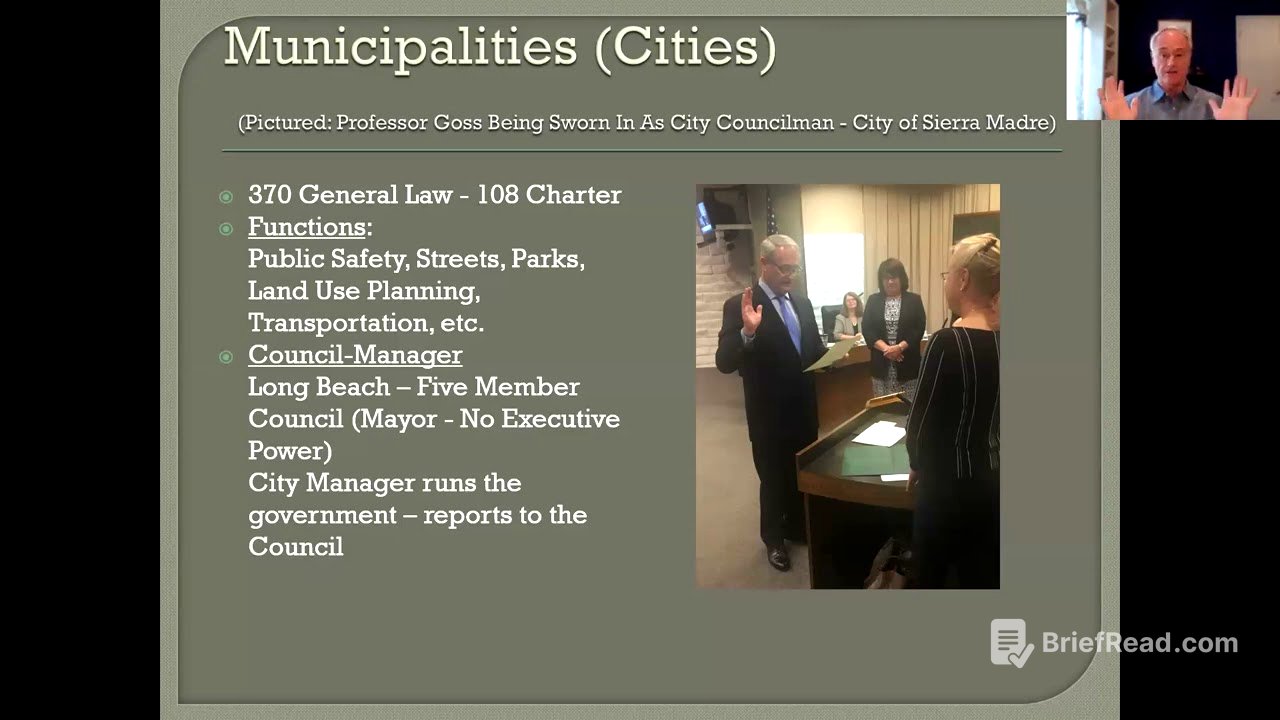
California has 370 General Law cities and 108 Charter cities. The primary functions of city government are public safety (police and fire services), parks and land use planning, and roads and bridges. Public safety typically constitutes the largest portion of a city's budget. Most cities in California operate under a council-manager system, where an elected council hires a city manager to run the city's day-to-day operations. The mayor, usually selected from the city council, presides over council meetings but typically lacks significant executive authority. Long Beach and Los Angeles are exceptions, with separately elected mayors; the Los Angeles mayor has considerable executive authority.
Local Government: Special Districts [11:03]
Special districts are single-function governments independent of cities, counties, school districts, and the state or federal government. School districts are one type of special district, tasked solely with running local schools and governed by elected school boards that appoint a superintendent. Other special districts include the Metropolitan Water District (MWD), which controls water quality, quantity, and price for much of Southern California, flood control districts, hospital districts, cemetery districts, and mosquito abatement districts. These districts have independent governing boards and specific functions.
The California Legislature [14:04]
The California legislature is bicameral, consisting of the Assembly and the Senate. The Assembly has 80 members serving two-year terms, and the Speaker leads the Assembly. The Senate has 40 members serving four-year terms, and the President Pro Tem leads the Senate and chairs the Rules Committee. Term limits are 12 years total, combined for both bodies. Legislators earn over $130,000 a year, plus a per diem for living expenses. The legislative process is similar to that of Congress.
The Executive Branch: The Governor [16:31]
The Governor of California, currently Gavin Newsom, serves as the chief legislator, presenting a State of the State address annually, and as the chief executive, overseeing the state bureaucracy and issuing executive orders. Governors are limited to two four-year terms. The governor has line-item veto power over the state budget and appoints top officials to bureaucratic agencies and the California courts. The governor's power is limited by the need for cooperation from lower levels of government.
Statewide Executive Officers and the Courts [20:17]
Other statewide executive officers, such as the Lieutenant Governor, Attorney General, Secretary of State, Controller, Treasurer, Superintendent of Public Instruction, Insurance Commissioner, and the Board of Equalization, are independently elected and control agencies, requiring the Governor to negotiate and work with them. The California court system includes trial courts (Superior Courts), Courts of Appeal, and the Supreme Court, with seven justices appointed by the Governor. All judges must face voters for approval after serving a set term. The California court system is the largest in the nation, serving nearly 40 million people, and is governed by the Judicial Council of California.
Challenges Facing California [24:31]
California faces several challenges, including rising crime rates, increasing homelessness (up 47% since 2017), a growing population that strains resources, and a significant outmigration of middle-class individuals and businesses. Housing costs are historically high, and discontent is growing. Education standards lag behind national and international benchmarks, exacerbated by COVID-19 shutdowns. Protecting the environment and natural resources, particularly forests threatened by wildfires, remains a key concern.
Summary and Final Thoughts [32:03]
Despite its challenges, California has a higher education system that remains the envy of the world, offering tremendous value through its community colleges, Cal State system, and UC schools. The state's weather and other benefits continue to attract and retain many residents. The lecture concludes with reminders about upcoming course assignments and exams, and an invitation to consider future political science courses.