TLDR;
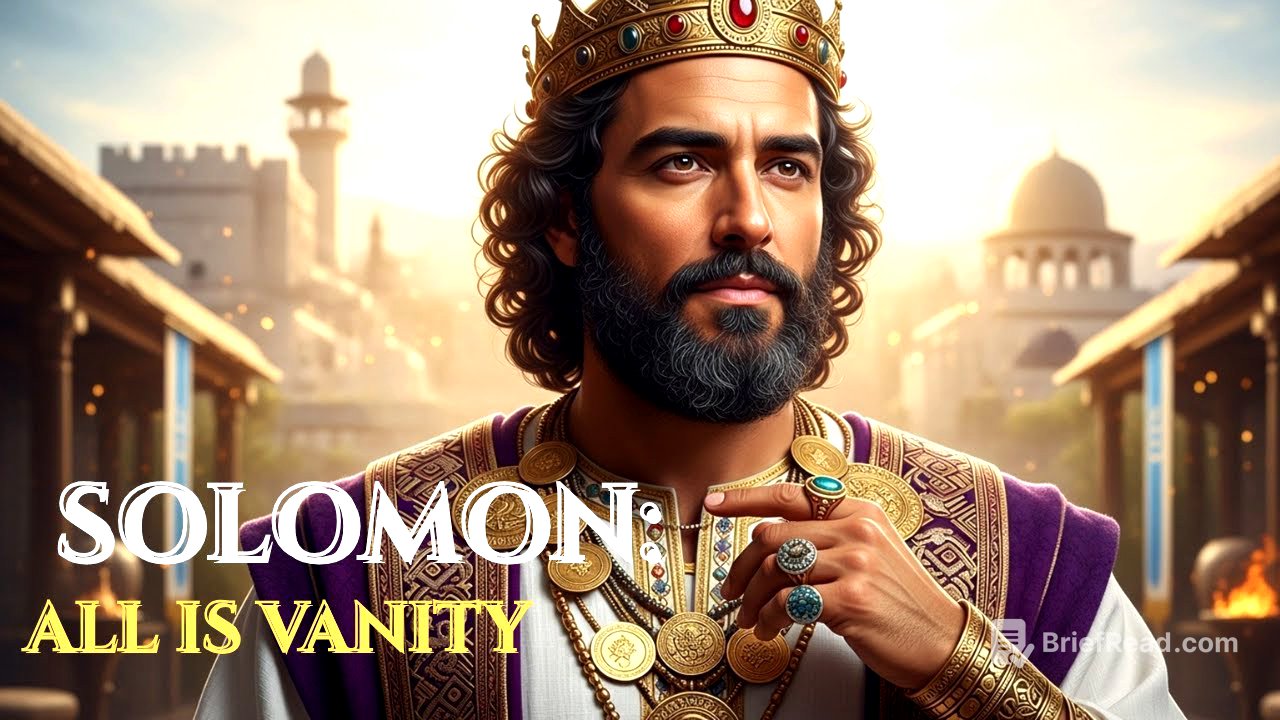
This video tells the story of Solomon, focusing on his ascent to the throne, his reign marked by wisdom and the construction of the Temple, and his eventual downfall due to his compromises with foreign gods. It highlights the themes of ambition, divine wisdom, the cost of legacy, and the ultimate importance of fearing God.
- Solomon's rise to power was fraught with challenges, including a power struggle with his brother Adonijah.
- He was granted divine wisdom, which he used to rule justly and build the magnificent Temple in Jerusalem.
- Solomon's reign was marked by increasing compromise with foreign religions due to his many wives, leading to his downfall.
- In his final years, Solomon reflected on the vanity of human achievements and emphasized the importance of fearing God and keeping His commandments.
Solomon's Ascent to the Throne [0:00]
As King David lay dying, Solomon, a young and unlikely heir, faced a precarious situation. His brother Adonijah, with the support of powerful figures like Joab and Abiar, was plotting to seize the throne, holding a feast to declare himself king. Bathsheba and Nathan intervened, reminding David of his oath to make Solomon king. David then ordered Zadok and Benaiah to anoint Solomon as king at Gihon, effectively thwarting Adonijah's coup.
Solomon's First Decisions as King [3:01]
Following his anointing, Solomon had to decide the fate of Adonijah, who sought refuge at the altar. Solomon spared Adonijah's life on the condition that he prove worthy, but warned that any evil found in him would result in his death. After David's death, his final instructions to Solomon included dealing with Joab and Shimei. Adonijah later asked Bathsheba to petition Solomon for Abishag, David's concubine, which Solomon interpreted as a veiled attempt to claim the throne, leading to Adonijah's execution.
Consolidating Power: Justice and Divine Guidance [4:47]
Solomon continued to consolidate his power by ordering the execution of Joab, who had sought sanctuary at the altar, fulfilling David's last wish. Burdened by these acts of violence, Solomon went to Gibeon and offered a thousand burnt offerings, seeking guidance from God. In a dream, God offered to grant him anything he desired, and Solomon asked for a discerning heart to govern his people justly. God was pleased with his request and promised him wisdom, wealth, and honor beyond any king.
The Wisdom of Solomon [7:20]
Solomon's wisdom was immediately put to the test when two women came before him, both claiming to be the mother of the same baby. Solomon proposed cutting the baby in half, revealing the true mother who was willing to give up her child to save its life. This display of wisdom spread throughout Jerusalem, solidifying Solomon's reputation as a wise and just ruler.
Building the Temple [8:39]
Solomon embarked on the ambitious project of building the Temple in Jerusalem, a task his father David had longed to do. He used skilled labor and materials from across the region, including cedar from Lebanon provided by Hiram of Tyre, in exchange for 20 towns in Galilee. The construction was massive and expensive, involving conscripted labor and causing discontent among the people, but Solomon pressed on, viewing the Temple as a symbol of Israel's greatness and a fitting house for God.
Dedication and Recognition [11:28]
After seven years, the Temple was completed, and the Ark of the Covenant was brought into the Holy of Holies. A cloud filled the Temple, signifying God's presence and acceptance. Solomon offered a long prayer, dedicating the Temple and asking for God's forgiveness and blessings on Israel. Solomon's fame spread, and the Queen of Sheba visited to test his wisdom, ultimately acknowledging that his wisdom and prosperity exceeded all reports.
The Seeds of Decline [15:22]
Despite his achievements, Solomon's reign began to decline as he accumulated foreign wives for political alliances. These wives brought their own gods and rituals, leading to the construction of shrines to foreign deities around Jerusalem. Solomon, once devoted to God, compromised his faith, and his counselors were replaced by flatterers. Although he maintained some religious routines, his decisions became clouded, and he lost the clarity he once had.
The Consequences of Compromise [18:52]
God declared that the kingdom would be torn from Solomon's son because of his unfaithfulness. Solomon attempted to reverse the damage by destroying foreign altars, but his efforts were futile. The temple felt empty, and Solomon prayed for the people of Israel, knowing that they would suffer the consequences of his actions. He saw his son Rehoboam as ill-prepared to rule, and foresaw the division of the kingdom.
Solomon's Final Wisdom [20:45]
In his final years, Solomon reflected on his life and wrote the book of Ecclesiastes, expressing the vanity of human achievements and the futility of worldly pursuits. He realized that wisdom, wealth, and pleasure were meaningless without God. His final wisdom was to fear God and keep His commandments, recognizing this as the duty of all mankind. Solomon died, and his son Rehoboam inherited a divided kingdom, fulfilling the prophecy.