TLDR;
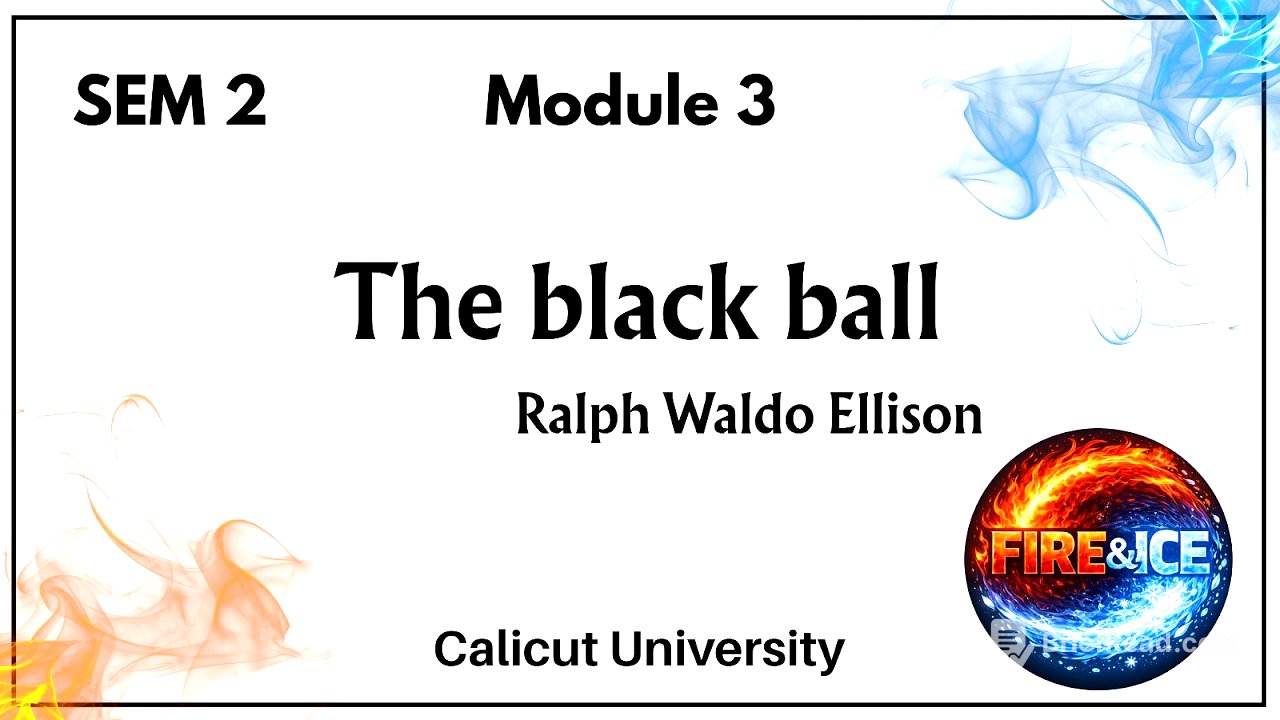
The short story "The Black Ball" by Ralph Waldo Ellison explores themes of racial discrimination and the loss of innocence through the experiences of a black man and his son. The story follows the man's interactions with a white union organizer and a prejudiced boss, highlighting the challenges and complexities of race relations. Ultimately, the story underscores the harsh realities of racial prejudice and its impact on a young child's understanding of the world.
- Racial discrimination and prejudice
- Loss of innocence
- The complexities of race relations
Introduction [0:11]
The video introduces "The Black Ball," a short story by Ralph Waldo Ellison, an American literature figure, focusing on themes of racial discrimination and the innocence of a young black boy.
A Day's Work and a Child's Question [2:00]
The narrator describes his busy morning at work, including helping Mrs. Johnson, who has a new baby. He then goes to dress his son, who asks him, "Daddy, am I black?" The narrator responds that he is brown, not black, after his son mentions that Jackie called him black. The narrator tries to reassure his son that brown is better than white, but emphasizes that being American is best.
A Red-Faced Man and Polishing Brass [5:33]
While polishing brass at work, the narrator notices a lean, red-faced man watching him. He focuses on his work, knowing that the manager, Bry, values the luster of the brass as a measure of his industry. The narrator recalls that two other black employees were dismissed because white people demanded their jobs. He is concerned about maintaining his job because he needs to provide for his son and plans to return to school.
An Offer of Tobacco and a Union Proposition [8:10]
The red-faced man approaches the narrator and offers him tobacco. The man reveals that he is from the union and wants to organize the building service help in the district, promising shorter hours, higher wages, and better conditions. The narrator is skeptical, believing that unions do not want black members.
Scars of Alabama [12:05]
The man reveals that he received scars in Mon County, Alabama, for defending a black friend who was falsely accused of rape. He recounts how the friend was lynched and his house burned down. The man explains that he has been working to organize croppers and has moved around to different states to continue his work. He invites the narrator to a series of meetings.
The Manager's Inspection and a Child's Play [15:44]
Mr. Bry arrives and inspects the brass, satisfied with the narrator's work. The narrator returns to his quarters and finds his son playing with a toy truck. They have a lighthearted conversation about trucking. The narrator tries to study but is distracted by thoughts of the red-faced man and his scarred hands.
Trucks and Buttons [18:30]
The son tells his father that he wants to drive a truck when he grows up and wear buttons on his cap like the colored men who deliver meat to the grocery store. The narrator looks at his son, considering his future.
Children at Play [19:37]
Looking out the window, the narrator observes children playing, including Jackie, the gardener's son. He recalls that Jackie was the one who called his son black. The narrator's son asks to play with his ball, and the narrator allows him to play in the back, warning him not to ask too many questions.
The Missing Ball and a Confrontation [22:32]
The narrator falls asleep and wakes up to find his son missing. He searches for him and eventually finds him in front of the building, where Mr. Bry confronts them. Bry is angry that the boy has ruined one of his plants with his ball and warns the narrator that if it happens again, he will find himself "behind the black ball."
The Meaning of the Black Ball [26:19]
The narrator takes his son back to their quarters and tends to a scratch on his hand. His son asks what Mr. Bry meant by "the black ball." The narrator explains that it means he would be in trouble if his son's ball landed in Bry's office again. The son observes that the white man cannot see very well because his ball is white.
A White Ball and a Card [28:14]
The narrator acknowledges that his son's ball is white. He reflects on the game his son will have to play in life and decides to tell him the rules later. As he waters the lawn, he thinks about the red-faced man's fried hands and checks to make sure he still has the card the man gave him, wondering if there is a color other than white in the world.
Conclusion [29:46]
The video concludes by summarizing the story's themes of constant fights, the innocence of the child, and racial discrimination.