TLDR;
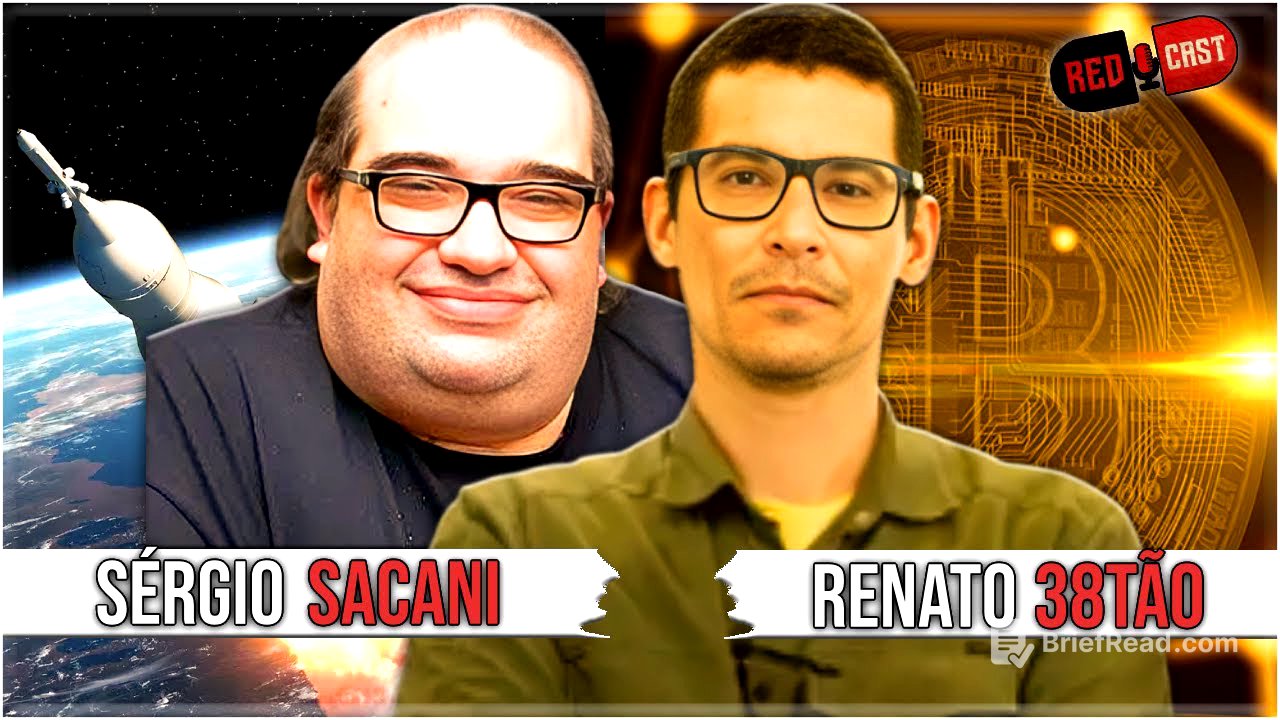
This RedCast episode features Junior Masters, Renato 38, and Serjão discussing a wide range of topics, from flat Earth theories and space exploration to economic policies and personal anecdotes. They touch on the influence of religion on beliefs, the importance of questioning established narratives, and the potential for technological advancements to shape the future. The conversation also explores societal trends, economic challenges, and the importance of individual preparedness in an ever-changing world.
- The origin of flat Earth beliefs is rooted in religion.
- The importance of considering the Earth's curvature in practical applications like oil exploration.
- The potential of lunar resources, particularly Helium-3, to revolutionize energy production.
- The impact of government policies and economic structures on individual freedom and societal well-being.
- The importance of critical thinking, questioning established narratives, and seeking diverse perspectives.
Intro [1:31]
Junior Masters welcomes viewers to another episode of RedCast, joined by Renato 3 and Serjão, promising an episode full of knowledge and information. Renato 3 jokes about his recent podcasting spree in Orlando and mentions upcoming episodes with guests like Miguel Milhão and Carol Dias. Serjão is introduced as an expert in rockets and geophysics, with a wealth of experience, including time at the International Space Station.
Flat Earth Theory [3:26]
The hosts begin by discussing the flat Earth theory, with Serjão explaining how his knowledge of navigation and celestial bodies proves the Earth is a sphere. He points out that the positions of stars and the moon's angle change with latitude, which wouldn't be possible on a flat Earth. Renato 3 adds that the flat Earth movement gained traction in 2015 due to endorsements from celebrities like rapper B.o.B. and a basketball player. He recounts his experiences debating flat Earthers, including an incident where he was nearly attacked after a debate.
The Religious Origin of Flat Earth Beliefs [7:23]
Renato 3 explains that the flat Earth movement is rooted in religious beliefs, with proponents often citing biblical verses to support their claims. He states that he avoids debating the topic using the Bible because it is not a productive approach. He prefers to focus on scientific evidence and logical arguments. Renato 3 also clarifies the difference between those who have doubts about the shape of the Earth and those who vehemently defend the flat Earth theory.
The Bible as Metaphor [9:10]
The hosts discuss how the Bible often uses metaphors and analogies to explain complex concepts, especially when communicating with those who may not have the scientific knowledge to understand them literally. They use the story of Noah's Ark as an example, suggesting that it could be interpreted as a metaphor for preserving DNA rather than physically housing all animals on a boat.
The Curvature of the Earth and Oil Exploration [11:40]
Serjão, a geologist, challenges flat Earthers to provide calculations that account for a flat Earth when locating oil reservoirs. He explains that oil exploration relies on considering the Earth's curvature, and without it, finding oil would be impossible. He emphasizes that the gasoline in cars is a direct result of calculations that acknowledge the Earth's spherical shape.
Monark's Changing Views [13:17]
The conversation shifts to Monark, who now admits the Earth is not flat and that satellites exist. Renato 3 recounts how seeing rocket launches in Florida changed Monark's perspective. He also shares an anecdote about a test where he was asked about the speed of light, highlighting the difference between general knowledge and specialized expertise.
The Value of Knowledge and Intelligence [16:23]
The hosts discuss how intelligence is measured in tests, noting that there are different categories, including problem-solving, cultural knowledge, and innate abilities. They agree that formal education can provide certain advantages, but it doesn't necessarily equate to overall intelligence or success.
Monark and the Moon Landing [17:48]
Monark still questions the moon landing, despite accepting the existence of satellites. Renato 3 mentions receiving a book arguing that the moon landing was faked. The hosts discuss the evidence for the moon landing, including moon rocks and retroreflectors left on the moon. They also address the argument that if we went to the moon, why haven't we returned, explaining that the initial goal was simply to prove superiority over the Soviet Union.
The Space Race and Propaganda [25:39]
The hosts discuss how the space race was largely driven by propaganda and the desire to demonstrate technological superiority. They compare it to the Nazis' use of the Hindenburg airship to project power and influence. They also touch on the current space race between the United States and China, driven by the potential for lunar industrialization and the extraction of Helium-3.
Helium-3 and the Future of Energy [27:11]
The discussion centers around the potential of Helium-3, found on the moon, to revolutionize energy production through nuclear fusion. Serjão explains that China has already mapped the Helium-3 resources on the moon, giving them a significant advantage. He also mentions Russia's recent launch of secret military satellites, highlighting the growing importance of space in geopolitics.
Dyson Spheres and Space Colonization [29:48]
The hosts discuss alternative energy solutions, including Dyson spheres, which would capture the sun's energy. They also explore the idea of using lasers to propel spacecraft, enabling faster travel to distant stars. They emphasize that the primary motivation for space colonization is economic, with the potential for cheaper satellite launches from the moon.
Freeman Dyson and Kardashev Scale [33:56]
The hosts explain Freeman Dyson's concept of capturing the sun's energy using a Dyson sphere or Dyson swarm. They also reference the Kardashev scale, which categorizes civilizations based on their energy consumption, with humanity currently at a 0.6. They discuss the potential for using lasers to propel spacecraft, enabling faster travel to distant stars.
The Problem with Current Energy Production [37:04]
The hosts discuss the problems with current energy production methods, which are largely based on fossil fuels. They note that even alternative energy sources like electric cars have their own environmental challenges, such as battery disposal. They emphasize the need for a transition to cleaner energy sources, such as nuclear fusion.
The Promise of Nuclear Fusion [39:17]
The hosts discuss the promise of nuclear fusion as a clean and sustainable energy source. They mention that many startups in the United States are developing small fusion reactors, with Bill Gates investing in several of them. They acknowledge that fusion technology is still in its early stages, but it has the potential to solve the world's energy problems.
The Importance of Energy and Space Colonization [42:27]
The hosts reiterate that energy is the biggest problem facing humanity and that space colonization is essential for securing future energy resources. They discuss the potential for mining Helium-3 on the moon and using it to power fusion reactors on Earth. They also touch on the importance of having a secure and decentralized financial system, such as Bitcoin, to protect against government control.
The Problem of Declining Birth Rates [1:02:03]
The hosts discuss the global trend of declining birth rates, attributing it to economic pressures, the high cost of raising children, and changing societal values. They reference experiments like Universe 25 and Paradise of Rats, which suggest that stress and societal factors can negatively impact reproduction. They also touch on the role of women in society and the potential consequences of prioritizing career over family.
The Third Law of Newton and Societal Reversal [1:08:10]
The hosts discuss the third law of Newton, suggesting that every action has an equal and opposite reaction. They apply this concept to societal trends, arguing that the excesses of modern society will eventually lead to a reversal. They point to the rise of traditional values and religious movements as evidence of this trend.
The Consequences of Welfare and State Control [1:14:10]
The hosts discuss the negative consequences of welfare programs and state control, arguing that they can undermine individual responsibility and family structures. They reference the "mamãe falei" quote about women being less likely to engage in prostitution if they are wealthy, suggesting that financial independence can reduce reliance on men. They also touch on the potential for false accusations and the need for legal protections.
The Importance of Family and Traditional Values [1:16:12]
The hosts emphasize the importance of family and traditional values, arguing that they provide stability and security. They suggest that the decline of these values is contributing to societal problems, such as declining birth rates and mental health issues. They also touch on the importance of intergenerational connections and the role of fathers and grandfathers in providing guidance and support.
The Role of Education and Skills [1:17:51]
The hosts discuss the role of education and the skills that are necessary for success in the modern world. They argue that traditional education often fails to prepare young people for the challenges they will face, emphasizing the importance of practical skills and real-world experience. They also touch on the limitations of formal education and the potential for self-taught individuals to excel.
The Importance of Opportunity and Mentorship [1:21:12]
The hosts discuss the importance of providing opportunities for everyone, regardless of their background or abilities. They argue that even those who struggle in traditional academic settings may find success in other areas. They also emphasize the importance of mentorship and guidance in helping young people develop their skills and find their path.
The Value of Connections and Real Education [1:28:06]
The hosts discuss the value of connections and real education, arguing that they are more important than formal qualifications. They emphasize the importance of building a network of people who can provide support and opportunities. They also touch on the importance of being able to produce useful things and contribute to society.
The Inevitable Collapse and the Rise of Bitcoin [1:30:11]
The hosts discuss the inevitable collapse of the current societal and economic system, arguing that it is unsustainable. They suggest that Bitcoin will play a key role in the new world order, providing a decentralized and secure financial system. They also touch on the importance of being prepared for the collapse and having a plan for survival.
The Importance of Mobility and Bitcoin [1:35:30]
The hosts emphasize the importance of mobility and having assets that cannot be easily seized by governments or other entities. They suggest that Bitcoin is a key tool for achieving this, allowing individuals to protect their wealth and maintain their freedom. They also touch on the potential for governments to confiscate Bitcoin, urging listeners to take control of their own private keys.
The DREX and Government Control [1:40:00]
The hosts discuss the DREX, Brazil's central bank digital currency, and the potential for it to be used for government control. They argue that the DREX is the opposite of Bitcoin, as it would give the government the ability to track and control all financial transactions. They urge listeners to resist the DREX and embrace Bitcoin as a tool for financial freedom.
The Potential for Government Confiscation of Bitcoin [1:43:31]
The hosts discuss the potential for governments to confiscate Bitcoin, drawing parallels to the US government's confiscation of gold in the 1930s. They urge listeners to take control of their own private keys and avoid storing Bitcoin on exchanges or in custodial wallets. They also suggest that it may be necessary to leave the country to protect one's Bitcoin.
The Importance of Communication and Decentralization [1:52:27]
The hosts discuss the importance of communication and decentralization in the face of increasing censorship and control. They mention Nostr, a decentralized social network, as a potential alternative to mainstream platforms. They also touch on the challenges of building and maintaining decentralized systems.
The Monopoly of Big Tech [1:57:37]
The hosts discuss the monopoly of Big Tech companies, such as Meta, and the challenges of competing with them. They acknowledge that these companies provide valuable services, but they also express concern about their power and influence. They touch on the importance of supporting alternative platforms and promoting decentralization.
The Elon Musk and Alexandre de Moraes Situation [2:01:02]
The hosts discuss the situation between Elon Musk and Alexandre de Moraes, arguing that it is largely a power struggle between two powerful individuals. They suggest that both Musk and Moraes are benefiting from the situation, while ordinary people are being harmed. They also touch on the importance of having access to uncensored information.
The Future of Technology and Society [2:03:19]
The hosts discuss the future of technology and society, touching on topics such as synthetic assets, decentralized betting markets, and the potential for technological advancements to solve societal problems. They also emphasize the importance of critical thinking, questioning established narratives, and seeking diverse perspectives.
The Importance of Real Investments [2:05:34]
The hosts discuss the importance of making real investments, such as health, education, and relationships, rather than relying solely on financial assets. They argue that these real investments are more likely to provide long-term security and fulfillment. They also touch on the importance of being prepared for potential societal collapse.
The Importance of Leaving the Country [2:08:56]
The hosts discuss the importance of having a plan for leaving the country if necessary. They suggest that it may be necessary to move to a more stable and free society to protect one's wealth and freedom. They also touch on the potential for economic opportunities in other countries.
The Operation Paperclip [2:13:38]
The hosts discuss the Operation Paperclip, a secret United States intelligence program in which more than 1,600 German scientists, engineers, and technicians were taken from former Nazi Germany to the U.S. after the end of World War II. They also touch on the Soviet Union's efforts to acquire German technology and expertise.
The Importance of Technology and Military Power [2:15:10]
The hosts discuss the importance of technology and military power in shaping the world order. They point to the Soviet Union's transformation from a feudal society to a technological superpower as an example of the power of innovation. They also touch on the importance of having a strong military to protect one's interests.
The Importance of Self-Reliance and Community [2:19:46]
The hosts discuss the importance of self-reliance and community in the face of potential societal collapse. They suggest that it may be necessary to learn survival skills and build relationships with like-minded individuals. They also touch on the importance of having a plan for providing for one's own needs.
The Importance of a Boat [2:22:48]
The hosts discuss the importance of having a boat as a means of transportation and survival. They argue that a boat can provide access to resources and allow individuals to escape from dangerous situations. They also touch on the importance of learning how to sail.
The Importance of Community and Conversation [2:32:15]
The hosts emphasize the importance of community and conversation, arguing that they are essential for mental health and well-being. They urge listeners to connect with others and engage in meaningful dialogue. They also touch on the importance of being open to different perspectives.
The Importance of the Third Law of Newton [2:45:00]
The hosts discuss the importance of the third law of Newton, suggesting that every action has an equal and opposite reaction. They apply this concept to societal trends, arguing that the excesses of modern society will eventually lead to a reversal. They point to the rise of traditional values and religious movements as evidence of this trend.
The Importance of the Past [2:54:31]
The hosts discuss the importance of the past, arguing that it can provide valuable lessons for the present and future. They point to the decline of the Roman Empire as an example of a society that collapsed due to internal problems. They also touch on the importance of learning from history and avoiding the mistakes of the past.
Outro [2:59:30]
The hosts thank the audience for watching and promote their respective channels and projects. They also express their desire to continue the conversation and explore new topics in future episodes.