TLDR;
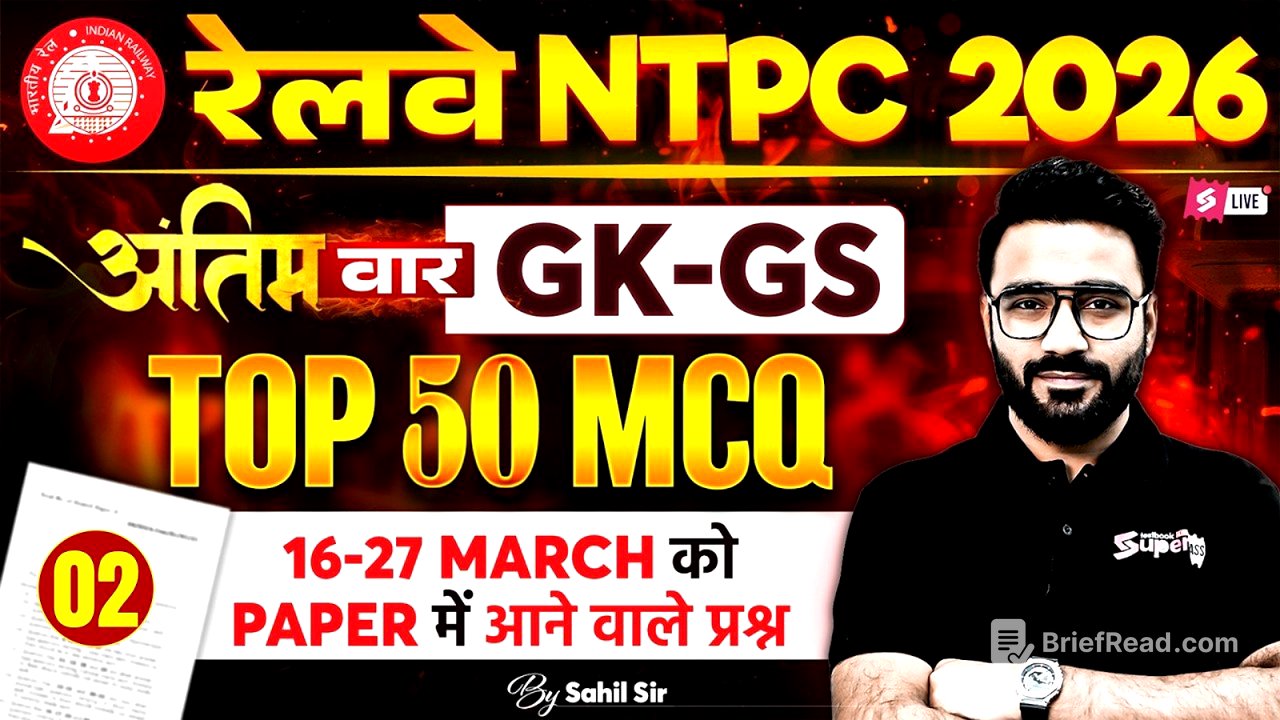
This YouTube video by Railway Testbook is a comprehensive preparation session for the upcoming NTPC exam, covering static GK, amendments, articles, and a live mock test. The session includes 30 static GK questions, 10 amendment-related questions, 10 article-related questions, and a live mock test from the Testbook application.
- Static GK
- Amendments
- Articles
- Live Mock Test
Introduction [0:03]
The instructor welcomes students to the class, which is designed for those preparing for the NTPC exam starting March 16th, as well as undergraduate students. The session will cover 30 static GK questions, 10 questions on amendments, 10 on articles, and a mock test using the Testbook application.
Static GK Questions [1:47]
The session begins with static GK questions, such as where the Harihar Kshetra Mela (also known as Sonpur Mela) is celebrated, which is in Bihar. Another question asks which religious community primarily celebrates the Pateti festival, with the answer being the Parsi community, mainly in Maharashtra and Gujarat. The discussion includes various festivals and their locations, such as the Kharchi Puja in Tripura, the Bangala Festival in Meghalaya, and the Ambubachi Festival at the Kamakhya Temple in Assam.
More Festivals and Fairs [3:18]
The lecture continues with questions about the Bhagwal fair in Devidhura and the association of the Ambubachi festival with the Kamakhya Temple in Guwahati, Assam. It identifies the Wangala Festival celebrated in Meghalaya and the Yaoshang festival in Manipur. The session also covers the Chapchar Kut festival in Mizoram and Asia's first floating festival held in Mandsaur, Madhya Pradesh.
Shopping Festivals and Cultural Events [6:01]
The discussion shifts to India's largest shopping festival in Delhi in 2023 and the Palki festival in Maharashtra. The Surajkund International Fair, located in Faridabad, Haryana, is highlighted for its global recognition. The Shanghai festival, a cultural event, is celebrated in Manipur, and the Ganga Sagar Mela in West Bengal is noted as one of the largest gatherings after the Kumbh Mela.
Festivals Across India [9:42]
The session continues with the Motsu festival in Nagaland, known as the "Land of Festivals," and other significant festivals like the Hornbill Festival. It identifies the Chhath Puja as a festival dedicated to the Sun God and his wife Usha. The Navchandi Mela is celebrated in Meerut, and the Jawa cultural festival is observed in Jharkhand.
More Cultural Festivals and State Capitals [12:42]
The lecture covers the Khajuraho Dance Festival in Madhya Pradesh, prompting a question about the state's capital. The Pushkar Camel Fair in Rajasthan and the Thyagaraja Aradhana festival in Thanjavur, Tamil Nadu, are also discussed. The session identifies the Rasleela, Yaoshang, and Lai Haraoba festivals celebrated in Manipur and the Onam festival in Kerala.
Festivals in Jammu & Kashmir, Sikkim, and New Year Celebrations [16:16]
The discussion includes the Herath festival in Jammu & Kashmir and the Losar festival in Sikkim. Ugadi is identified as the Telugu New Year. The instructor explains various New Year celebrations across India, such as Baisakhi in Punjab, Navreh in Jammu & Kashmir, Losoong in Sikkim, Bohag Bihu in Assam, and Puthandu in Tamil Nadu.
Temple Festivals and Cultural Initiatives [19:01]
The session covers the Thrissur Pooram festival at the Vadakkunnathan Temple in Kerala and the Khel Mahakumbh 2024 held in Haryana. The Umang Rangoli festival is organized by the Ministry of Culture, and the Saga Dawa or Triple Blessed Festival is celebrated in Sikkim.
Amendments to the Constitution: Introduction [20:53]
Transitioning to the next segment, the instructor introduces questions related to amendments to the Indian Constitution. The first question concerns which constitutional amendment increased the number of Lok Sabha members elected from the states, with the correct answer being the 7th and 31st Amendments.
Amendments Related to Lok Sabha and Constitution Parts [22:12]
The discussion includes the 104th Amendment in 2019, which removed Anglo-Indian members from the Lok Sabha and state legislative assemblies, effective in 2020. The segment also identifies Part 20 of the Indian Constitution as related to constitutional amendments, as well as Article 368.
Amendments and Council of Ministers [24:35]
The 91st Amendment in 2003 is highlighted, which limited the size of the Council of Ministers to 15% of the total number of members of the Lok Sabha. The session also covers the addition of languages to the Eighth Schedule through various amendments, including the 92nd Amendment, which added Bodo, Dogri, Maithili, and Santhali.
Amendments and Union Territories [27:29]
The 10th Amendment added Dadra and Nagar Haveli as a Union Territory, while the 12th Amendment added Goa, Daman, and Diu. The 69th Amendment granted Delhi a legislative assembly and the status of a National Capital Territory (NCT) in 1991.
Amendments and Socially Backward Classes [31:58]
The 105th Amendment empowered states to recognize socially and educationally backward classes (OBCs). The 101st Amendment is associated with the introduction of the Goods and Services Tax (GST), and the 106th Amendment discusses the Nari Shakti Adhiniyam, which reserves 33% of seats in the Lok Sabha and state legislative assemblies for women.
GST and Language Amendments [32:52]
The session revisits the 101st Amendment, which introduced GST in 2016 and was implemented in 2017. It also reiterates that the 92nd Amendment added Bodo, Dogri, Maithili, and Santhali to the Eighth Schedule of the Constitution.
Questions on Articles of the Constitution [35:16]
The lecture transitions to questions about specific articles of the Indian Constitution. It identifies that Article 17 deals with the abolition of untouchability, not the abolition of titles (which is Article 18). Articles 2 and 3 both address the formation of new states, but Article 3 specifically concerns states within India.
DPSP, Vice President, and Ordinance Power [38:09]
The session covers that Articles 36-51 discuss the Directive Principles of State Policy (DPSP), which were borrowed from Ireland. Article 63 states that there shall be a Vice President of India. Article 123 grants the President the power to issue ordinances, while Article 213 grants the same power to the Governor.
Residuary Powers, Right to Property, and Uniform Civil Code [39:51]
Article 248 vests residuary powers with the Union. The right to property is identified as a legal right under Article 300A, having been changed from a fundamental right by the 44th Amendment in 1978. Article 44 discusses the Uniform Civil Code (UCC).
Financial Emergency and Rajya Sabha [41:57]
Article 360 concerns financial emergencies, which have never been imposed in India. Article 80 discusses the Rajya Sabha, with a maximum strength of 250 members, including 238 from states and Union Territories and 12 nominated by the President.
Live Mock Test Introduction [43:06]
The instructor transitions to a live mock test using the Testbook application. He encourages students to note the current affairs classes that occur every day at 1 PM.
Live Mock Test [44:48]
The instructor takes a live mock test, answering questions such as who was appointed as the Chief Information Commissioner (Rajkumar Goyal), what kind of tools were used by Harappan people (bronze), and when Vijay Diwas is celebrated (December 16). Other questions include India's first interplanetary mission (Mangalyaan) and the association of the Bharat Mala project (highways).
Padma Awards and Economic Survey [46:30]
The mock test continues with questions about which Padma award Rohit Sharma received (Padma Shri), which part of the Indian Constitution discusses the Union Executive (Part Five), and India's rank in service exports according to the Economic Survey 2025-26 (seventh).
Forward Bloc and Geography Question [47:47]
The test includes questions about who founded the Forward Bloc (Subhas Chandra Bose) and a geography question requiring arranging mountain ranges from south to north. The instructor successfully completes the mock test, scoring 10 out of 10.
Conclusion and Marathon Announcement [49:50]
The instructor announces upcoming marathon sessions, including mathematics on the 12th, reasoning on the 13th, and a general studies and current affairs marathon on the 14th. The session concludes with a thank you and encouragement for students to like the video, subscribe to the channel, and share their mock test scores in the comments.