TLDR;
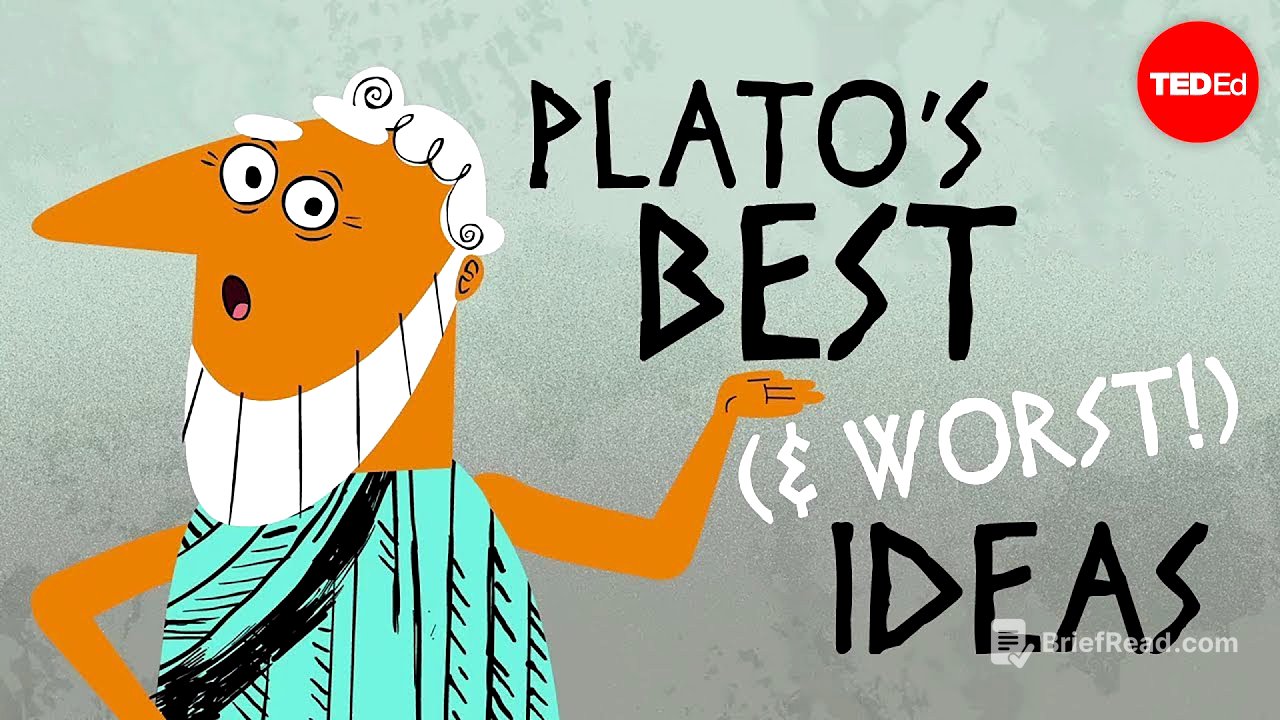
This video explores the enduring influence of Plato, highlighting both his groundbreaking ideas and some of his less successful ones. It covers his theory of Forms, his contributions to political theory including the concept of the philosopher king, and some of his outdated views on women and social structure. The video emphasizes that while not all of Plato's ideas have stood the test of time, his work provided a crucial foundation for Western thought and continues to be debated and refined today.
- Plato's theory of Forms posits a perfect, unchanging world that serves as a blueprint for our imperfect reality.
- He was a pioneer in political theory, advocating for philosopher kings and, surprisingly for his time, equal ability for women to rule.
- Some of Plato's ideas, such as his views on women and the "noble lie," have been criticized and discredited.
Introduction [0:07]
Plato's profound influence on the world and contemporary thinkers is discussed, noting that one 20th-century philosopher described Western philosophy as footnotes to Plato. He founded the first Western university and taught influential figures like Aristotle. However, the video acknowledges that Plato's ideas were not all perfect and some have not aged well. The video will explore some of Plato's best and worst ideas.
The Theory of Forms [0:44]
Plato's theory of Forms suggests that beyond our imperfect world exists a perfect, unchanging realm of ideal versions of things and concepts. These Forms serve as instruction manuals for our world, including ideal versions of objects, concepts, and virtues. Our reality consists of imperfect copies of these Forms, and philosophers should strive to understand them to navigate our misleading reality. The video emphasizes the philosophical problem of the disconnect between appearance and truth, and Plato's belief in reason as the means to contemplate the Forms.
Plato's Imperfect Reasoning [1:57]
The video transitions to one of Plato's less successful ideas, recounting how he classified humans as "featherless bipeds." This definition was famously challenged by Diogenes the Cynic, who presented a plucked chicken as "Plato's man."
Political Theory and the Philosopher King [2:22]
Plato is recognized as one of the earliest political theorists, who believed that ruling requires mastery, similar to any other craft, and should be entrusted to those who have contemplated the Forms. In his Republic, Plato envisioned a utopia led by a philosopher king, aiming for justice and harmonious balance. He also proposed that women were equally capable of ruling in this ideal city, which was a progressive idea for the time.
Inconsistencies and Problematic Ideas [3:07]
The video highlights Plato's inconsistencies, noting that he sometimes likened women to children and held incorrect beliefs about their anatomy. He also advocated for a society divided into producers, the military, and rulers, maintained by a "noble lie." This lie involved the idea that people are born with different metals in their souls (gold, silver, or a mixture of brass and iron) determining their roles in society. Some thinkers have associated this "noble lie" with 20th-century propaganda and the philosopher king with dictators.
Conclusion [4:06]
The video concludes by asking whether Plato's flawed ideas diminish his status as a great philosopher. It asserts that they do not, because Plato provided a starting point for subsequent thinkers. Over the centuries, his ideas have been tested, refined, and edited, forming the foundations of the modern world.