TLDR;
This video explains passive transport, which involves the movement of particles across the cell membrane from an area of higher concentration to an area of lower concentration without using energy. The three main types of passive transport discussed are diffusion, osmosis, and facilitated diffusion. Each type is illustrated with examples and explanations to clarify how they work.
- Passive transport moves particles from high to low concentration without energy.
- The types of passive transport include diffusion, osmosis, and facilitated diffusion.
Passive Transport Overview [0:03]
The video introduces the concept of passive transport, highlighting its key characteristic of moving particles from areas of higher concentration to lower concentration without the use of energy. This process is described as movement along the concentration gradient.
Types of Passive Transport [0:25]
The narrator presents the three types of passive transport: diffusion, osmosis, and facilitated diffusion.
Diffusion Explained [0:35]
Diffusion is explained using a visual example of a solution in a container, where the aqua color represents the solvent and the yellow particles represent the solute. The semi-permeable cell membrane allows certain particles to pass freely. Solute particles will move from an area of high concentration to low concentration until equilibrium is achieved, where both sides have equal solute particles.
Natural Process of Diffusion [1:56]
An everyday example of diffusion is offered: spraying air freshener in a room. Initially, only nearby individuals smell it, but over time, the scent spreads, demonstrating how diffusion naturally occurs without needing energy, similar to a ball rolling down a hill.
Osmosis Introduced [2:50]
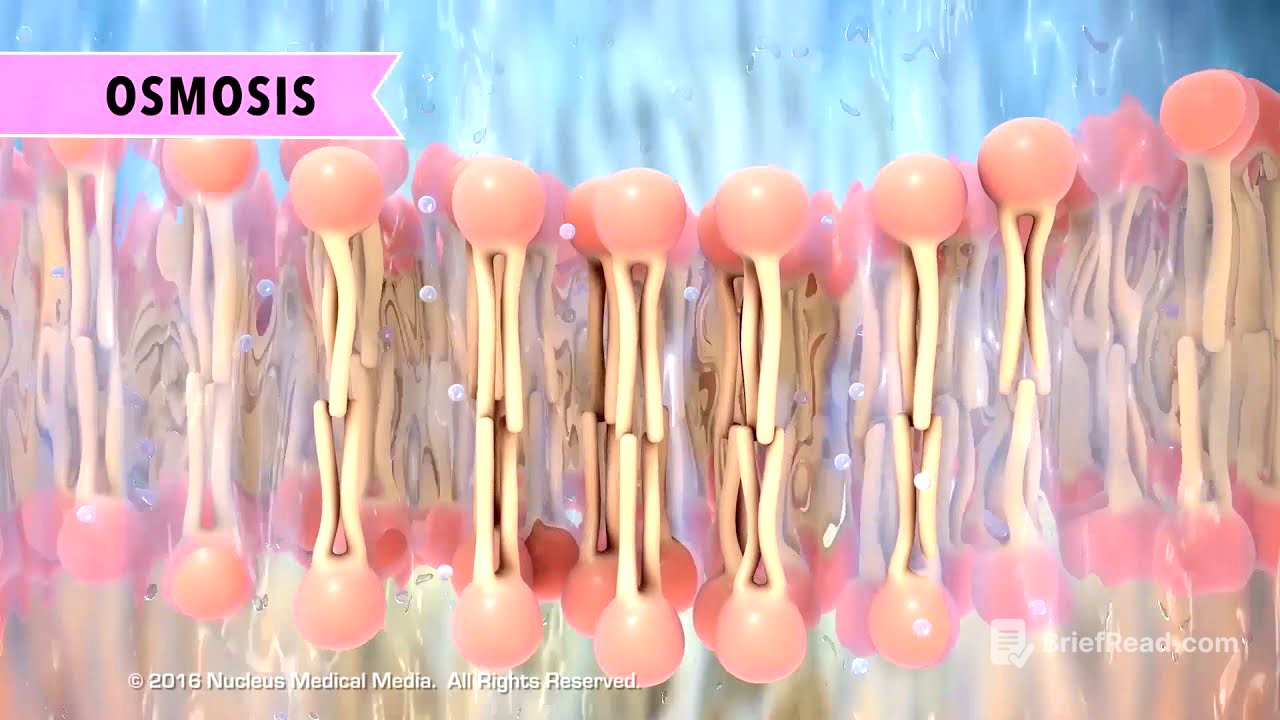
Osmosis is defined as the diffusion of water molecules. An example is given with a container where water can pass through a membrane, but larger solute particles cannot. Water will move from an area of high concentration to low concentration until an equilibrium is reached, ensuring the proportion of water to solute particles is balanced on both sides.
Equilibrium in Osmosis [3:44]
Osmosis in a cell context means that water can enter or leave the cell through its membrane until it achieves equilibrium with its surroundings. Like diffusion, osmosis occurs passively without any energy requirement.
Facilitated Diffusion Overview [4:12]
Facilitated diffusion involves molecules moving through specialized protein channels in the cell membrane. These protein channels act as ports or tunnels that allow substances to enter or exit the cell. It also follows the principle of moving from high to low concentration but is essential for larger particles that cannot pass through the membrane's phospholipid layers.
Summary of Passive Transport [5:11]
The video concludes by summarizing that passive transport is a natural process requiring no energy expenditure from the cell, with the three types being diffusion, osmosis, and facilitated diffusion.