TLDR;
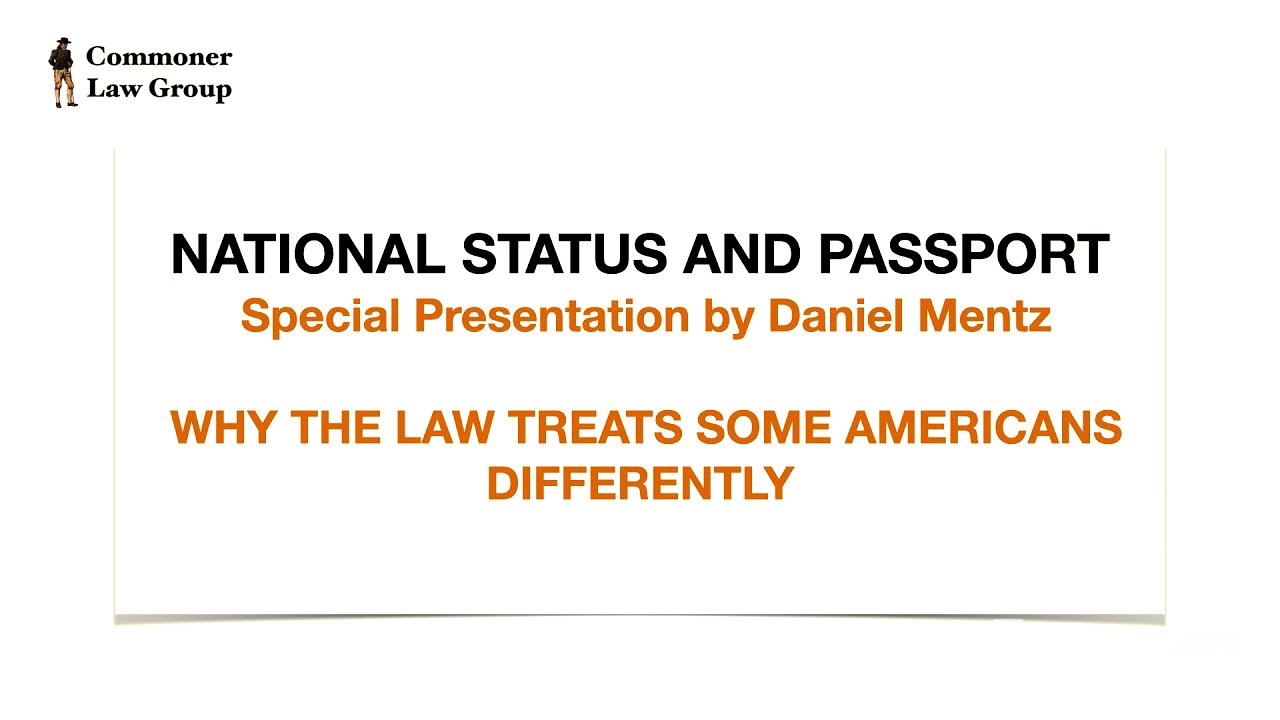
This presentation by Daniel Menz from the Sacred Honor Educational Fellowship, hosted by Clint Greece of Commoner Law Group, introduces the concept of national status and passport as a pathway to changing one's relationship with the legal system and government. It covers the history, legal basis, and practical applications of national status, distinguishing it from other movements like state nationals or sovereign citizens. The presentation emphasizes verifiable information, using standing case law, official policy documents, and historical evidence.
- National status is presented as a way to reclaim individual sovereignty and exit the "B system."
- The presentation highlights the importance of understanding dialectics and the dual system of citizenship in the United States.
- Practical benefits and drawbacks of national status are discussed, along with real-life examples and testimonials.
Introduction to National Status [0:04]
Clint Greece introduces Daniel Menz, emphasizing his extensive experience and customized presentation for the Commoner Law Group. The presentation aims to educate attendees on transitioning from US citizen to national status, including its implications and benefits. Material and spiritual advantages of exiting the "B system" are highlighted, followed by a Q&A session. Daniel Menz shares his journey into this field, sparked by questions about governmental overreach in 2020 and guided by Roger Sales' teachings on private remedies and equity.
Overview of the Presentation [4:45]
Daniel Menz introduces the national status and passport pathway, one of four pathways offered by the Sacred Honor Educational Fellowship. He emphasizes the importance of understanding the facts to make informed decisions and undo the programming related to status, legal versus lawful rights, and their origins. The presentation is based on extensive research and knowledge accumulated since 2007. Daniel clarifies that "status correction" is about changing one's relationship with the legal system, not correcting an error, but addressing fraud, deception, and mind control.
Daniel's Background and Mission [7:59]
Daniel shares his background as an ex-Hollywood filmmaker who left the industry due to its content. Inspired by David Icke and Roger Sales, he met Michael Joseph in 2022 and began teaching status correction. His mission is to clarify the confusion surrounding status correction by providing clear, cohesive information backed by legal and lawful proof. He stresses that everything presented is verifiable through standing case law, official policy documents, and historical evidence, encouraging viewers to verify the information themselves.
Understanding Citizenship and Rights [12:27]
Daniel asserts that US citizens are considered property, while nationals/state citizens are not, presenting four Supreme Court decisions to support this distinction. These cases highlight that 14th Amendment privileges protect federal rights, not state citizenship rights, and that the only absolute right of US citizenship is residence within the US. He questions why state citizenship, with its inherent natural rights, is not commonly taught despite Supreme Court recognition.
Dialectics and the Matrix [16:06]
Daniel introduces the concept of dialectics, emphasizing its importance in understanding how the world and governments operate. He defines dialectics as a fallacy that depends on the double meaning of words and ambiguous expressions used to mislead. He contrasts being free versus being a slave (or in bondage), and explains how legal language exemplifies dialectics, particularly in the multiple, conflicting definitions of "person" in Black's Law Dictionary.
Pre-Civil War America and the 14th Amendment [19:08]
Daniel discusses the limited education on pre-Civil War America, highlighting that the country was founded under common law, honoring individual sovereignty and rights from a higher power. He notes the absence of personal income tax until 1913 and the freedom to travel and trade without permissions. The 14th Amendment marked the beginning of political status dialectics, where citizenship required being a citizen of one of the several states.
The Corporation of the United States [24:29]
Daniel explains that the "United States" equates to the federal corporation District of Columbia, established in 1871, while the "United States of America" represents the constitutional union. He cites US Code 28, §3002(15)(A) as proof that "United States" legally means a federal corporation. He contrasts this with the definition of "national" in Title 8 US Code §1101(a)(21), meaning a person owing permanent allegiance to a state.
Certificates of Non-Citizen Nationality [26:59]
Daniel references the State Department's official policy document, "Certificates of Non-Citizen Nationality," which states that all US citizens are US nationals. He explains that the pre-Civil War state citizen status was hidden behind American Samoan legislation, relabeled as "national." He emphasizes the importance of the small "s" in "state" within the definition of national, contrasting it with the capital "S" in "State," which includes the District of Columbia, Puerto Rico, Guam, and the Virgin Islands.
Jurisdiction and Allegiance [30:44]
Daniel connects the concept of jurisdiction to the ancient feudal system, where allegiance is exchanged for protection. He explains that permanent allegiance to a small "s" state equates to the pre-Civil War state citizen. He references the document's instruction to declare an intention to be a national but not a citizen of the United States via affidavit to the US Secretary, which he says is a way to exit the corporate legal fiction matrix.
The 14th Amendment and Dual System [33:23]
Daniel examines the 14th Amendment, pointing out that it does not definitively state that all persons born or naturalized in the United States are subject to its jurisdiction, implying a choice between common law and the federal corporation. He rephrases the common questions "Are you a citizen of the United States?" and "Are you a resident?" to reflect their legal meaning post-Civil War, indicating federal citizenship and protection. He cites Title 28, §1746, to show the dual system, where declarations under penalty of perjury differ based on whether they are executed within or without the federal corporation.
Income Tax and Non-Resident Alien Status [38:40]
Daniel examines Title 26 §1.1-1, noting that income tax is imposed on citizens or residents of the United States, not the United States of America. He explains that sections 871(b) and 877(b) of the code relate to constitutional taxes before the Civil War. He defines "non-resident alien" as another dialectic label for a free state citizen, who is non-resident to the residency established by the 14th Amendment and alien to federal citizenship.
Benefits and Drawbacks of National Status [42:03]
Daniel lists the benefits of national status, including the absence of a "do not detain" code on passports, no personal income tax, exemption from federal jurisdiction, and the power to dismiss traffic citations and jury duty. Additional benefits include reserving rights on contracts, protecting children from CPS and elders from APS, and opting out of selective service. Drawbacks include ineligibility for green card holders, federal office, military contracting, and federal student aid loans.
Real-Life Proof and Examples [44:11]
Daniel presents real-life proof, such as the passport's reference to "citizen/national" and the exclusion of nationals from the tax requirements listed on page seven. He shares a response from the California Attorney General's office addressing individuals as "private individuals," indicating a lack of jurisdiction. He also shows an unemployment insurance contract where nationals can apply and a Wise verification process that accepts a "national ID." Finally, he presents a pay stub showing no state or federal taxes taken out of the paycheck.
Clarifications and Testimonials [50:51]
Daniel clarifies that terms like "state national" and "American national" are not legitimate statuses. He shares testimonials from members who have successfully navigated the process and expresses gratitude for their success. He encourages viewers to grab the free ebook for more information and thanks them for their time.
Q&A Session Part 1 [56:19]
Daniel answers questions about which sections of the US Code nationals are still subject to, clarifying that few apply and often provide exemptions. He discusses positive versus non-positive law, explaining that while positive law follows proper legislative channels, its interpretation and implementation in the US Code and CFR can alter or invert its original intent. He also addresses TSA procedures for nationals, noting ongoing efforts to find ways to bypass certain requirements.
Q&A Session Part 2 [1:01:25]
Daniel addresses questions about opting out of federal income tax withholding and still being told to pay taxes, advising to reiterate national status documents. He clarifies the process for obtaining a "do not detain" status, emphasizing the importance of filing an affidavit with the US Secretary of State before applying for or renewing a passport. He compares Sacred Honor Educational Fellowship's pathway with Copper Moonshine, noting that while Copper Moonshine adjusts passport status, it lacks the broader application of an affidavit.
Q&A Session Part 3 [1:07:05]
Daniel discusses biometric requirements at airports, asserting that universal mandates are unlikely due to the voluntary nature of the system. He emphasizes the importance of opting out and asking questions to assert rights. He suggests Montana non-resident plates as a solution for vehicle registration and addresses veterans' benefits, confirming they remain intact with national status.
Q&A Session Part 4 [1:14:07]
Daniel addresses questions about the vehicle code, advising that while it technically doesn't apply to nationals, law enforcement may not agree. He suggests remedies like passport cards or Montana non-resident plates. He clarifies that veterans benefits are unaffected by changing political status. He discusses independent contractor status with state or federal agencies, advising transparency only when necessary.
Q&A Session Part 5 [1:19:49]
Daniel explains the process for parents to establish national status for their children, requiring both parents to become nationals first and sign a children's affidavit. He outlines the support provided by the Sacred Honor Educational Fellowship, including email support, monthly membership calls, and private consultations. He advises that existing contracts do not need review after becoming a national, as the affidavit disavows any previous contracts infringing on new rights.
Q&A Session Part 6 [1:24:20]
Daniel provides guidance on interacting with law enforcement during traffic stops, recommending a script based on equity and asking questions rather than making statements. He suggests carrying a passport card and invoking the Fifth Amendment. He acknowledges the complexity of national status for incarcerated individuals, suggesting equity pathways as a potentially better approach.
Course Overview and Additional Pathways [1:28:10]
Daniel describes the course structure, including five main video modules, bonus modules, monthly membership call archives, and Q&A modules, totaling 20-30 hours of content. He highlights the resources section with templates, documents, and PDFs for various situations, emphasizing ongoing updates. He briefly touches on additional pathways offered by the fellowship, including land patents, equity passage, and the trifecta trust model.
Closing Remarks and Testimonials [1:32:18]
Clint expresses gratitude to Daniel for the comprehensive presentation. Daniel shares a testimonial from John Casser, who commends his work in clarifying and presenting the information. Both thank the audience for their participation and express their commitment to the journey.