TLDR;
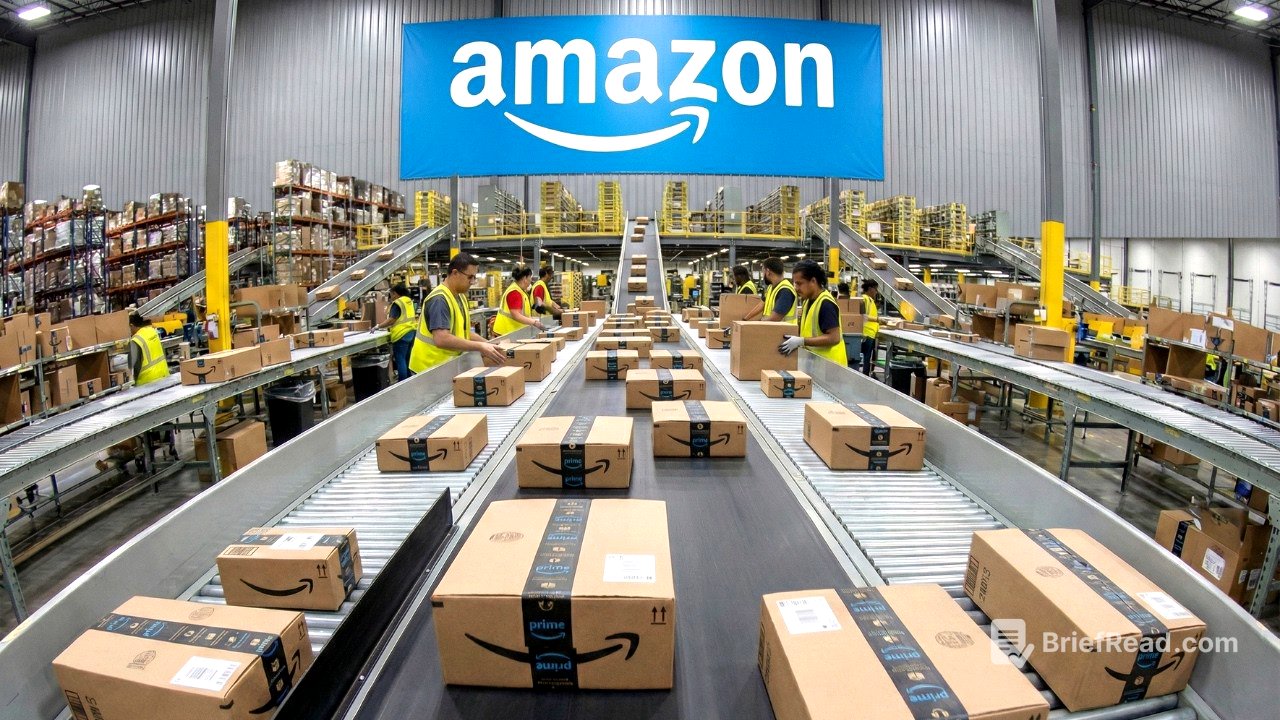
This video explains the complex logistics behind Amazon's fulfillment centers, detailing the journey of a product from arrival at the docks to final delivery. It covers the inbound process, chaotic storage system using robots, the picking process after a customer order, the packaging and labeling stages, and the final sorting and delivery to the customer's door.
- Inbound: Receiving and cataloging products.
- Storage: Chaotic storage system using robots.
- Outbound: Picking, packing, labeling, and shipping.
Introduction [0:00]
Every year, Amazon delivers over 5 billion packages worldwide, with approximately 66,000 orders placed every hour in the United States alone. The video explores the inner workings of an Amazon Fulfillment Center, from the moment goods arrive at the loading docks to when they are dispatched to the customer.
Inbound: Receiving and Cataloging [0:39]
The process begins when a customer sees an "in stock" message online, which represents a physical item in a vast warehouse. Goods arrive at the receiving docks via trucks from suppliers and manufacturers. The boxes are unloaded onto extendable conveyor belts and taken to a receiving station where employees scan the external barcode. The system identifies the contents, such as 100 phone cases, and registers them in the inventory. Products often arrive in large master cases from manufacturers and are transferred into yellow or black plastic containers known as totes. These totes move through the facility on miles of conveyor belts.
Chaotic Storage System [2:38]
Amazon uses a chaotic storage system, where items are not organized by category. A tube of toothpaste might be placed next to a book or a video card. Mobile robots bring shelves to stationary employees (Storers). The employee scans the item from the tote, places it in any available space on the shelf, and then scans the shelf. This creates a digital link, so the system knows the item's exact location. The item becomes instantly available for sale online. The robot then returns the shelf to a restricted area called the "robot dance floor." This random arrangement prevents congestion by ensuring that popular items are spread out, making them quickly accessible from various locations.
Outbound: Picking [4:49]
When a customer places an order, an algorithm determines the item's location, the nearest robot, the least busy packing station, and the fastest route to the customer. A robot retrieves the shelf and brings it to a picking station where a "picker" sees an image of the ordered product on a screen. The employee retrieves the product, checks its condition, scans the barcode, and places it in another tote on a conveyor belt. Once scanned, the system confirms the item is en route to packaging.
Packing and Labeling [5:52]
The tote with the product travels to a packing station. An employee scans the item, and the computer indicates the appropriate box size to minimize wasted space. The employee assembles the box, adds protective materials like air cushions or crumpled paper, and uses a tape machine that dispenses the exact amount of water-activated tape needed. The sealed box proceeds to the SL (Scan, Label, Apply, Manifest) area, where a scanner reads the internal code, and a machine prints and applies the shipping label with the customer's name and address. The box is then weighed to ensure accuracy.
Sorting and Delivery [7:32]
The labeled box moves to a sorter, where a mechanism pushes it onto a slide leading to the correct truck for its destination. Employees load the boxes into trucks, which are then sealed and dispatched. These trucks often go to a classification center where the process is simplified. Boxes are unloaded, scanned, and grouped on pallets by postal zones. These pallets are transported to delivery stations located near cities. During the night, the pallets are dropped off, and the boxes are sorted into delivery routes for vans. The van drivers load their vehicles with pre-defined routes and begin deliveries, with the system optimizing routes to save fuel and time. The driver's app indicates which package to deliver to each address.