TLDR;
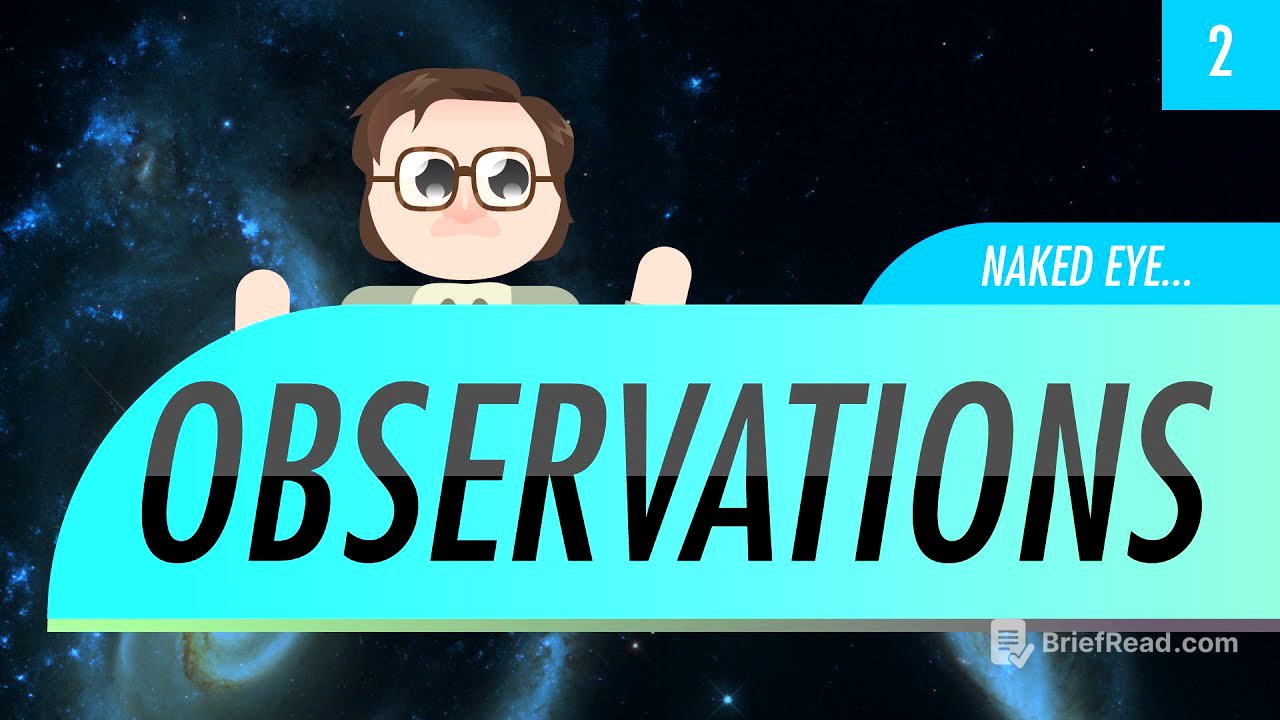
In this episode of Crash Course Astronomy, Phil Plait discusses naked-eye observations of the night sky. Key points include the visibility of thousands of stars, the varying brightness and distances of stars, the historical context of star cataloging, and the effects of light pollution.
- Naked-eye astronomy allows observation of stars without the use of telescopes or binoculars.
- The brightness of stars is influenced by both their intrinsic luminosity and distance from Earth.
- Constellations are human-made patterns that group stars, with 88 officially recognized constellations today.
- Light pollution significantly affects visibility of celestial objects, particularly fainter stars and the Milky Way.
- The movement of stars in the night sky is a result of Earth's rotation, leading to regional visibility differences based on location.
Naked Eye Observations [0:02]
Phil Plait introduces the concept of naked-eye observations in astronomy, emphasizing that no special instruments are needed to appreciate the night sky. He paints a picture of an ideal viewing scenario far from city lights, where viewers can see a vast number of stars appearing as night falls.
Brightness and Distance of Stars [0:35]
He explains that during a clear night, a few thousand stars can be observed, with intrinsic brightness varying greatly among them. The discussion highlights how the faintest stars visible to the naked eye are vastly outnumbered by the brighter ones due to differences in brightness and distance from Earth.
Star Cataloging History [2:08]
Plait recounts the historical contribution of Hipparchus, who created the first star catalog and classified stars by their brightness using a magnitude system. The magnitude system is still used today, demonstrating its lasting impact on astronomy.
Color of Stars [2:32]
He discusses the apparent colors of stars, noting that while only the brightest stars show distinct colors due to human eye sensitivity, many faint stars appear white. The colors are a result of their intrinsic properties, with examples like blue Vega and red Betelgeuse.
Constellations [3:23]
The video covers how constellations, defined by groups of stars, were established by ancient civilizations. Plait describes several well-known constellations, including Orion and Scorpius, and explains that there are 88 officially recognized constellations today.
Proper Names and Designations [4:15]
Plait notes that many bright stars have proper names of Arabic origin, while less bright stars are designated using Greek letters or numbers based on their brightness within a constellation. This system helps astronomers communicate about stars more effectively.
Light Pollution [5:04]
Light pollution, caused by artificial lights interfering with the visibility of celestial objects, is a significant issue for astronomers. Plait explains how it obscures faint stars and even the Milky Way, and discusses efforts to mitigate it through better lighting practices advocated by various organizations.
Planets vs Stars [6:33]
An observation of night skies reveals some bright objects that do not twinkle—these are planets. Plait describes the five naked-eye planets visible at night, noting that their proximity reduces the atmospheric distortion that causes stars to twinkle.
Celestial Motion [7:42]
Plait explains how the stars appear to move across the sky due to the rotation of the Earth. He describes how different locations on Earth affect which stars are visible, including mentioning Polaris as a star that remains relatively fixed in the sky.
Celestial Equator and Poles [9:39]
The celestial sphere is discussed, including how its rotation creates observable patterns. Plait explains that the visibility of stars depends on the viewer's geographic location, with certain stars, like Polaris, being more prominent in the northern hemisphere.
Conclusion [10:28]
In conclusion, Plait summarizes the episode by reiterating the beauty of a clear night sky, the importance of naked-eye observations, and the effects of light pollution. He emphasizes how factors such as geographical location influence the visibility of stars, setting the stage for further exploration in future episodes.



![교양 없으면 안 되는 이유 [ft. 영화평론가가 역사 얘기해도 되는 이유]](https://wm-img.halpindev.com/p-briefread_c-10_b-10/urlb/aHR0cDovL2ltZy55b3V0dWJlLmNvbS92aS9RcUpEV2gydnRqcy9ocWRlZmF1bHQuanBn.jpg)