TLDR;
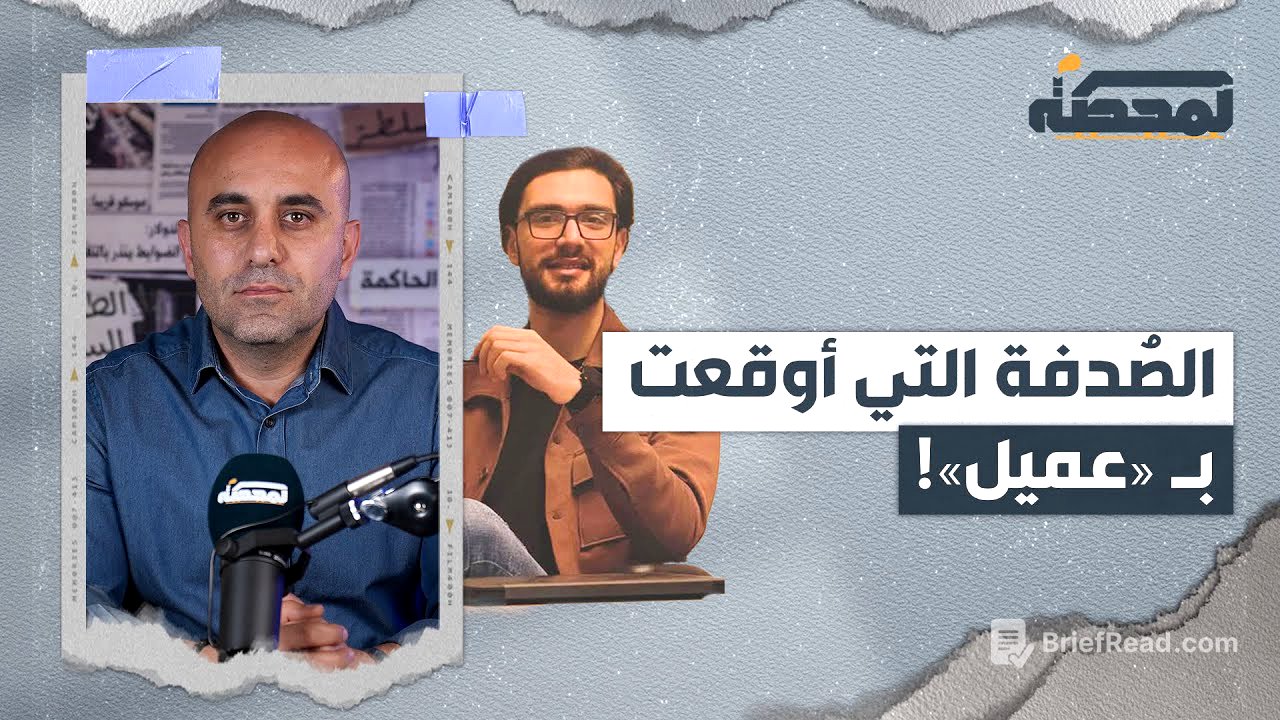
This episode discusses the case of Mohammed Saleh, a former Hezbollah operative accused of collaborating with Israeli intelligence. It covers his arrest, the evidence against him, and his claims of being a double agent. The episode also addresses the broader issue of betrayal and infiltration within Hezbollah, emphasizing the need for internal review and accountability.
- Mohammed Saleh, a former Hezbollah operative, was arrested for allegedly dealing with Israeli intelligence.
- The evidence includes emails detailing tasks he performed for the Israelis and information he provided.
- Saleh claims he was a double agent working for Hezbollah's benefit.
- The episode highlights the need for Hezbollah to investigate security breaches and internal betrayals.
مقدمة [0:00]
The episode introduces the case of Mohammed Saleh, who is accused of collaborating with the Israeli enemy. The host outlines the details that will be covered, including the circumstances of Saleh's arrest, the evidence of his communication with Israeli operators, the tasks he was asked to perform, the information he provided, and how he was recruited. The host also mentions that many news reports about the case are inaccurate and will be refuted. Additionally, the host notes that Saleh claims to be a double agent who had informed Hezbollah of his work with the Israelis. This episode marks the host's return after a hiatus following the recent war.
الانقسام بالهوية الوطنية [0:42]
The host explains the decision to retreat temporarily after witnessing incitement and gloating, some of which bordered on treason, both within and outside the resistance. The host criticizes the judiciary's failures and the tailoring of truth to serve individual interests. The host points out the division in the country and the lack of a unified national identity, where some consider the country their property and others as outsiders. The host equates those who rejoice in one's suffering to the enemy, while those who offer support are considered brothers. Despite the ongoing struggle, the host expresses hope for the triumph of the righteous and the liberation of the country. This introduction is considered central to the episode's theme and motivation.
أسئلة ما بعد الحرب [2:43]
The host resumes working on investigations, emphasizing the necessity of spreading awareness in light of inaction and complicity. A review is needed to learn from past experiences. The host advocates for Hezbollah to establish a commission of inquiry, similar to Israel's Winograd Commission after the July War, to investigate security breaches. This investigation should be transparent and address the causes of the breaches that led to the deaths of resistance leaders and the destruction of weapons facilities. The host also mentions the Pagers operation, which injured over 3,000 young resistance members, and stresses the importance of accountability. While acknowledging Hezbollah's sensitivity on the subject, the host argues that necessity and the greater good require addressing these issues. The host also notes that Hezbollah's military achievements in the south prevented Israeli incursion for 66 days.
كيف قُبض على محمد؟ [12:40]
The episode transitions to detailing how Mohammed Saleh was apprehended. Saleh was arrested by chance on April 28th. Another suspect, A.M., was discovered at the time and fled to Erbil. Saleh, who worked in the stock exchange and had been previously expelled from Hezbollah, was caught when he failed to pay back money he owed to a Wish branch in Ghobeiry. The owner of the shop tracked him down and pressed him for the money. When Saleh couldn't secure the funds, the shop owner went through his emails and found messages from someone named Lewis, requesting information about the "organization's" facilities, motorcycles, and individuals. The two men reported this to Hezbollah, and Saleh admitted to being recruited in Iraq. He had applied to rejoin Hezbollah after the war. Attorney Qassem Al Diqa informed the police, who arrested Saleh.
تفاصيل التجنيد [20:11]
The defendant admitted to communicating with the Mossad since October 2024 after interacting with a Facebook post titled "Were you formerly a member of Hezbollah?". To verify their identity, the Israeli side asked him to send a numerical code to the official IDF Facebook account, which they then sent back to him. He communicated with two operators, Mohsen and Abu Dawood, and a third person named Ali. They asked him for information about his previous formations in Unit 4500 and his service in Aleppo, Syria. Mohammed claimed he was tasked with rejoining Hezbollah to work in the Central Personnel unit. He had previously been transferred to Unit 1100, the Preventive Security Unit, for rehabilitation before returning to Unit 4100. Emails from an account named Lewis contained requests for information, and Saleh's replies included videos. He seemed primarily interested in receiving money in exchange for information.
هل أصبح عميلًا مزدوجًا؟ [22:08]
Judge Fadi Akiki, the Government Commissioner to the Military Court, prosecuted Mohammed Saleh for collaborating with the Israeli enemy and participating in the killing of Lebanese individuals in exchange for payment. The prosecution also alleges that he provided the enemy with coordinates of Hezbollah security centers that were attacked by Israel, resulting in the deaths of Lebanese officials.
القضاء يتّهم صالح بالعمالة [22:34]
Mohammed's father is a long-standing and devout member of Hezbollah. The host emphasizes that if Mohammed Saleh is proven guilty, he alone should bear the responsibility. The family's initial statement was due to their awareness of his financial problems and threats related to financial disputes, not suspecting any connection to espionage. News reports claiming that Mohammed has a martyred brother or was a vocalist for Hezbollah are false. He is close to the sons of several Hezbollah officials. The investigation is ongoing, and new information may emerge.
تورّط فرد لا يُعمّم [30:26]
The host concludes by reiterating that the investigation is ongoing and that new data and facts may emerge to either confirm or deny the current findings. In future episodes, the host plans to discuss the cases of other agents arrested during and after the war who were found to be involved in dealing with the Israeli enemy. The episode ends with a video showcasing Mohammed Saleh's emails that were seized during the initial investigation.
![AI Expert: Learn AI Agents Before 2025 Ends🔥[Build 5 AI Agents in 50 Minutes]](https://wm-img.halpindev.com/p-briefread_c-10_b-10/urlb/aHR0cDovL2ltZy55b3V0dWJlLmNvbS92aS9BUmEwVkNNOEpQdy9ocWRlZmF1bHQuanBn.jpg)