TLDR;
This YouTube video features a webinar by DentistChannel.Online, where Dr. Rahul W. discusses cortico basal implants as a significant advancement in implantology. He covers the concepts, rationale, and types of these implants, emphasizing their benefits, such as immediate loading and reduced invasiveness. Dr. Rahul shares his experiences and presents various case studies, highlighting successful outcomes in different scenarios, including full mouth reconstructions and cases with limited bone availability.
- Introduction to cortico basal implants and their advantages.
- Concepts and rationale behind cortico basal implantology.
- Case presentations showcasing successful implant outcomes.
- Key factors contributing to successful implant procedures.
Introduction and Speaker's Background [0:04]
The DentistChannel.Online team welcomes participants to a live webinar featuring Dr. Rahul W., an experienced dental surgeon with post-graduate qualifications in aesthetic dentistry and implantology from prestigious institutions like New York University and UCLA. Dr. Rahul currently runs a successful private practice and is a certified teacher for immediate loading implantology. Dr. Kapil Kalra, also a master in implant foundation, joins to answer questions alongside Dr. Rahul. The webinar focuses on cortico basal implants and their transformative impact on implant dentistry.
Speaker's Gratitude and Introduction to Cortico Basel Implants [3:29]
Dr. Rahul expresses his gratitude to DentistChannel.Online for the opportunity to present on cortico basal implants, which he considers a game-changer in implant dentistry, especially in the post-COVID era. He clarifies that he is a general dental surgeon who integrates implants into his practice. He shares his journey from traditional implantology to cortico basal implants, highlighting his experiences with masters in the field and the limitations he encountered with conventional methods.
Key Points and Agenda [7:22]
Dr. Rahul acknowledges his mentors, including Dr. SM Jooshi and Dr. Stfan Hide, for their guidance in his implantology journey. He emphasizes the importance of continuous learning and maintaining an open mind. The agenda includes an introduction to cortico basal implantology, its concepts, rationale, location in human jaws, and different implant types. He poses the question of why alter bone or tissue when implants can be adapted to the existing bone structure. The presentation will also cover 72-hour loading, case presentations, and key success factors.
Tectonic Shift and Patient Expectations [11:29]
Dr. Rahul describes the "tectonic shift" in his practice due to cortico basal implants, emphasizing that patients seek fixed teeth, not just implants. He highlights the desire for simple, minimally invasive procedures with minimal post-operative discomfort and fast, predictable results. He addresses common patient concerns, such as multiple surgeries, discomfort, time constraints, and budget limitations, which often lead to the rejection of dental implant treatments.
Evolution to Strategic Implantology [14:51]
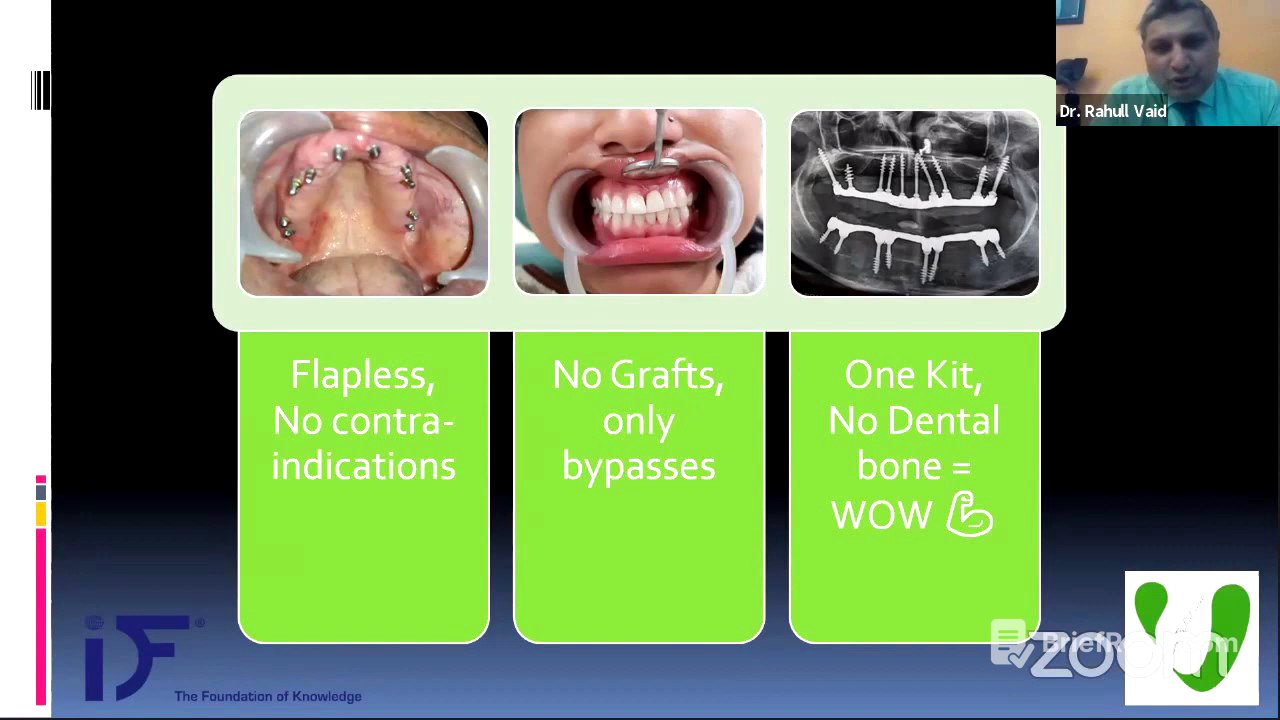
Dr. Rahul recounts his initial satisfaction with traditional implantology, including bone grafting and sinus lifts, but notes the limitations when dealing with insufficient alveolar bone. This led him to explore cortico basal implantology, which offers flapless, incisionless treatments with fewer contraindications and a reduced inventory. He emphasizes that reduced bone availability becomes an opportunity rather than a limitation with this approach.
Strategic Implantology Defined [17:38]
Strategic implantology, or cortico basal implantology, is defined as a science involving unique crystal and basal implants with advanced designs placed strategically to facilitate immediate functional loading within 72 hours. This concept merges orthopedic traumatology with conventional implantology, utilizing flapless techniques without augmentation procedures.
Types of Cortico Basel Implants [19:39]
Dr. Rahul outlines three main types of implants: crystal implants (Kos and Kos micro series) for good bone cases, basal or trans-cortical implants (BCS, VOIs) for low or no bone cases, and combination implants (BC XES/TPG UNO) for post-extraction cases. He details the characteristics and applications of each type, noting that all implants are made of titanium and promote osseointegration.
Comparison with Conventional Implants and Location in Jaws [23:05]
Dr. Rahul uses the analogy of a brick wall to explain the difference between cortico basal and conventional implants. Crystal implants go from the crest into the cancellous bone, while cortico basal implants engage the cortical and basal bone, which are less susceptible to infection and resorption. These implants are found in non-dental bone areas such as the pterygoids, nasal floor, and mylohyoid ridge, which are less prone to resorption.
Rationale Behind Cortico Basel Implantology [27:40]
The rationale behind cortico basal implantology is rooted in orthopedic principles, emphasizing cortical engagement and load-bearing areas away from infection portals. The use of smooth surfaces, bicortical anchorage, and non-parallel screws increases stability against lateral forces. This approach aims to fix teeth within 72 hours, leveraging infection-free and basil bone with minimal mucosal penetrations.
The Science Behind 72-Hour Loading [29:53]
Dr. Rahul addresses the question of why cortico basal implants are loaded in 72 hours, explaining that it is based on the bone's natural healing process. According to skeletal tissue mechanics, bone remodeling starts three days after any bone surgery or implant placement. Loading the implants within this period ensures stability before osteoclastic activity begins.
Bone Remodeling Process [32:58]
Dr. Rahul explains the bone remodeling process following a stimulus, such as trauma or implant placement. The process involves activation, resorption, reversal, refilling, and formation. Osteoclasts are the first cells to reach the site, taking 3-5 days to activate. The bone is most stable during this period, making it ideal for loading implants.
Cortical Engagement and Minimally Invasive Nature [35:44]
Cortico basal implants engage multiple cortices for anchorage, such as the crest, maxilla, and pterygoids. The minimally invasive nature of these implants results in minimal surgical complications, as they are incisionless and involve minimal bone cutting. Immediate extraction and implant placement are preferred to avoid bone remodeling and ensure a stable foundation.
Advantages and Bypassing Structures [39:30]
Cortico basal implants avoid bone grafting by bypassing structures like sinuses and utilizing stable bone areas. The implants are polished, with a small osteotomy diameter, allowing for trans-sinus placement. In the lower jaw, buccal or lingual bypasses are used, and the implants are bendable to meet prosthetic demands. The presenter reiterates the core message: why alter existing structures when implants can be designed to suit the bone?
Additional Rationale and Advantages [41:32]
Cortico basal implants display less bone loss compared to conventional implants, with minimal impact on bone integrity and perfusion. They reduce the risk of fibrous formation, minimize woven bone, and promote laminar bone formation. The bone-implant contact is greater in immediately loaded implants. These implants work well with gum diseases, utilizing the cortices rather than the alveolar bone.
Suitability and Contraindications [45:25]
Cortico basal implants are suitable for various conditions, including controlled smokers and patients with chronic periodontitis or little to no bone. They require minimal oral hygiene measures and offer cost and time savings. Implants are available for different conditions, making them versatile for various applications. The presenter emphasizes that these implants are not just for cases with no bone but can be used in regular good bone cases as well.
Case Presentation: Controlled Diabetic Patient [47:12]
Dr. Rahul presents a case of a controlled diabetic patient in her early 60s with failing bridges. He treated the entire case holistically, salvaging teeth where possible and placing Kos micros implants in areas with good bone. The case demonstrates a successful outcome with a 3.5-year follow-up, showcasing the stability and functionality of the implants.
Case Presentation: Full Mouth Reconstruction [50:44]
A case of a patient with multiple implants and shaky confidence is presented. The patient received lower jaw implants first, followed by an upper complete denture. After three months, satisfied with the lower fixed implants, she opted for upper jaw implants as well. The case shows a 5-year follow-up with high patient satisfaction.
Case Presentation: Parkinson's Patient with Knife-Edge Ridge [52:29]
Dr. Rahul shares a challenging case of a 75-year-old lady with Parkinson's disease and a knife-edge ridge. Eight implants were placed, utilizing Kos micros in the anterior region and BCS in the posterior. The patient received her final prosthesis on day three, improving her chewing ability significantly. A 1.5-year post-op CBCT shows good results.
Case Presentations: Athlete with Lower Jaw Issues and Edentulous Patient [54:41]
The presentation includes cases of an athlete with lower jaw issues, where implants were placed in both jaws, and an edentulous patient with severe ridge resorption, where a buckle bypass was performed. These cases demonstrate the versatility of cortico basal implants in addressing various clinical scenarios.
Case Presentations: Patients with Denture Complaints and Chronic Pan Chewer [57:01]
Dr. Rahul presents cases of patients with complaints about dentures and failing bridges, where cortico basal implants were used to provide fixed solutions. He also shares a case of a chronic pan chewer, highlighting the implants' ability to withstand constant stress despite the patient's habits.
Case Presentations: Failed Conventional Implants and Referred Patient [1:00:26]
The presentation includes cases of patients with failed conventional implants, where cortico basal implants were used as a replacement, and a patient referred for dissatisfaction with lower implant-supported prostheses. These cases demonstrate the versatility and effectiveness of cortico basal implants in addressing complex situations.
Case Presentation: Mucor Mycosis Patient with Hemimaxillectomy [1:03:23]
Dr. Rahul shares a challenging case of a mucor mycosis patient with a hemimaxillectomy, where zygomatic implants were used to provide support. Despite the lack of bone, a bar was placed to support the prosthesis, resulting in a functional outcome.
Case Presentations: Segmental Cases and Compromised Patients [1:06:17]
The presentation includes segmental cases, where implants were used to replace missing teeth in specific areas, and cases of compromised patients with various health issues. These cases demonstrate the adaptability of cortico basal implants in addressing diverse clinical needs.
Case Presentations: Anterior Segment and Aesthetic Cases [1:13:51]
Dr. Rahul presents cases focusing on anterior segment replacements, including a police officer with fractured teeth and patients seeking aesthetic improvements. These cases highlight the ability of cortico basal implants to provide immediate solutions and enhance aesthetics.
Case Presentations: Young Patients and Failed Grafts [1:18:50]
The presentation includes cases of young patients with missing teeth, where implants were used to restore function and aesthetics, and a patient with failed grafts, where cortico basal implants provided a successful alternative.
Potential Complications [1:21:27]
Dr. Rahul discusses potential complications associated with cortico basal implantology, including intraoperative issues like bleeding and cortical bone fracture, immediate post-op complications like pain and nerve paresthesia, and delayed post-operative issues like mobility and infections. He emphasizes the importance of proper training and knowing how to handle these complications.
Reasons for Complications and Recap [1:24:10]
The reasons for complications include improper treatment planning, lack of adequate skill, improper armamentarium, and incorrect occlusion. Dr. Rahul recaps the benefits of cortico basal implants, including keyhole surgeries, immediate functional loading, no bone augmentation, and suitability for smokers and controlled diabetics.
Takeaway Messages and Conclusion [1:27:55]
Dr. Rahul concludes with takeaway messages, emphasizing the importance of strengthening basics, treating the case as a whole, documenting cases meticulously, and ensuring regular follow-ups. He highlights the unique immediate functional loading system and the best patient conversion ratio. He reiterates the quote from the father of the nation, "First they ignore you, then they laugh at you, then they fight you, then you win," and encourages doctors to be at the right place, at the right time, with the right person.
Team Introduction and Closing Remarks [1:30:13]
Dr. Rahul introduces his team, including Dr. Nila Maheshwari and Dr. Kapil Kalra, who conduct regular courses on cortico basal implantology. He emphasizes the importance of undergoing good training and getting well-appraised with the different systems. He encourages viewers to contact them for further information and expresses gratitude to DentistChannel.Online for the opportunity to present.
Q&A Session [1:37:15]
The session transitions to a live question and answer segment with Dr. Rahul and Dr. Kapil Kalra addressing queries from the audience.