TLDR;
The video provides an in-depth analysis of fair value gaps (FVG) and their application in trading, particularly within the NASDAQ market. It emphasizes precise entry and stop-loss techniques, explaining how to identify valid FVGs and avoid common pitfalls. The content also covers market structure, liquidity, and the importance of understanding the algorithm's role in price delivery.
- Focus on precise entry and stop-loss techniques for fair value gaps.
- Understand market structure, liquidity, and algorithmic price delivery.
- Desensitize oneself to the outcome by practicing with a single micro contract in a demo account.
Audio Check and Initial Market Observation [0:28]
The instructor begins by checking the audio quality and then transitions into an overview of the NASDAQ market. He notes the presence of a new day opening gap from the previous Friday and identifies a discount opening range gap, highlighting a specific level at 14745 as an initial focus. The aim is to observe market behavior without pre-established biases, watching for gap formations.
Fair Value Gap Identification and Exercises [5:26]
The instructor mentions waiting for a fair value gap to form and emphasizes letting the market establish its initial range and direction. He plans to teach his son, Caleb, how to identify the correct fair value gaps, which involves trial and error. The lesson will include exercises using lower time frame charts (15-second and one-minute charts) to practice identifying valid FVGs and recognizing signatures that indicate their validity.
News Impact and Market Structure [8:15]
The instructor dismisses the importance of medium-impact news data released at 8:30 AM, stating a preference for trusting price action over economic data. He points out a large opening gap and notes that the price is trading within a gap from the previous Thursday. The mid-gap level is identified as a key area, with retail traders likely wanting to short from equal highs.
Rolling Over to the December Contract [13:08]
The instructor discusses transitioning to the December NQ contract (NQZ2024) and mentions using barchart.com to determine the rollover. He looks for specific numbers to indicate when to shift focus from the September contract. The instructor notes that the market went below a recent low and highlights a volume imbalance on the one-minute chart, anticipating a potential move higher to reach the buy side and mid-gap level.
Coaching and Identifying Key Price Action [15:48]
The instructor explains his coaching approach, which involves outlining desired price action to frame setups. He emphasizes the importance of identifying fair value gaps that should not be viewed as shorting opportunities. The rules for valid FVGs include specific candlestick formations, with stop losses placed above the number two candle in a three-candlestick formation.
Fair Value Gap Mechanics and Stop Loss Placement [19:26]
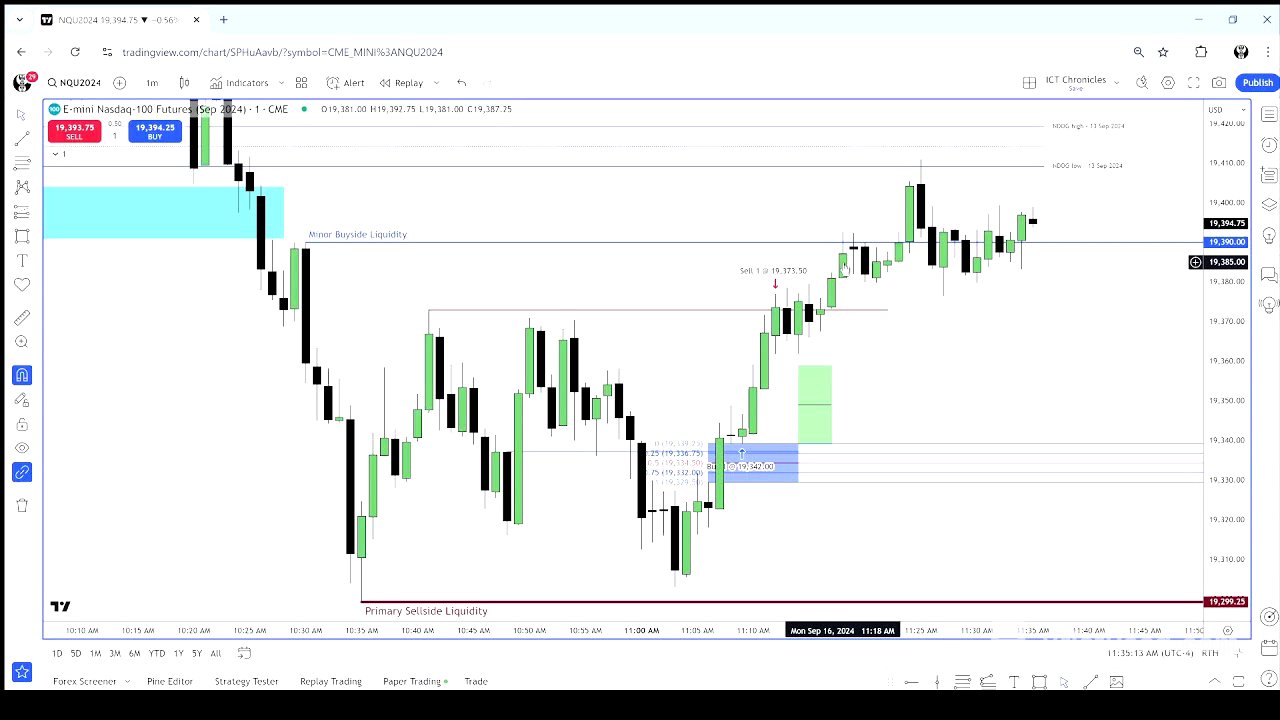
The instructor details the mechanics of trading FVGs, explaining that the number two candle frames the FVG and the number three candle is the entry trigger. Stop-loss placement is crucial: for aggressive leverage, it goes above the number two candle; for conservative trading, it goes above the number one candle. The ideal entry point is within the consequent encroachment of the FVG.
Why Fair Value Gaps Are Not Supply and Demand Zones [22:30]
The instructor clarifies that FVGs are not supply and demand zones but specific price levels. He describes how to build pyramided positions, entering short at the high of candle number three and adding more contracts at the lower quadrant of the gap. If the price trades above the midpoint, additional contracts are added at the upper quadrant, with the stop loss above candle number one's high.
Bullish Fair Value Gap [39:52]
The instructor explains the inverse scenario for a bullish fair value gap. The entry is one tick above candlestick number three's low. Additional contracts can be added in the upper quadrant, with the stop loss below candlestick number two's low. The goal is for the lower half of the gap to remain open, indicating a strong bullish signal.
Importance of Desensitization and Practice [42:48]
The instructor stresses the importance of desensitization to outcomes through consistent practice. He recommends starting with a single micro contract in a demo account to focus on following rules and tape reading. This approach helps remove fear and the need for immediate profits, allowing for better learning and adaptation to market conditions.
Identifying a False Shorting Opportunity [1:01:19]
The instructor explains why a particular setup was not a good shorting opportunity. The market had already gapped lower from the previous day's settlement price, and an initial drop after the 9:30 AM opening was a Judas swing (a fake move). He advises waiting for the market to create a swing low and then looking for inefficiencies and order blocks.
Order Blocks and Inversion Fair Value Gaps [1:07:05]
The instructor identifies an inefficiency and explains that if the price fails to stay in the upper half of it, it indicates a potential sell-off. He also points out an inversion fair value gap, which, when breached, signals a move in the opposite direction. The instructor expresses frustration with others teaching his concepts incorrectly and emphasizes the importance of precise execution and understanding.
Lunch Macro and Trading Strategy [1:26:00]
The instructor discusses trading the lunch macro, focusing on recent market behavior to determine whether to go long or short. He highlights the importance of waiting for clear setups and avoiding forced trades. The instructor emphasizes that if a mean threshold is violated, it indicates weakness and a likely move lower.
Reclaimed Order Block and Potential Scenarios [1:40:45]
The instructor identifies a potential reclaimed order block, which could lead to a bullish move. He stresses the importance of having a minimum 20-handle range potential for a trade to be viable. The instructor also shares his personal experiences and challenges in teaching these concepts, particularly to his son.
Live Trade Execution and Analysis [1:48:25]
The instructor executes a live trade, emphasizing the importance of hammering in with a market order to feel the emotional rush. He reminds viewers not to take the trades he is doing and stresses that the session is for educational purposes only. The instructor analyzes the trade in real-time, highlighting the low drawdown and quick move to profit.
Fair Value Gap and Consequent Encroachment [1:56:59]
The instructor identifies a fair value gap and explains his entry strategy, which involves entering at the market plus one tick. He discusses the importance of grading inefficiencies and using consequent encroachment levels for stop-loss placement. The instructor also highlights the significance of time and macros in trading decisions.
One-Second Chart Analysis and Trade Management [2:04:02]
The instructor analyzes the trade using a one-second chart, demonstrating the minimal drawdown and quick move to profit. He emphasizes the importance of journaling and logging data to improve trading performance. The instructor also discusses the two stages of exits: the first partial and the final terminus.
Final Thoughts and Disclaimer [2:09:50]
The instructor concludes by reiterating the importance of concise trading sessions and avoiding overtrading. He emphasizes that the goal is to twist the knife and demonstrate the precision and effectiveness of his trading methods. The instructor also reminds viewers that there is an algorithm driving price action and that understanding it is crucial for success.