TLDR;
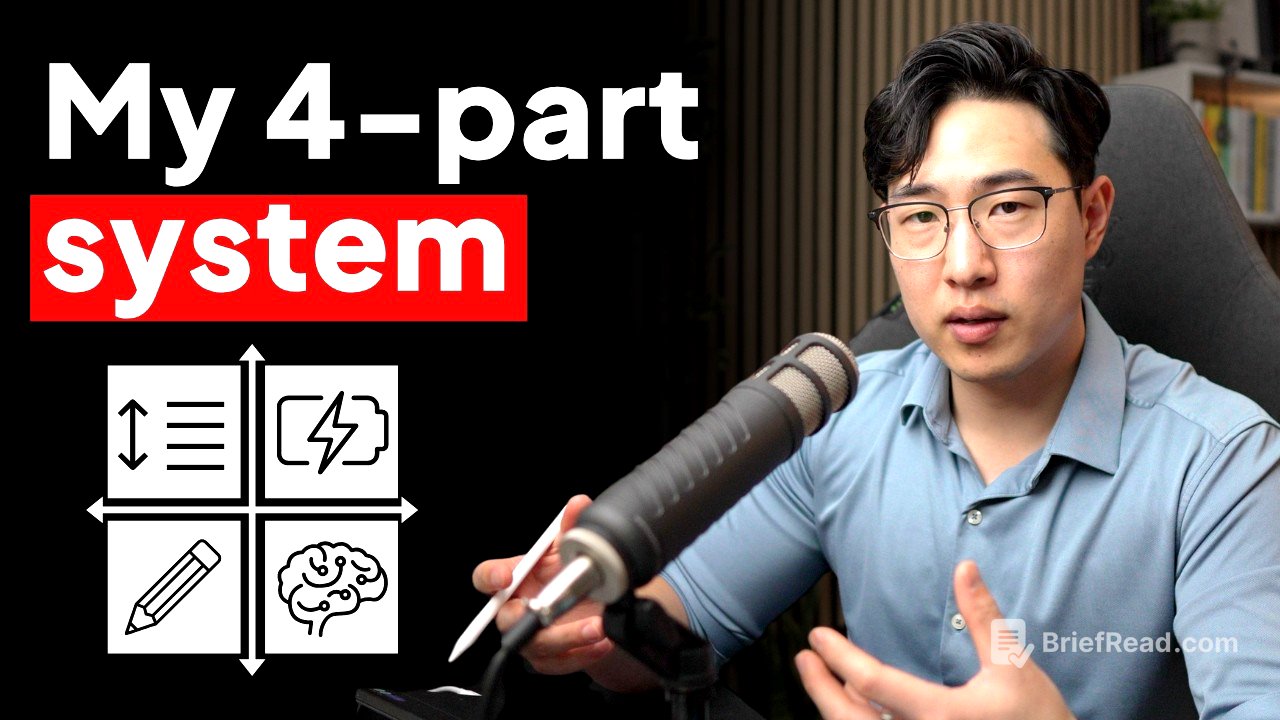
This video explains how to improve memory by understanding how it works and applying learning science principles. It challenges the notion of memory as a fixed trait, instead framing it as a skill that can be developed through robust construction of information. The video introduces four key principles: the spacing effect, the generation effect, the testing effect, and higher-order thinking. By integrating these principles into your learning process, you can construct stronger memories, retain information more effectively, and achieve better learning outcomes.
- Memory is not a fixed trait but a skill developed through robust information construction.
- Spacing effect: Reviewing information at intervals flattens the knowledge decay curve.
- Generation effect: Actively producing knowledge leads to better retention than passive learning.
- Testing effect: Testing yourself helps you remember things better, especially when the testing method matches the application context.
- Higher-order thinking: Connecting new information to a broader network of knowledge enhances memory and understanding.
Introduction: Memory as a Skill [0:00]
The speaker, a learning coach and doctor, shares his personal journey from struggling with a poor memory to mastering the ability to learn and retain large amounts of information. He emphasizes that memory is not a fixed trait but a skill that can be trained through understanding and applying learning science principles. He contrasts his past experiences of constant relearning with his current ability to learn efficiently, attributing this transformation to thousands of hours spent researching and experimenting with learning techniques. The video aims to share four key learning science principles related to memory, providing viewers with actionable strategies to improve their own memory and learning outcomes.
Understanding Memory: Construction, Not Retrieval [0:55]
The speaker challenges the common misconception of memory as an innate ability, arguing instead that it is a quality imparted to information through the way we construct it in our minds. He uses an analogy of building a box to represent how we process information, explaining that a flimsy construction leads to quick degradation, while a robust construction ensures lasting retention. He quotes American psychologist Daniel Willingham, stating that "memory is the residue of thought," emphasizing that recalling something involves remembering the thoughts and processes engaged with at the time of learning. The focus should be on constructing memory in a robust way through principles and methods.
The Spacing Effect: Repetition for Long-Term Retention [5:18]
The spacing effect is introduced as a foundational principle for improving memory, which suggests that repeating information over intervals enhances long-term retention. The speaker explains the concept of knowledge decay, where the ability to recall information decreases over time. By revisiting the information at spaced intervals, the decay curve flattens, leading to more durable memory. While repetition is essential, the speaker cautions against relying solely on the spacing effect, as passive review methods may not significantly improve memory. He shares his personal experience of being overwhelmed by the need for constant repetition using flashcards, highlighting the importance of combining spacing with more active and thoughtful learning techniques.
The Generation Effect: Actively Producing Knowledge [8:58]
The generation effect is presented as the second principle, stating that actively producing knowledge results in better memory retention compared to passively receiving it. The speaker clarifies that generating knowledge doesn't necessarily mean creating entirely new information but rather engaging in mental effort to retrieve or reconstruct it. He provides examples of passive learning methods, such as rereading notes or listening to lectures, and contrasts them with more generative alternatives, such as rewriting notes from memory or summarizing lecture points. The key is to involve the brain more actively in thinking, recalling, and piecing together information, which leads to stronger neural connections and longer-lasting memories.
Applying the Generation Effect: Marginal Gains and Practical Steps [12:30]
The speaker discusses how to train oneself to be more generative in learning, emphasizing the principle of marginal gains. He advises against trying to make drastic changes to learning habits overnight, instead recommending incremental improvements of just 1% each day. He suggests starting by identifying current learning techniques and then taking one step towards making them more generative. The speaker provides a practical exercise of writing out a learning schedule and identifying opportunities to incorporate more active recall and knowledge production. He also mentions his free newsletter as a resource for learning from his experiences and avoiding common mistakes in the learning process.
The Testing Effect: The Importance of Level-Matched Testing [18:57]
The testing effect is introduced as the third principle, emphasizing that testing oneself enhances memory retention. The speaker stresses that the way you test yourself matters significantly. He uses the example of a senior executive learning about different industries to make strategic decisions, pointing out that testing recall through flashcards may not translate well to complex decision-making. He emphasizes the importance of level-matched testing, where the testing method aligns with the context in which the knowledge will be applied. He shares his personal experience of failing a clinical attachment in medical school, realizing that his academic study methods did not translate to real-world patient diagnosis and management.
Effective Testing: Finding and Filling Knowledge Gaps [21:40]
The speaker discusses the importance of finding and filling gaps in knowledge through effective testing. He notes that many students avoid making mistakes during testing, focusing on subjects they are stronger at. He argues that the purpose of testing is to proactively identify gaps and errors to avoid making them later when it really matters. He emphasizes that the first round of testing should be very difficult to reveal as many gaps as possible. The speaker also addresses the traps of recognition and overconfidence, advising viewers to avoid judging their confidence based on whether an answer makes sense and to always test themselves again to ensure true recall.
Integrating Spacing, Generation, and Testing [28:54]
The speaker summarizes the first three principles—spacing, generation, and testing—and how they can be integrated into a learning system. He explains that spacing sessions provide opportunities for testing, and testing should be done in a way that applies the principles of generation. He emphasizes that these principles are universally applicable to all types of learning scenarios.
Higher Order Thinking: Connecting Information to a Wider Network [29:30]
Higher-order thinking is presented as the fourth and most important principle for creating long-lasting knowledge and deep understanding. The speaker explains that higher-order thinking involves looking at pieces of information as part of a wider network, making the information feel more relevant and easier to remember. He contrasts learning a topic that is irrelevant and difficult to connect with anything else to learning about a topic you know a lot about, where new facts are easily integrated into your existing knowledge network. He emphasizes that higher-order thinking is the key to increasing memory drastically and achieving a flatter knowledge decay curve.
Training Higher Order Thinking: Techniques and Questions [33:11]
The speaker provides techniques for training oneself to be better at higher-order thinking, including creating analogies, teaching, and mind mapping. He emphasizes that these techniques are just methods to encourage a certain way of thinking, and it's the thinking process itself that matters most. He suggests asking three questions after each learning session: How often am I trying to connect what I'm learning to the big picture? How often do I actively try to simplify what I'm learning? How long do I delay creating relationships between new information and what I already know? He advises viewers to take a step-by-step approach, gradually increasing the frequency of these thinking processes.
Conclusion: Consistent Improvement and Further Learning [41:07]
The speaker concludes by reiterating the four principles—spacing, generation, testing, and higher-order thinking—and guaranteeing that applying these principles will improve memory. He emphasizes the importance of consistent, incremental improvement, taking one step at a time to get 1% better every day. He encourages viewers to check out another video on building a holistic learning system and thanks them for watching.