TLDR;
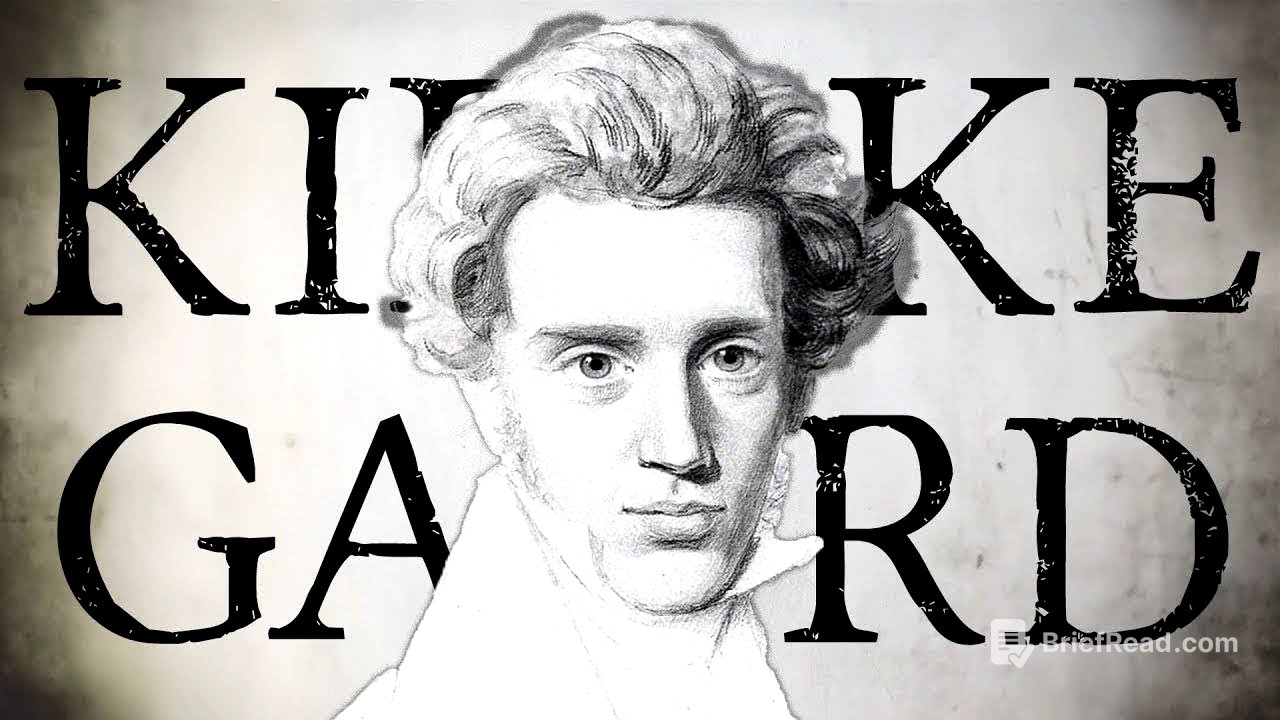
This video explores the philosophy of Søren Kierkegaard, often considered the father of existentialism, focusing on his unique perspective as a devout Christian. It examines his concept of faith as a passionate, personal relationship with God, his critique of the church, and his emphasis on individual responsibility. The video also discusses Kierkegaard's indirect communication method, his life, and the three key phases of his work: the first authorship, the second authorship, and his direct attacks on the church.
- Kierkegaard's existentialism is rooted in his Christian faith, emphasizing personal faith over reason.
- His writing career was influenced by his father's guilt and his broken engagement with Regine Olsen.
- Kierkegaard's work is divided into three stages: aesthetic, ethical, and religious.
Introduction [0:00]
Kierkegaard, known as the father of existentialism, was a devout Christian who saw faith as a personal relationship with God, valuing passion over reason. He criticized the church for infantilizing its congregation and focused on the individual as the locus of faith. Kierkegaard employed indirect communication, using pseudonyms and stylistic devices to provoke independent thought in his readers, similar to Socrates' ironic questioning. He aimed to ignite a passion for living faith, urging individuals to transcend the superficiality of the crowd and become true individuals. Kierkegaard viewed himself as a Christian missionary within Christendom, tasked with converting people into genuine individuals of faith. His work is divided into three phases: the first authorship, the second authorship, and a direct attack on the church.
The Life of Kierkegaard [2:42]
Soren Kierkegaard began his prolific writing career after graduating from university in 1841. Between 1843 and 1846, he published 16 books, including masterpieces like "Either/Or" and "Fear and Trembling." This intense period of writing was driven by two major influences: his father's deep-seated guilt and the broken engagement with Regine Olsen. Kierkegaard's father, Michael, believed he was cursed to lose his children young due to a youthful blasphemy. This created an oppressive environment for Soren, who inherited his father's guilt and faced the early deaths of family members. His broken engagement to Regine Olsen, whom he met in 1837 and was engaged to in 1839, added to his turmoil. The reasons for the breakup were never fully explained, but factors such as a "terrible secret," religious vocation, avoidant attachment style, or financial constraints may have contributed. The combination of this broken engagement and the shadow of death fueled Kierkegaard's creative output.
The First Authorship [5:38]
Kierkegaard's first authorship, spanning three years, resulted in 16 books and concluded with "Concluding Unscientific Postscript" in 1846. This phase explores three value systems or ways of being: the aesthetic, the ethical, and the religious stages.
First Authorship - Aesthetical Stage [6:08]
The aesthetic stage is characterized by nihilism and hedonism, where individuals seek to make the most of life in the absence of inherent meaning. This includes sensual hedonism and intellectual/cultural hedonism, driven by a desire to avoid boredom. Aesthetes prioritize possibility over reality, using irony, sarcasm, and skepticism to maintain distance from life. This way of being is fundamentally egotistical, as individuals fill their lives with distractions and maintain an ironic detachment to keep life at bay.
First Authorship - Ethical Stage [7:36]
The ethical stage involves connecting with society and embracing commitment, with marriage serving as an archetypal example. It calls for individuals to enter the world and adhere to traditional morals and social norms. Ethical actions conform to societal values, providing clear guidelines for right and wrong. Ethical individuals view the aesthetic life as selfish, as aesthetes fail to acknowledge their social debt and communal existence, living in a narcissistic fantasy rather than the real world. Jordan Peterson's advice to take responsibility and improve one's life exemplifies the ethical stage, bridging the gap between the aesthetic and the ethical.
First Authorship - Religious Stage [9:55]
The religious stage, the highest in Kierkegaard's hierarchy, is exemplified by the biblical story of Abraham and Isaac. Being religious involves a personal faith that must be lived, requiring individuals to continually do the work of faith for themselves. Faith is a choice that carries immense responsibility, leading to anxiety—the awareness of the magnitude of this choice. This choice, made in a single moment, creates a self that will be judged for eternity. The religious stage transcends the ethical, requiring individuals to go beyond cultural ethics and listen directly to God, who can suspend the ethical. This is illustrated by God's inexplicable command for Abraham to kill Isaac, an action that defies ethical justification. Kierkegaard argues that faith goes beyond reason, requiring a leap of faith into the absurd. The stages progress from focusing on the individual (aesthetic) to the community (ethical) and ultimately to God (religious), with each layer nested in the greater reality of the next.
Second Authorship [13:50]
Kierkegaard's second authorship was prompted by an attack from the Copenhagen newspaper, The Corsair, which ridiculed him personally. This led him to postpone his pastoral ambitions and renew his creative efforts. The second authorship, while maintaining pseudonyms, shifted focus to positive Christian discourses. Unlike the first authorship, its contours were not pre-planned, and Kierkegaard produced nothing in two of those years. The Corsair affair influenced these later works, emphasizing the relationship between the individual and society. Kierkegaard critiqued the modern age's "crowd," a sensible, passionless public that steamrolled the individual. He distinguished between Eros (selfish love) and Agape (universal love), advocating for the latter as a spiritual duty exemplified by Christ. "Sickness Unto Death" explores despair, the opposite of faith, as choosing an inauthentic life. Kierkegaard increasingly resembled an Old Testament prophet, calling people back to true faith and criticizing established religion.
Kierkegaard's Final Stage [18:21]
In the final year of his life, Kierkegaard abandoned indirect communication and directly attacked the church, criticizing its political ties and the superficiality of its Christianity. He believed the church infantilized its members, preventing them from developing a personal relationship with God. Kierkegaard advocated for a more challenging Christianity, contrasting the individual's struggle with eternity against the fashionable tradition of Christendom. He published his criticisms in newspapers and self-published pamphlets called "The Moment." Before publishing the tenth issue, Kierkegaard collapsed and died a month later at the age of 42 from tuberculosis.