TLDR;
This module provides an overview of the human musculoskeletal system, its functions, and key components. It covers the skeletal structure, including the axial and appendicular skeletons, different types of bones and joints, and connective tissues like tendons, ligaments, cartilage, and fascia. The importance of these components in supporting the body, enabling movement, and protecting vital organs is highlighted.
- The musculoskeletal system is an intricate network of bones, muscles, tendons, ligaments, and joints.
- The skeletal system is divided into axial (skull, rib cage, vertebral column) and appendicular (limbs, girdles) skeletons.
- Bones are categorised based on their shape (long, short, flat, irregular, sesamoid) and joints are classified by their movement capability (synarthrosis, diarthrosis, amphiarthrosis).
Introduction to the Musculoskeletal System [0:00]
The human body is a complex machine comprising various systems, with the musculoskeletal system being a key focus. This system is an intricate network of bones and muscles, along with skeletal structures like tendons, ligaments, and joints. These components collectively support the body's structure, enable movement, and protect vital organs. The harmonious integration of muscles and bones is essential for structural integrity and overall functional well-being.
Axial Skeleton [2:34]
The skeletal system consists of 206 bones that provide structural support, protect vital organs, and assist in movement. It is composed of bones, cartilage, ligaments, and tendons, all of which are connective tissues. For easier understanding, the system is divided into the axial and appendicular skeletons. The axial skeleton, comprising the skull, rib cage, and vertebral column, maintains the body's form and function. The skull protects the brain and sensory organs, the rib cage protects the heart and lungs, and the vertebral column supports the spinal cord. The vertebral column includes cervical, thoracic, lumbar, and sacral vertebrae, each designed to allow specific movements.
Appendicular Skeleton [5:24]
The appendicular skeleton facilitates movement, stability, and interaction with the environment. It includes the upper and lower limbs, which attach to the girdles connecting them to the axial skeleton. The pelvic and shoulder girdles are key components. Upper limbs enable intricate movements like reaching and grasping, while lower limbs support body weight and facilitate locomotion. The shoulder girdle connects the upper limbs to the axial skeleton, consisting of the scapula (shoulder blade) and clavicle (collar bone), providing mobility and flexibility to the arms. The pelvic girdle attaches the lower limbs to the axial skeleton, supporting body weight and providing stability.
Skeletal Structures: Bones [8:15]
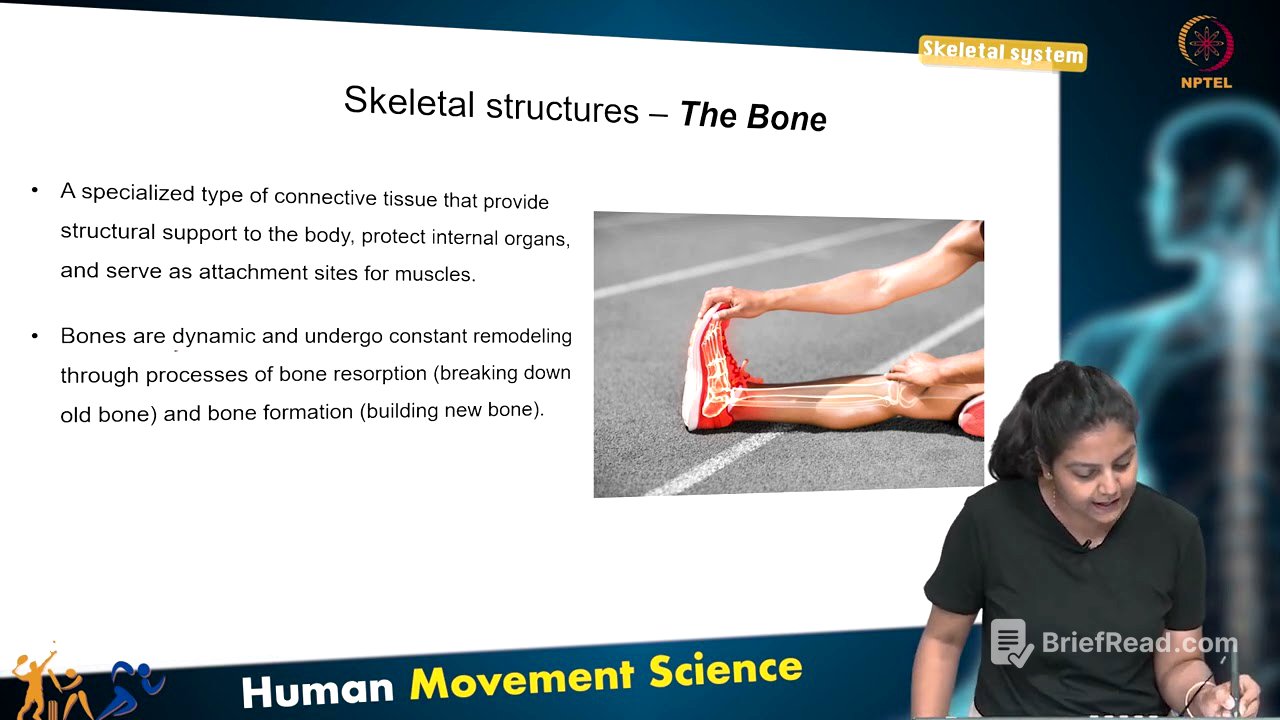
Bones are connective tissues that provide structural support, protect internal organs, and serve as attachment sites for muscles. They undergo constant remodelling through bone resorption and formation. Bone health is crucial for structural integrity and requires good nutrition, exercise, and hormonal regulation. Bones are categorised based on their shape and function. Long bones, like the femur and humerus, are longer than they are wide, supporting body weight and enabling movement. Short bones, equal in length and width (e.g., wrist and ankle bones), provide stability and support. Flat bones, thin and flattened (e.g., skull bones and scapula), protect organs and provide surfaces for muscle attachments. Irregular bones, like vertebrae, have complex shapes and provide support and protection to the spinal cord. Sesamoid bones, small and embedded within tendons (e.g., the kneecap), reduce friction and protect tendons from wear and tear.
Types of Joints [14:31]
A joint is a connection between two or more bones, allowing movement. Joints are classified by their movement capability. Synarthrosis joints are immovable (e.g., sutures of the skull), providing stability and support. Diarthrosis joints are freely movable (e.g., elbow, shoulder, and hip), also known as synovial joints, and contain synovial fluid for shock absorption. They are characterised by a joint capsule, synovial fluid, and articular cartilage, allowing smooth and flexible movement. Amphiarthrosis joints have limited mobility (e.g., adjoining vertebrae), providing stability and support while allowing slight movement.
Joint Types and Function [19:35]
Movement availability varies based on the nature and type of joint. A pivot joint, like the neck joint (C1-C2 vertebrae), allows rotational movement around a central axis, providing range of motion, stability, and support. A saddle joint, shaped like a saddle with concave and convex surfaces (e.g., carpometacarpal joint of the thumb), allows a wide range of motion for fine movements. A plane joint, characterised by flat and smooth surfaces (e.g., intertarsal joint), allows sliding and gliding movements, providing stability and versatility. A hinge joint, like the elbow and knee joints, allows movement in one direction, similar to a door hinge, providing stability and controlled movements. A condyloid joint, with one side shaped like an oval and the other with a ball head (e.g., wrist joint), provides stability and versatility for a wide range of movements. A ball and socket joint, with a concave socket and a ball head (e.g., hip and shoulder joints), allows a wide range of movements in multiple directions, making it the most mobile joint in the body.
Connective Tissues: Tendons, Ligaments, Cartilage, and Fascia [27:21]
Tendons, ligaments, cartilage, and fascia are crucial connective tissues that support and enable movement, providing structural integrity. Tendons attach muscle to bone, transmitting force generated by muscles for efficient movement and stability. Injuries like tendonitis or tears can result from overuse, trauma, or improper technique. Ligaments connect bones to bones, providing stability to the joint. Injuries like sprains or tears result from sudden twisting motions or excessive force on the joint. Cartilage is a tough, flexible connective tissue that cushions joints, providing structural support and allowing smooth movement between bones. Damage to cartilage can lead to joint pain and decreased mobility. Fascia is a connective tissue that surrounds muscles, groups of muscles, blood vessels, and nerves, providing support and protection. Injuries to the fascia can occur when it becomes tight and develops trigger points, leading to discomfort or pain.
Module Summary [34:33]
The human skeletal system provides structural integrity, protects vital organs, and assists in movements. It is composed of bones and skeletal structures like cartilage, ligaments, and tendons. Bones are specialised connective tissues classified based on their shape. Joints, connections between bones allowing movement, are categorised based on movement capability. Tendons, cartilage, ligaments, and fascia are crucial connective tissues that each have a unique role in providing structural integrity, support, and movement.