TLDR;
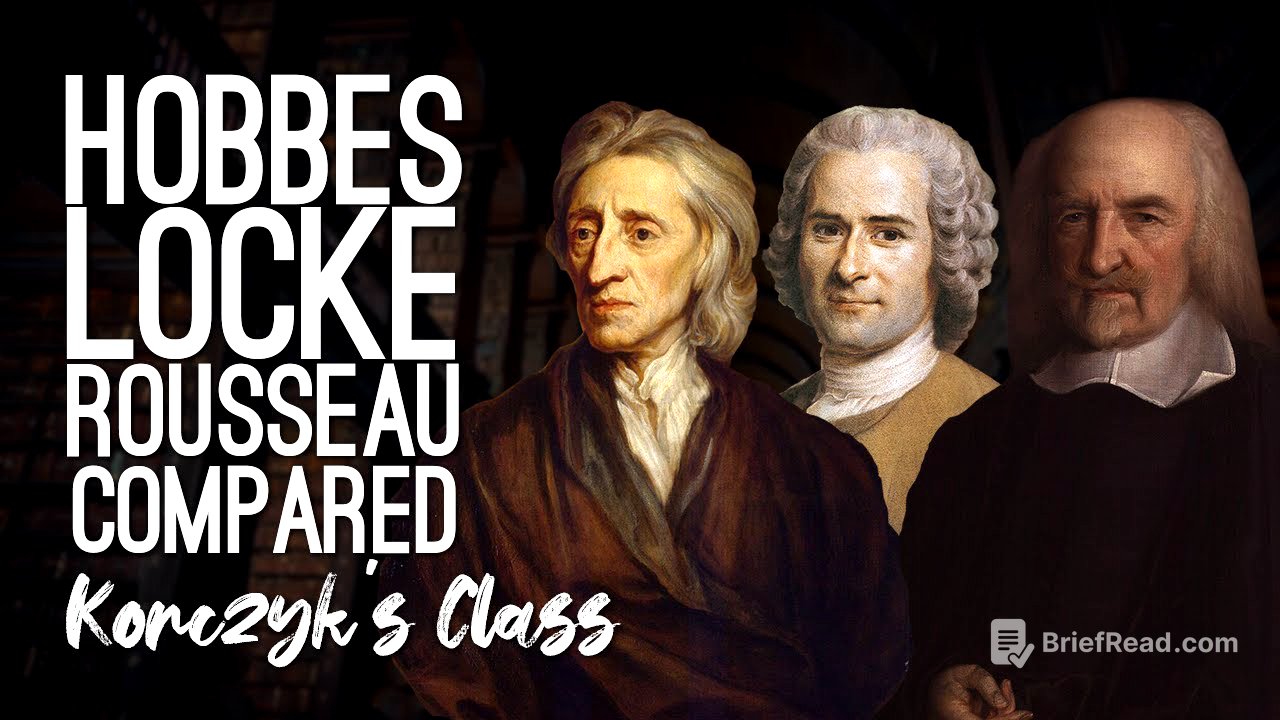
This video explains the concept of the social contract as envisioned by three key Enlightenment philosophers: Thomas Hobbes, John Locke, and Jean-Jacques Rousseau. It contrasts their views on human nature, the role of government, and the balance between freedom and security. Hobbes believed in a strong, authoritarian government to control inherently destructive human nature. Locke advocated for limited government protecting individual rights and freedoms. Rousseau argued that society corrupts people and favored a community-based system focused on the general will.
- Hobbes: Authoritarian rule for security.
- Locke: Limited government, individual freedoms.
- Rousseau: Community-based equality.
Introduction: Divine Right vs. Social Contract [0:00]
Before the Enlightenment, rulers often justified their authority through the divine right of kings, claiming their power came directly from God. The Enlightenment introduced social contract philosophy, which posits that the right to rule originates from the people. Different philosophers had varying perspectives on the social contract, particularly regarding how much freedom individuals should relinquish to the government in exchange for protection and security.
Thomas Hobbes: The Need for a Strong Authority [0:43]
Thomas Hobbes believed that human nature is inherently destructive, leading to violence and chaos without governance. In his book Leviathan, Hobbes described life in the state of nature as "solitary, poor, nasty, brutish, and short," a constant state of war. Therefore, Hobbes advocated for a strong, authoritative figure, a "Leviathan," to maintain order. People should willingly surrender their freedom to this ruler, understanding that absolute freedom would result in societal collapse.
John Locke: Limited Government and Individual Rights [1:50]
John Locke held a contrasting view, believing that people are born with a "tabula rasa" or blank slate, without inherent destructive tendencies. He argued that individuals, if left to their own devices, would naturally improve themselves and society. Locke emphasized the importance of a limited government that protects people's life, liberty, and property. He asserted that individuals are naturally free, equal, and independent, and should not be subjected to political power without their consent. Locke supported a representative democracy where elected leaders make laws on behalf of the people, and citizens have the right to overthrow leaders who no longer act in their best interests, often expressed through elections.
Jean-Jacques Rousseau: The Corruption of Society and the General Will [3:36]
Jean-Jacques Rousseau took a different approach, arguing that the freedoms promoted by Locke would lead to corruption and societal disintegration, echoing Hobbes' concerns. Rousseau famously stated that "man is born free, but everywhere in chains," suggesting that social structures corrupt individuals. He envisioned a society where people are free and equal, making decisions collectively based on the "general will" of the community. In Rousseau's ideal society, laws are made directly by the people, and individuals may not always get their way, but decisions reflect the community's best interests.
Modern Applications and the Balance of Freedom and Security [4:53]
Modern societies draw upon the ideas of all three philosophers in shaping their social contracts. Liberal democracies often align with Locke's emphasis on protecting personal freedom and private property. However, individual freedoms are sometimes restricted to protect security or the common good, reflecting concerns about individuals making decisions that may not benefit society as a whole. The central challenge remains: to what extent should government and laws limit freedom in exchange for security?