TLDR;
This video provides an introduction to historical linguistics, covering key concepts such as synchronic and diachronic analysis, language change (phonetic, morphological, syntactic, and semantic), and the methods used in historical linguistics (comparative method and internal reconstruction). It also defines essential terminology like etymology, cognates, etymological doublets, atimone and glosses.
- Synchronic linguistics studies language at a specific point in time, while diachronic linguistics examines language change over time.
- Language change occurs across all levels of grammar, including phonetics, morphology, syntax, and semantics.
- The comparative method and internal reconstruction are two primary methods used to establish language relationships and infer historical developments.
Introduction to Historical Linguistics [0:03]
The lecture begins by emphasizing the importance of understanding the terms "synchronic" and "diachronic" before defining historical linguistics (HL). Synchronic linguistics studies language processes and states at a specific point in time, while diachronic linguistics examines language processes as they evolve through time. Historical linguistics is defined as the study of language change, focusing on the types of changes that occur, the reasons behind them, and the constraints that prevent other changes. Historical linguists aim to identify changes in a language's history and determine the historical relationships between languages.
Language Change [1:26]
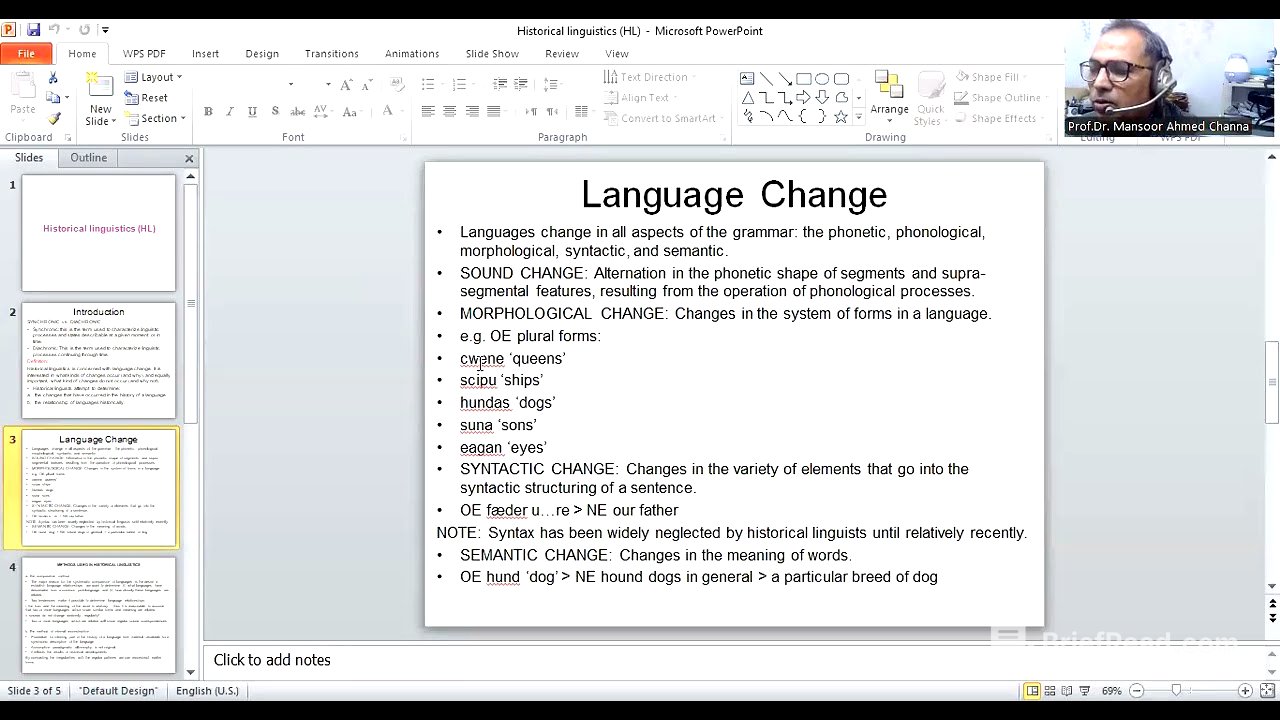
Language change affects all aspects of grammar, including phonetics, phonology, morphology, syntax, and semantics. Sound change involves alterations in the phonetic shape of segments and supersegmental features due to phonological processes. Morphological changes occur in the system of forms within a language, illustrated by examples of old English plural forms evolving into modern English forms (e.g., "queen" changing from "cweene" to "queens"). Syntactic change involves changes in the elements that structure sentences, with syntax being a relatively recently emphasized area in historical linguistics. Semantic change refers to changes in the meaning of words, such as the old English "hund" (referring to any dog) evolving into the new English "hound" (referring to a specific breed).
Methods in Historical Linguistics [3:39]
Two primary methods are used in historical linguistics: the comparative method and internal reconstruction. The comparative method systematically compares languages to establish language relationships, determine which languages descended from a common proto-language, and assess how closely related these languages are. This method relies on the principles that the form and meaning of words are arbitrary, and sounds change regularly, leading to regular sound correspondences between related languages. Internal reconstruction infers a language's history from synchronic descriptions, assuming that paradigmatic allomorphy is not original and reflects historical developments. By contrasting irregularities with regular patterns, earlier forms can be reconstructed.
Basic Historical Linguistics Terms [5:45]
Several key terms are used in historical linguistics. Etymology is the study of the history of words. Cognates are words that have descended from the same word in a proto-language. Etymological doublets are two different words in one language with an identical etymological source. An atimone is the form from which another form developed. A gloss is an explanation or translation of a word, morpheme, or phrase, often placed interlinearly or in the margin to clarify archaic, foreign, or complex linguistic elements in historical documents, aiding scholars in understanding meaning, structure, and grammatical features across time. Examples include "SG" for singular and "PL" for plural.