TLDR;
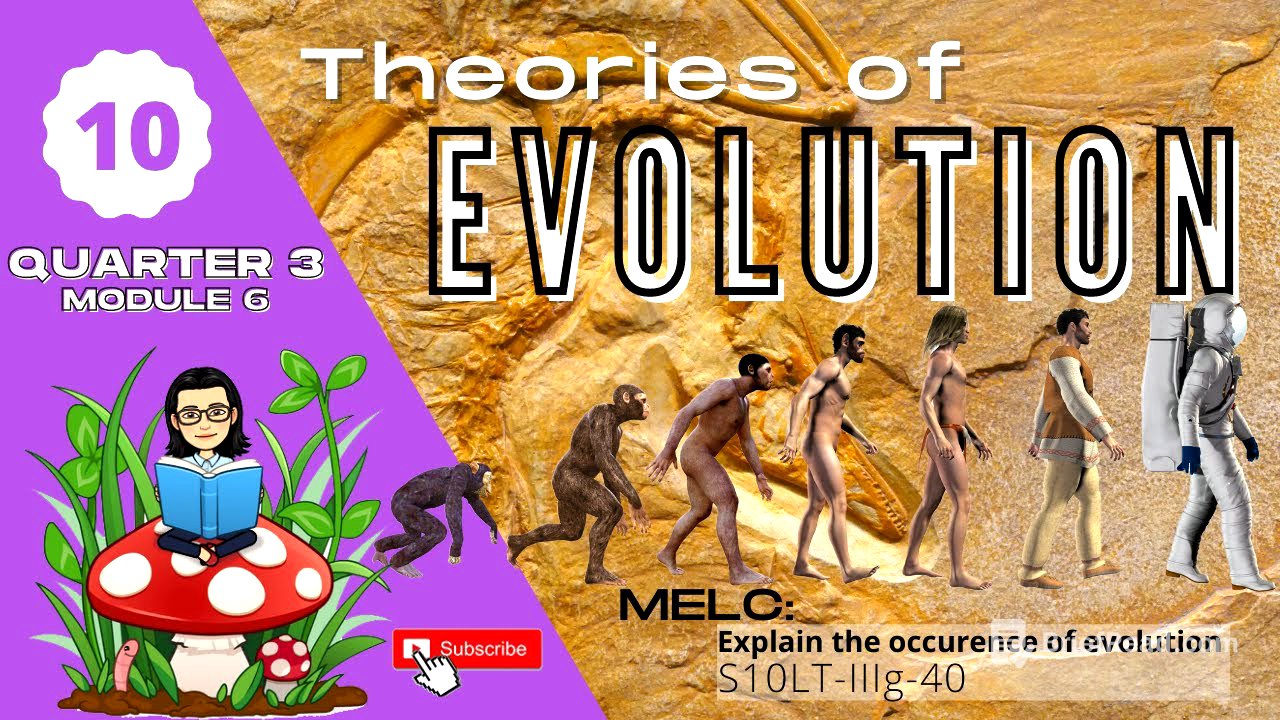
This video explains the theories of evolution, focusing on the contributions of Jean-Baptiste Lamarck and Charles Darwin. It covers the historical context of evolutionary thought, including catastrophism and uniformitarianism. Lamarck's theories of need, use and disuse, and acquired characteristics are discussed and then contrasted with Darwin's theory of natural selection, which emphasizes survival of the fittest through adaptation and variation. The video uses examples such as giraffes and peppered moths to illustrate these concepts.
- Jean-Baptiste Lamarck proposed that organisms evolve based on their needs and the use or disuse of certain body parts, and that acquired traits can be inherited.
- Charles Darwin's theory of natural selection posits that individuals with favorable traits are more likely to survive and reproduce, passing on those traits to future generations.
- The video highlights the importance of adaptation and variation within a population for survival and speciation.
Introduction [0:02]
The video introduces the topic of evolution and highlights the essential learning competency of explaining the occurrence of evolution. It mentions that the evidences of evolution have been discussed in a previous video. The presenter then introduces the two major scientists who contributed to evolutionary theory: Jean-Baptiste Lamarck and Charles Darwin.
History of Evolutionary Thought [0:58]
Before discussing Lamarck and Darwin's contributions, the video explains the history of evolutionary thought, starting with catastrophism, proposed by Abraham Werner and Baron George Cuvier. Catastrophism suggests that the Earth and geological events formed suddenly due to major catastrophes like asteroid impacts or Noah's flood. The video then introduces uniformitarianism, which posits that the Earth has always changed in uniform ways and that the present is key to understanding the past, with large geological changes occurring gradually over long periods.
Jean-Baptiste Lamarck's Theories [2:51]
The video introduces Jean-Baptiste Lamarck, who developed early theories on how species change, suggesting that more complex organisms evolved from less complex ones. Lamarck's theories include the theory of need, the theory of use and disuse, and the theory of acquired characteristics. The theory of need states that organisms change because they need to, and to evolve a structure, they must need it. The theory of use and disuse suggests that organisms develop specialized characteristics through the use and misuse of organs; used parts become stronger, while unused parts weaken and disappear. The theory of acquired characteristics claims that traits acquired during a parent's lifetime can be passed on to offspring.
Examples and Disproving Lamarck's Theories [4:30]
Lamarck's theories are illustrated using the example of giraffes, where he suggests that giraffes evolved long necks because they needed to reach high leaves. The video also mentions water birds developing webbed feet through straining their toes to swim. However, the video points out that many experiments have disproved Lamarck's theories, especially the theory of acquired characteristics. Examples include body modifications like tattoos or developed muscles from exercise not being inherited by offspring, and the tails of mice being cut off for generations without affecting the offspring's tail length.
Charles Darwin and Natural Selection [11:58]
The video introduces Charles Darwin, who proposed the theory of evolution by natural selection. Darwin's voyage on the HMS Beagle, particularly his observations in the Galapagos Islands, provided key evidence for his theory. In the Galapagos, Darwin found 13 varieties of finches with different beak shapes adapted to their environments. After 20 years of organizing his data, Darwin wrote "The Origin of Species," presenting his theory of evolution based on natural selection. Alfred Russel Wallace independently developed a similar concept. Natural selection states that individuals with the most favorable traits for an environment survive and pass on those traits, often summarized as "survival of the fittest."
Main Points of Natural Selection [16:08]
The video outlines the six main points of natural selection: species overproduction, competition, variation, adaptation, natural selection, and speciation. Species overproduction means organisms tend to over-reproduce. Competition arises due to limited space and resources, leading to a struggle for existence. Variation indicates that no two individuals are the same, with differences in size, strength, and adaptive structures. Adaptation is the process of becoming better suited to the environment, increasing an organism's chance of survival. Natural selection involves the environment selecting organisms that survive to be the parents of succeeding generations. Speciation occurs as favorable adaptations accumulate and unfavorable ones disappear.
Comparing Lamarck and Darwin's Giraffes [18:45]
The video compares Lamarck's and Darwin's explanations of giraffe evolution. Lamarck believed giraffes stretched their necks to reach higher leaves, passing this trait to offspring. Darwin, however, proposed that there were giraffes with varying neck lengths from the beginning, and those with longer necks were more successful at reaching food, thus surviving and reproducing more, leading to a population of long-necked giraffes.
Peppered Moths and Natural Selection [20:26]
The video uses the example of peppered moths to further illustrate natural selection. Before the industrial revolution in Britain, white peppered moths were more common because they blended with the light-colored trees, while darker moths were easily spotted and eaten by birds. After the industrial revolution, pollution darkened the trees, giving the black peppered moths a survival advantage, and they became more numerous in urban areas.
Conclusion [22:35]
The video concludes with a quote from Charles Darwin: "It is not the strongest of the species that survive, nor the most intelligent, but the one most adaptable to change."