TLDR;
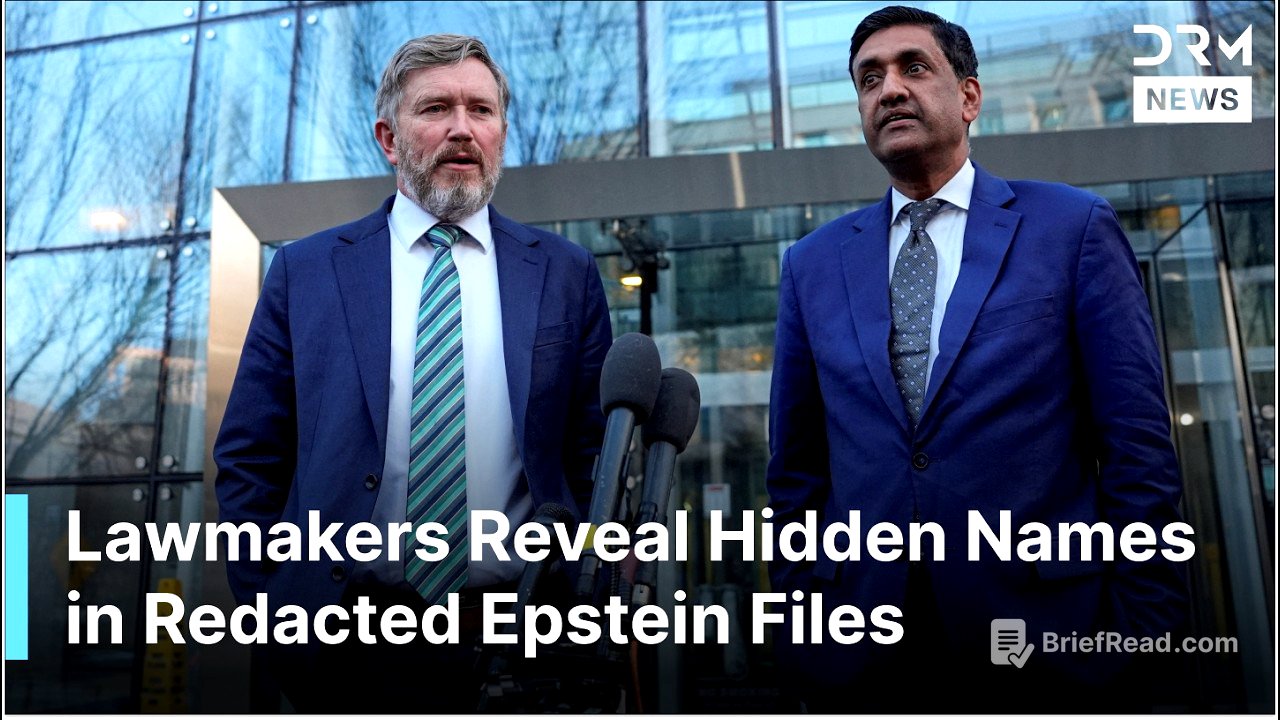
The discussion revolves around the redacted documents related to the Jeffrey Epstein case and the speakers' efforts to uncover the names of individuals involved in the trafficking of women. They express concern over the redaction of names, particularly six men implicated in the files, and the lack of transparency from the Department of Justice (DOJ) and FBI. They highlight the need for accountability for powerful individuals involved with Epstein, regardless of their political affiliation or status.
- Redaction concerns: Highlighting the redaction of six men's names and photos without clear justification.
- Transparency issues: Criticizing the DOJ for providing redacted documents and removing files from the public domain.
- Call for accountability: Urging for the release of unredacted documents and accountability for individuals involved with Epstein.
Initial Observations and Concerns [0:04]
The speakers express initial concerns regarding the user interface and the redaction of names in the documents. They specifically mention the names of at least six men that have been redacted, who are likely incriminated by their inclusion in the files. The speakers highlight that there is no explanation for why these individuals were redacted, which raises concerns about transparency and accountability.
Redactions and Missing Documents [0:33]
The speakers discuss the redaction of six men's names and photographs, questioning the reasons behind it. They also address concerns about sensational emails, noting that some senders were women, suggesting redactions might be appropriate in some cases. A significant issue is that the documents provided by the DOJ were already redacted, mirroring redactions from the FBI and grand jury, contrary to the expectation of unredacted materials. Additionally, some files were taken down by the DOJ and were not available for search, raising further questions about transparency.
Call for Transparency and Releasing Documents [2:53]
The speakers emphasize the need for the DOJ to release the documents and correct over-redactions, particularly the names of the six men. They clarify that their goal is to expose those who trafficked women with Jeffrey Epstein, not to embarrass individuals unnecessarily. The speakers express disappointment that the 302 forms were redacted before reaching the DOJ, and they insist that the FBI and Attorney General must provide more information. They point out that in a short review, they identified six implicated men whose names were redacted, underscoring the need for thorough investigation.
DOJ's Responsibility and Prior Redactions [5:19]
The speakers urge the DOJ to do more work and consider making the names of the six men public. They acknowledge that some redactions were appropriate to protect survivors but emphasize that the most significant concern is what was redacted before the documents reached the Justice Department. The 302 files and prosecution memos appear to have been redacted beforehand, and the speakers stress that the law requires compliance and transparency to uncover the involvement of powerful individuals.
Missing Files and Identifying Individuals [6:26]
The speakers note that documents previously available online were taken down and not included in the searchable database. They demand an explanation for this and whether these files will be re-uploaded with appropriate redactions. They reveal that at least one of the six men is a U.S. citizen and another is a foreigner, with one holding a high position in a foreign government. The speakers reiterate that these findings are from a limited review and that the broader issue is the extensive redaction of files.
Focus on Justice and Accountability [7:35]
The speakers clarify that their aim is not a witch hunt or political scoring but to achieve justice for the survivors. They acknowledge that some redactions may be appropriate but stress the importance of investigating powerful individuals involved in the abuse of underage girls. They emphasize that the DOJ needs to address the issue of redacted material to ensure compliance with the law and provide answers to the public about who was involved.
DOJ's Non-Compliance and Strategy for Information Release [9:55]
The speakers state that the DOJ is already breaking the law by missing deadlines, initially justified by the need to protect victims' information, which they failed to do. They call for the DOJ to review and correct their mistakes, compelling the US attorneys and FBI to produce unredacted material. They explain that their strategy has been to release information gradually, resulting in the largest release of Epstein files to date, exposing individuals in high positions across various sectors and countries.
Source of Redactions and Call for Accountability [11:20]
The speakers suspect that the redactions were made by the FBI or attorneys in the grand jury before the documents reached the Justice Department. They reiterate that the law requires unredacted documents unless classified, and they believe this has not been complied with. They emphasize the need to uncover the involvement of powerful people, including whether they knowingly participated in or were aware of the abuse of underage girls.
Evidence Implicating the Six Men [12:26]
The speakers describe a redacted file containing a list of 20 individuals, including Maxwell and Epstein, with the remaining names redacted. The file includes 20 photographs, some of which are of males. They also mention an FBI form listing conspirators, with one male's picture and name redacted. The speakers highlight that there is no legal reason to redact these names unless they are male survivors, which seems unlikely.
Call for Accountability and Final Remarks [14:46]
The speakers support calls for accountability for individuals like Howard Lutnik, who have connections to the Epstein case. They draw parallels with accountability measures in other countries, such as Britain, and argue that the U.S. should also hold powerful individuals accountable, regardless of their party affiliation. They stress the need to decide whether to allow rich and powerful people involved with Epstein to evade justice or to ensure elite accountability.