TLDR;
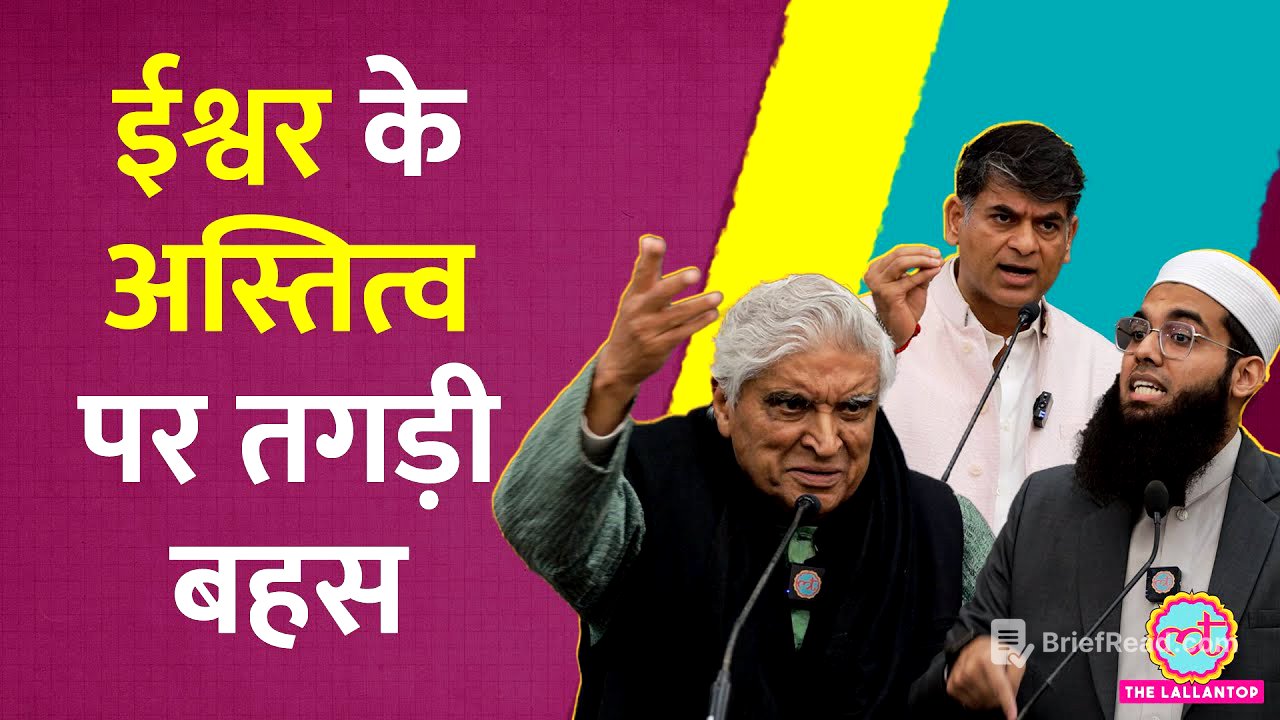
This is a summary of a debate between Javed Akhtar and Mufti Shamail Nadvi on the topic "Does God Exist?". The debate is moderated by Saurabh Dwivedi. Mufti Shamail Nadvi argues for the existence of God using logic and reasoning, while Javed Akhtar argues against it, emphasizing the importance of evidence and questioning religious faith. The debate covers topics such as the nature of faith, the problem of evil, and the role of reason in understanding the universe.
- Mufti Shamail Nadvi argues for God's existence using logic and reasoning.
- Javed Akhtar questions religious faith and emphasizes the importance of evidence.
- The debate touches on the problem of evil, free will, and objective morality.
Introduction and Format [0:00]
The debate, titled "Does God Exist?", features Javed Akhtar and Mufti Shamail Nadvi. Saurabh Dwivedi, the moderator, outlines the structure: each speaker gets 10 minutes for initial arguments, followed by rebuttals, a second round of arguments (7 minutes each), a second rebuttal round (5 minutes each), a Q&A between the speakers (16 minutes), and closing arguments (5 minutes each). The debate will conclude with audience questions (30 minutes). The moderator emphasizes the need for respectful discussion and clarifies that the debate is not about promoting or denigrating any specific religion.
Mufti Shamail Nadvi's Opening Argument [6:00]
Mufti Shamail Nadvi begins by stating that the debate on God's existence requires establishing the right standards for judgment. He argues that science, revelation, and observation are not suitable standards for this debate. Science relies on empirical evidence, which is limited to the physical world, while God is a non-physical, supernatural reality. Revelation is a valid source of knowledge for him but not for Javed Akhtar. Demanding empirical evidence for God's existence is using the wrong tool. Therefore, the debate should be based on reason, logic, and definitive arguments. He challenges Javed Akhtar to present a definitive logical argument against God's existence, which he believes is impossible. He uses the example of finding a pink ball on an isolated island to illustrate that the universe, with its specific properties, must have a creator. He anticipates that Javed Akhtar will use arguments from ignorance, dogma, the "God of the gaps," and emotional arguments, which he refutes by stating that the existence of evil is proof that we are accountable to God. He concludes by stating that the universe and its contents are contingent, implying a "Necessary Being" as the cause.
Javed Akhtar's Opening Argument [16:20]
Javed Akhtar states that the concept of God is not new and has existed for centuries across various civilizations, including those of the Greeks, Egyptians, and Romans. He points out that these civilizations had their own gods, whom they believed in as fervently as people believe in their gods today. However, these gods have largely been forgotten. He argues that every religion demands faith, which he defines as believing in something without evidence, proof, or logic. He contrasts faith with belief, which is based on evidence and reason. He argues that believing in something without any evidence is foolish. He questions why people ask who created the universe but not who created the island or why they were born. He asserts that nature is indifferent to justice, which is a human concept. He concludes by stating that religions promise justice, which indicates that they are man-made. He also suggests that religion, like alcohol, has a tendency to increase and can be harmful if not used in moderation.
Mufti Shamail Nadvi's Rebuttal Round 1 [26:44]
Mufti Shamail Nadvi responds to Javed Akhtar's arguments by clarifying that the gods of past religions were contingent beings, unlike the "Necessary Being" he is discussing. He refutes Akhtar's definition of faith as illogical, stating that faith can be valid if backed by logic and evidence. He argues that atheism is foolish because it denies the obvious design and precision of the universe. He clarifies that his example of the ball on the island was meant to illustrate the need for a creator for both the ball and the island. He also argues that objective morality and justice exist, and the pursuit of justice is not irrational. He concludes by comparing atheism to alcohol, suggesting that excessive atheism can lead to negative outcomes.
Javed Akhtar's Rebuttal Round 1 [31:32]
Javed Akhtar acknowledges Mufti Shamail Nadvi's agreement that nature lacks justice. He points out that the beautiful flowers in gardens are not natural but created through human intervention. He criticizes Nadvi for not addressing his question about why religions demand faith when they claim to have logic and reason. He argues that religions discourage questioning and that human progress comes from questioning and seeking knowledge. He contrasts this with religions that claim to know everything about the universe and its origins. He emphasizes the importance of humility and acknowledging what we don't know. He concludes by stating that the modern world is built on the achievements of those who questioned and challenged existing beliefs.
Mufti Shamail Nadvi's Argument Round 2 [38:44]
Mufti Shamail Nadvi reiterates that faith can be right or wrong and that the discussion is about truth and God's existence. He encourages questioning, including questioning atheism. He argues that the universe cannot be eternal because it is bound by time and space, making it contingent. He clarifies that religious texts are not meant to explain science but to teach morality and reveal non-physical reality. He distinguishes between science and scientism, rejecting the latter's claim that science is the only source of knowledge. He emphasizes that claiming God does not exist requires proof. He explains that the question of what God was doing before creating the universe is illogical because time began with the universe. He uses the analogy of a car to illustrate that discovering the engine does not negate the need for a creator.
Javed Akhtar's Argument Round 2 [46:05]
Javed Akhtar argues that if God existed before the universe, then time must have existed as well. He asserts that the burden of proof lies on those who claim God exists, not on those who question it. He cites Bertrand Russell's analogy of a teapot orbiting Mars to illustrate this point. He argues that religions have historically resisted scientific advancements. He presents a map-based argument, suggesting that regions with strong religious adherence often correlate with injustice, oppression, and human rights violations. He questions the practical benefit of believing in God, arguing that it does not seem to improve societies. He concludes by stating that if a religious person is good, it is despite their religion, not because of it.
Mufti Shamail Nadvi's Rebuttal Round 2 [51:19]
Mufti Shamail Nadvi clarifies that God is timeless and not bound by time, as He created time. He argues that Javed Akhtar's analogy of a teapot is an imagination, while he is presenting a logical necessity for a "Prime Cause." He states that his worldview does not hinder science but opposes scientism. He presents statistics suggesting that European countries, which are more liberal and atheistic, have higher rates of rape and sexual harassment than the Middle East. He argues that if there is no God, there is no objective standard for good and evil.
Javed Akhtar's Rebuttal Round 2 [54:26]
Javed Akhtar criticizes the use of the term "metaphysical" as vague and meaningless. He questions how one can claim God is eternal if time did not exist before the universe. He expresses disbelief in a God who is all-powerful yet allows suffering and injustice to occur in the world. He questions why people pray for intervention in their daily lives if God does not interfere. He concludes by stating that he finds no reason to respect a God who allows such suffering to exist.
Cross Examination - Round 1 [58:03]
During the cross-examination round, Mufti Shamail Nadvi asks Javed Akhtar whether he believes in infinite regress of causes or the existence of a Necessary Being. Javed Akhtar responds that he doesn't see a need to stop at a Necessary Being and that the universe could be eternal. Mufti Shamail Nadvi then asks about the revelations in different religions and the contradictions between them. Javed Akhtar questions why God doesn't provide solid evidence of his existence, like a voice during a football final. He also questions how God was created, given that He is more intelligent than the universe.
Cross Examination - Round 2 [1:03:10]
Javed Akhtar asks Mufti Shamail Nadvi to define contingency. Mufti Shamail Nadvi explains that contingency refers to anything that is dependent on something else for its existence. Javed Akhtar then questions why the universe was created for humans, given its vastness. Mufti Shamail Nadvi responds that just because we don't know the reason doesn't mean there isn't one. Javed Akhtar then raises the problem of evil, questioning how an omnipotent and merciful God can allow suffering to exist. Mufti Shamail Nadvi responds that God is also all-wise and all-knowing, and there is wisdom behind His actions, even if we don't understand it. He also argues that evil is necessary to define good and that the world is a test. Javed Akhtar counters that he doesn't want a God whose wisdom involves children dying. Mufti Shamail Nadvi responds that evil is a result of human free will, and those who commit evil will be punished. Javed Akhtar questions whether God or the free will of the murderer is responsible for his death. Mufti Shamail Nadvi responds that God created the system of free will, but the individual is responsible for their actions. Javed Akhtar then questions how evil can be defined objectively without God. Mufti Shamail Nadvi responds that morality comes from God. Javed Akhtar counters that if the majority decides what is right and wrong, then atrocities like the Holocaust could be justified.
Closing Arguments - Mufti Shamail Nadvi [1:16:26]
Mufti Shamail Nadvi states that he was only able to present one argument for God's existence due to time constraints and Javed Akhtar's digressions. He claims that Javed Akhtar did not refute his argument of contingency. He argues that Javed Akhtar did not provide a definitive argument against God's existence and instead focused on criticizing religion. He states that he condemns ISIS and that their actions have nothing to do with God. He argues that there is no strong foundation for morality without God.
Closing Arguments - Javed Akhtar [1:18:44]
Javed Akhtar states that he sees no evidence of a supreme power working for the betterment of humanity. He argues that if God exists and is watching the suffering in the world, then His existence is irrelevant. He argues that the belief in God has been consistently proven wrong throughout history. He suggests that the belief in God is a package deal that comes with various harmful elements. He offers a hypothetical scenario where religious people disbelieve in nine out of ten major beliefs, just like atheists. He concludes by stating that the belief in God is a fading idea and that it will eventually disappear.
Audience Questions and Answers [1:22:00]
The final segment involves questions from the audience. One audience member asks Mufti Shamail Nadvi why children are dying in Gaza if God is merciful. Mufti Shamail Nadvi responds that God is also all-wise and that there is a recompense for those who suffer. Javed Akhtar responds that this justification should be given to the Israeli Prime Minister. He is then asked how he interprets the deaths of children if he doesn't believe in God. Javed Akhtar responds that powerful people commit injustices. Another audience member asks about the contradiction between God's wisdom and free will. Mufti Shamail Nadvi responds that God gave free will for testing and accountability. Another audience member asks what atheists offer in terms of social gatherings. Javed Akhtar responds that religious festivals were originally secular and that atheists can participate in all festivals. Another audience member asks why Mufti Shamail Nadvi is wasting his time talking about God if God is beyond human understanding. Mufti Shamail Nadvi responds that God tells us how to improve society. Another audience member asks about the morality of rape. Mufti Shamail Nadvi responds that morality comes from God. Javed Akhtar responds that morality comes from the desire to live together. Another audience member asks about Sir Syed Ahmed Khan's view on finding God through reason. Javed Akhtar responds that he searched for God through reason but did not find Him. Another audience member asks how atheists can prove that evil exists. Javed Akhtar responds that life forms have feelings and can experience pain. Another audience member asks how Javed Akhtar interprets the rise of atheism in Europe. Javed Akhtar responds that the most just societies are in Scandinavia and Western Europe. Another audience member asks what atheists offer in terms of social gatherings. Javed Akhtar responds that religious festivals were originally secular and that atheists can participate in all festivals. Another audience member asks why Mufti Shamail Nadvi is wasting his time talking about God if God is beyond human understanding. Mufti Shamail Nadvi responds that God tells us how to improve society. Another audience member asks about the morality of rape. Mufti Shamail Nadvi responds that morality comes from God. Javed Akhtar responds that morality comes from the desire to live together.