TLDR;
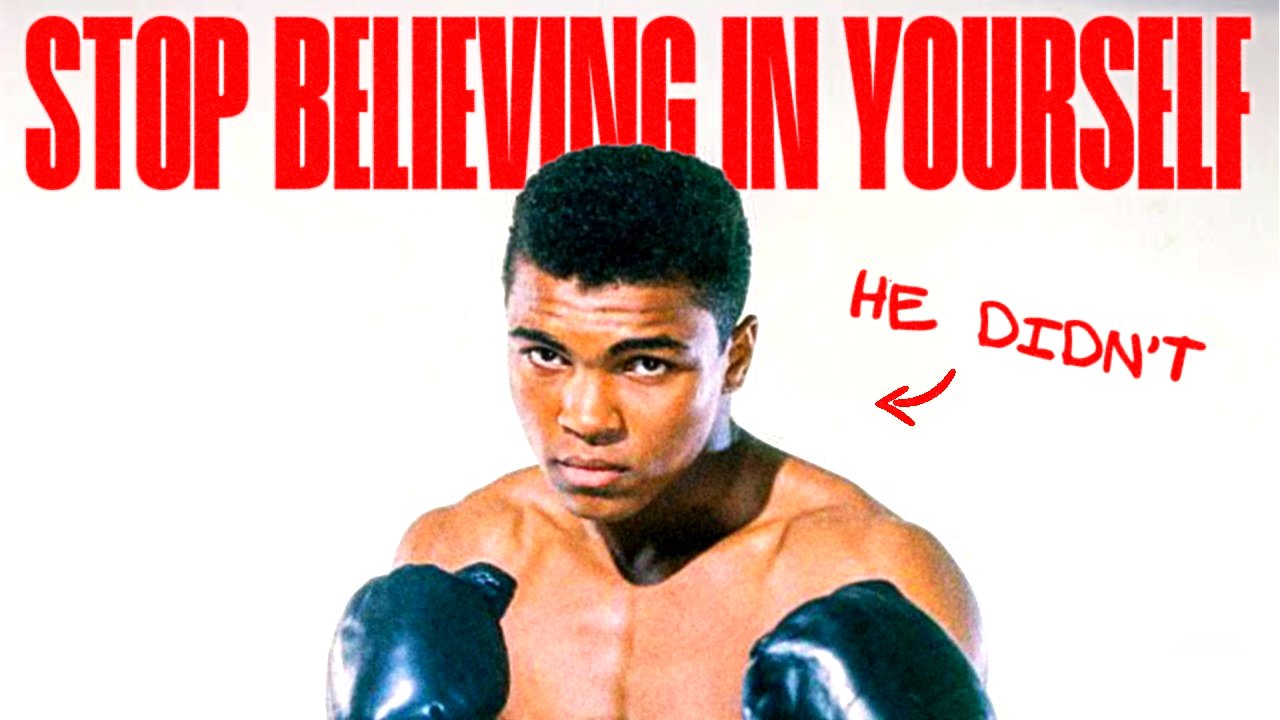
The video challenges the common belief in "believing in yourself," using Muhammad Ali as an example. It emphasizes the difference between mere belief, which is rooted in uncertainty, and certainty built through actionable evidence. Ali exemplified the transformation from a believer to a knower by putting in the hard work that demonstrated his capability, rather than relying on self-deception or delusional confidence.
- The video critiques the notion of delusional self-belief.
- It emphasizes the importance of building evidence through action rather than depending on belief alone.
Delusional Self-Belief [0:00]
The video opens by questioning the validity of delusional self-belief and how it's often confused with self-confidence. It acknowledges that while the phrase "believe in yourself" is well-intentioned, it presents a misleading message. The video highlights the example of Muhammad Ali, who did not just have belief, but a deep-rooted certainty that differentiated him from other fighters.
The Birth of a Legend [1:00]
The chapter introduces Muhammad Ali's journey, starting from a young age when he learned to fight after his bike was stolen. Despite facing significant societal barriers as a black man in America, Ali knew he was destined for greatness. The narrative establishes that belief usually stems from doubt, which Ali transcended by knowing rather than believing in his potential.
The Distinction Between Knowers and Believers [2:30]
The video introduces a philosophical perspective from Charles Sanders Peirce, highlighting that belief is a reaction to uncertainty. It explains that many individuals hold on to their dreams while constantly battling self-doubt, which leads to disappointment as they age. In contrast, Ali embodied a certainty that allowed him to assert himself confidently, fundamentally changing the game.
The Power of Declaration [4:00]
In 1963, before achieving any significant success, Ali released a poetry album declaring himself as "The Greatest." This boldness was a declaration made before any recognition, showcasing his mindset. The distinction between "knowers" and "believers" is further explored, indicating that knowers see themselves as capable without waiting for validation from the world.
The Burden of Belief [6:00]
The narrative shifts to highlighting the struggles of individuals like Harold, an average person with unfulfilled dreams who waits for a monumental event to prove his capability. The video emphasizes that believers need outcomes to validate their ambitions, leading to a fear of failure that hinders their progress.
Shifting from Belief to Knowing [8:00]
The video explains how to transition from being a believer to a knower by accumulating daily evidence of capability rather than waiting for success to happen. Using Ali's practices of rigorous training and hard work as examples, it illustrates that building evidence cultivates certainty over mere belief.
Action Over Affirmation [10:00]
The focus returns to the point that hearing motivational declarations without subsequent actions leads to a cycle of inaction. It argues that the process of waking up and actively working toward one's goals builds true confidence, illustrating that belief alone is insufficient for progress.
Conclusion: The Path to Capability [12:00]
The final thoughts emphasize that aspiring to become extraordinary doesn't require convincing oneself of guaranteed success. Instead, it stresses the importance of taking daily actions that lead to growth and capability. The takeaway is to shift from seeking confidence through belief to building evidence through actions, leading to a more genuine sense of knowing one's potential.